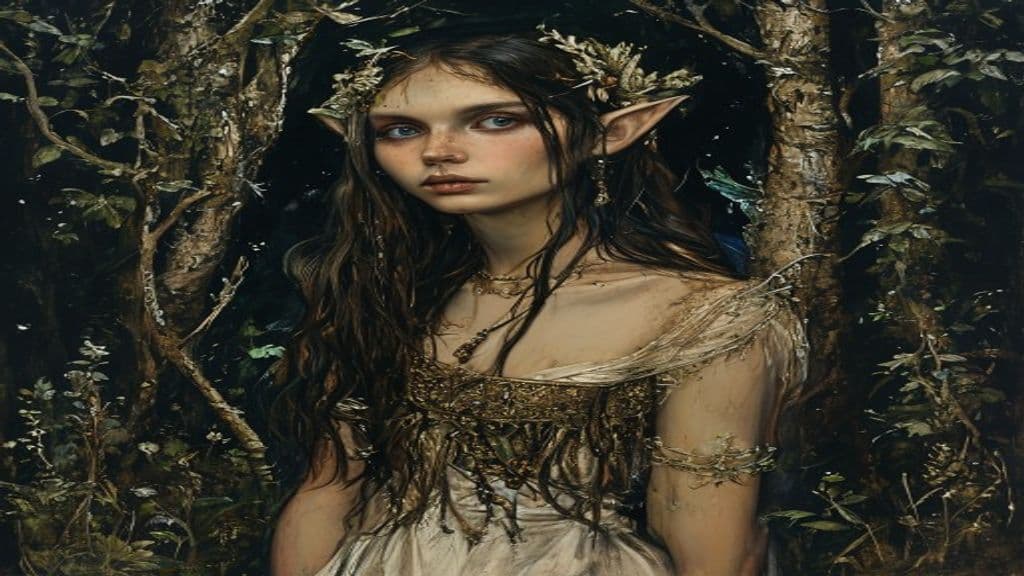
Oral tradition gives two overlapping accounts coexisting side by side: some say Anjanas are heavenly beings sent by God to do good deeds who return to heaven after 400 years and never return; others indicate they are spirits of trees who take care of the forests. Both strands are reported in the tradition rather than synthesized into a single canonical origin.
Folkloric descriptions portray Anjanas as beautiful, delicate female fairies of very small stature (traditionally given as about 0.5 ft / 0.15 m tall), with white skin and a sweet voice. Their eyes are described as slanted, serene and loving, with black or blue pupils "as bright as the stars." They have nearly transparent wings, long braids (jet black or golden) adorned with multicolored silk bows and ribbons, wear a crown of wild flowers, a blue cape over a long thin white tunic, and carry a stick of wicker or hawthorn said in tradition to shine in a different color every day of the week.
Anjanas are portrayed as caretakers of nature and helpers of people: they help injured animals and trees damaged by storms or by the Ojáncanu, assist lovers, guide people who become lost in the forest, aid the poor and suffering, can converse with spring waters, and leave gifts at the doors of helpful and kind villagers. They punish the wicked and oppose the cruel Ojáncanu. They are said to respond to summons for help if the summoner is "good of heart."
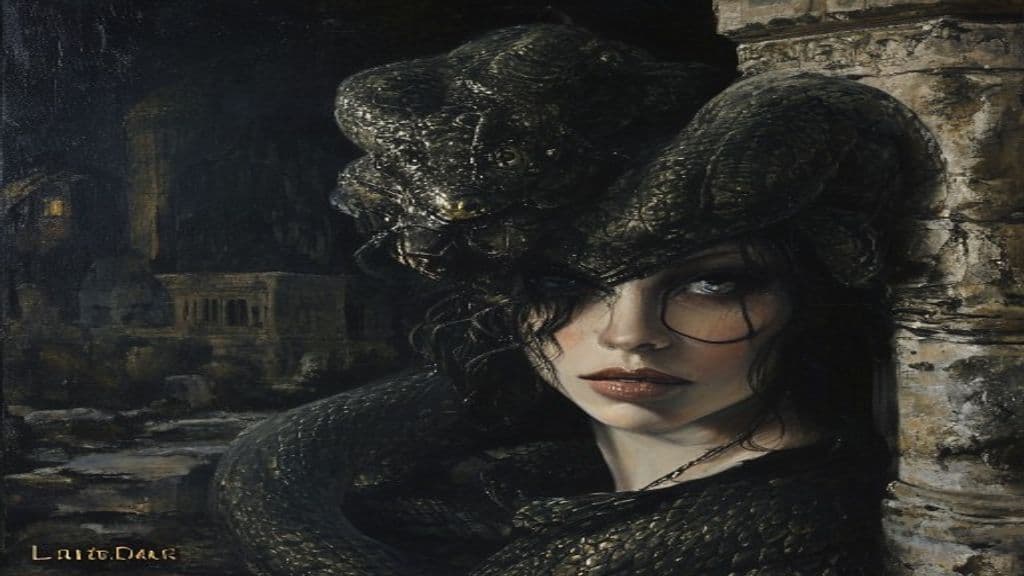
Animal Man
A fictional comic-book character (Bernard "Buddy" Baker) who gains the ability to temporarily borrow the abilities of animals. Originating in 1965 as a costumed superhero, later reinterpretations (notably in the Vertigo imprint) recast him as an animal-linked avatar or elemental tied to an animal life force called the "Red."
Anippe
Anippe (Ancient Greek: Ἀνίππης) is a river-nymph (naiad) in Greek mythology, described in mythographic sources as a daughter of the river-god Nilus and as the mother of the Egyptian king Busiris by the god Poseidon. She is attested primarily as a genealogical figure tying Egyptian place-figures into Greek divine genealogy.
Aniruddha
Aniruddha is a mythological Vrishni prince and warrior in Hindu narrative (notably the Bhagavata Purāṇa), grandson of Kṛṣṇa and Rukmiṇī, son of Pradyumna and Rukmavatī. He is portrayed as a dynastic hero (a mahārathi), participant in the Uṣā–Bāṇāsura episode, father of Vajra, and—in certain Vaiṣṇava theological schemes—counted among the catur-vyūha and associated with the boar (Varāha) theriomorph.
Anit
The string "Anit" appears in the consulted sources as a modern personal name, acronym/technical term, and occasional orthographic variant; the dataset contains no coherent folkloric entity named "Anit." The only mythic figure in the corpus with a vaguely similar spelling is the Egyptian minor goddess Iunit (also spelled Iunet), 'She of Armant,' consort of Montu — an identification with "Anit" is uncertain in the sources.
Anito
Anito is a category of non‑human and post‑human spiritual beings in indigenous Philippine animistic worldviews, encompassing ancestor spirits, nature spirits/local deities, and sometimes carved effigies (taotao) that house or represent those spirits. They mediate relations between the living and the unseen world, functioning as household guardians, owners of places, intercessors, or occasional agents of harm when offended.
Anius
Mortal king and priest of Apollo in Greek mythology, with significant spiritual roles. (Note: * Power tier: Lower than Primordial; considering Anius is described as a mortal king and priest, a more accurate power tier would be Greater or at least Ancient, but likely not Primordial. * Abilities)
Ankalamma (Angala Paramesvari)
Ankalamma (also Angala Paramesvari) is a village mother‑goddess and guardian deity (kaval deivam) of South India, venerated in Andhra Pradesh, Karnataka, and Tamil Nadu. She is associated with territorial protection, sacred groves, and liminal mortuary spaces (graves and cremation), and is often syncretized with Parvati, Kali, or counted among the Matrikas.
Ankh
A symbol representing life in ancient Egyptian cosmology, often associated with eternal life and resurrection. (Note: - Power tier should be Ancient (not Primordial), as it's a symbol representing concepts in ancient Egyptian cosmology. - Abilities description is too vague; consider specifying how the Ankh affects or)
Ankh-ef-en-Khonsu i
Ankh-ef-en-Khonsu i (Egyptian: ꜥnḫ-f-n-ḫnsw) was a historical Theban priest of the god Montu who lived in the late Third Intermediate to early Late Period (late 25th–early 26th Dynasty, c. 725 BCE). He is chiefly known as the dedicant of a painted wooden offering stele (Cairo A 9422, formerly Bulaq 666) made to guarantee his continued existence in the netherworld. In modern esoteric reception his name and stele were reinterpreted and adopted by Thelemic authors such as Aleister Crowley as a magical signature and symbol (the so-called "Stele of Revealing").
Ankou
The Breton personification of death — the last person to die in a parish each year who drives a creaking cart collecting the dead, whose appearance or sound presages death.
Anna Perenna
Anna Perenna is a minor Roman deity of the circle/wheel of the year (Perenna, 'per annum'), venerated in popular plebeian cult for the completion and renewal of the year and for longevity. Her festival falls on the Ides of March and was celebrated at a grove by the first milestone of the Via Flaminia and at a fountain (Fons Annae Perennae) in Rome; literary tradition also links her to the sister of Dido transformed into a perennial stream.
Annapurna
Annapūrṇā is a Hindu goddess, a manifestation of Parvati who presides over food, feeding, and nourishment. She is venerated in temple cults (notably in Varanasi) and in textual traditions that praise annadāna (the donation of food) and invoke her through stotras and name-lists.
Community Record
- [1]Anjana (Cantabrian mythology) — Wikipedia. Wikipedia: 'Anjana (Cantabrian mythology)'wiki