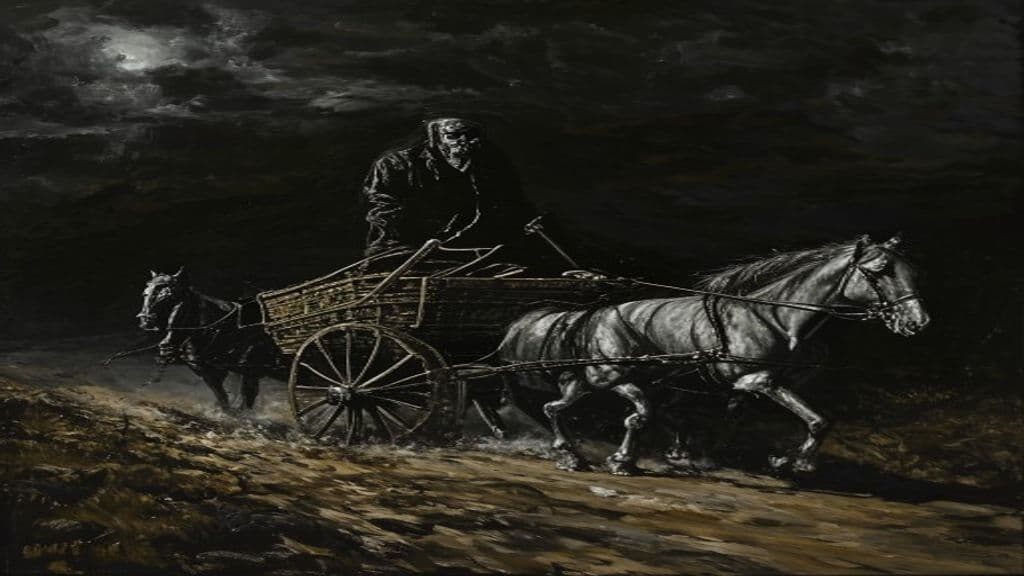
In Breton tradition, the Ankou is the servitor of Death — the last person to die in a given parish at year's end becomes the Ankou for the following year, collecting the dead in his creaking cart (the Karrig an Ankou) until his year of service is up. He carries a scythe turned backward, with which he harvests the living. The sound of the cart's squeaking axle heard at night was one of the most feared omens in Breton culture.
A tall, gaunt figure in a dark hat and cloak, driving a cart pulled by one or two thin horses. Sometimes depicted as a skeleton, sometimes as an extremely thin, pale man. He holds a scythe with the blade facing backward. His head turns fully around on his neck.
Collected the souls of the dying and the newly dead. His cart's squeak heard outside a house meant a death was imminent there. He could not be resisted or bargained with. His scythe could cut the thread of life.
Weaknesses
- conditionThe Ankou only comes for those whose time has come — cannot be prevented
Wards
- ritualDo not look out of windows when you hear the cart at night
Albiorix
Albiorix is a Celtic theonym attested in modern reference works as a Gaulish divine name that, in available summaries, is presented as an epithet or local identification of the Roman god Mars. The surviving remarks in the supplied sources are limited to name listings and disambiguation entries rather than narrative myth or cult detail.
Anu
Anu (also Ana, Anann, Anand) is a mother-figure in early Irish tradition associated with nourishment, territorial fertility and prosperity—especially in Munster—and is variably conflated with other maternal or war-related goddesses in later sources.
Banshee
A female spirit of Irish and Scottish folklore whose wail heralds an impending death in a family of Gaelic descent. Not a cause of death — a witness to it.
Breton Mythology
A collection of explanatory and heroic tales forming part of the Celtic mythos, rooted in ancient Celtic tradition. (Note: 1. Power tier: Primordial is incorrect; it should be Ancient (deity-level) as Breton mythology is rooted in ancient Celtic tradition but doesn't match the primordial level of cosmic entities. 2. Origi)
Conan Meriadoc
Conan Meriadoc is a legendary ancestral founder and early medieval royal leader credited in Welsh and Breton tradition with founding Brittany (Llydaw). Presented in medieval literary and genealogical sources as a historicized king or prince associated with Magnus Maximus/Macsen Wledig, he functions primarily as a dynastic progenitor and a figure in brittonic prophetic expectation rather than as a supernatural spirit.
Conomor
Conomor is a mid-6th-century Breton/Cornish ruler who in historical sources appears as a violent, ambitious political actor and in later Breton hagiography and folklore becomes a stock villain—an excommunicated count/king accused of murdering rivals, wives and children and opposed by saints such as Samson and Gildas.
Daolghas
Member of the Fianna, a band of warriors in Irish mythology, with supernatural abilities. (Note: * Power tier: Inconsistent with abilities described; should be Primordial or Ancient due to its cosmic/deity-level powers. * Abilities: Not entirely accurate; it's specifically stated that Daolghas ca)
Echtra Cormaic
A tale in Irish mythology recounting the journey of high-king Cormac mac Airt to the Land of Promise, a realm associated with Manannán mac Lir. (Note: 1. The source does not mention Echtra Cormaic's power tier, so it should be removed or marked as unknown. 2. Add an appearance description based on Irish mythological descriptions of high-king Cormac )
Ecne
Ecne is the personification of wisdom in Irish/Celtic mythic tradition, attested in modern summaries as a member of the Tuatha Dé Danann and glossed in Old Irish as 'wisdom' (ecna, ecne). Sources present Ecne genealogically as the offspring of three brothers and as connected to the goddess Anu/Ananna, with variant accounts assigning ambiguous gender and, in one later report, an association with poetry.
Fairy
A class of anthropomorphic supernatural beings found across multiple European folk traditions, fairies are magical, liminal entities variously described as spirits, an older race, or enchanted people; their depiction ranges from human-sized to diminutive and their attributes and moral alignment vary by region and period.
Little people
A cross-cultural folkloric category of diminutive supernatural or semi-supernatural beings found worldwide. They occupy liminal places near humans (woods, mounds, anthills, mines, shorelines) and range from helpful household spirits to mischievous tricksters or dangerous guardians of places and resources.
Paps of Anu
Two mountain peaks in County Kerry, Ireland, with breast-like shapes and mythological associations to the Celtic goddess Anu. (Note: - Power tier: Not Primordial; given they are mountain peaks with a limited geographical scope, it's more accurate to categorize them as Lesser. - Summary: Should mention the mythological associations )
Community Record
- [1]Barzaz-Breiz. La Villemarqué, Théodore Hersart de. 1839. Barzaz-Breiz: Chants populaires de la Bretagne. Charpentier.folk
- [2]The Death Customs of Brittany. Sébillot, Paul. 1882. Traditions et superstitions de la Haute-Bretagne. Maisonneuve.academic