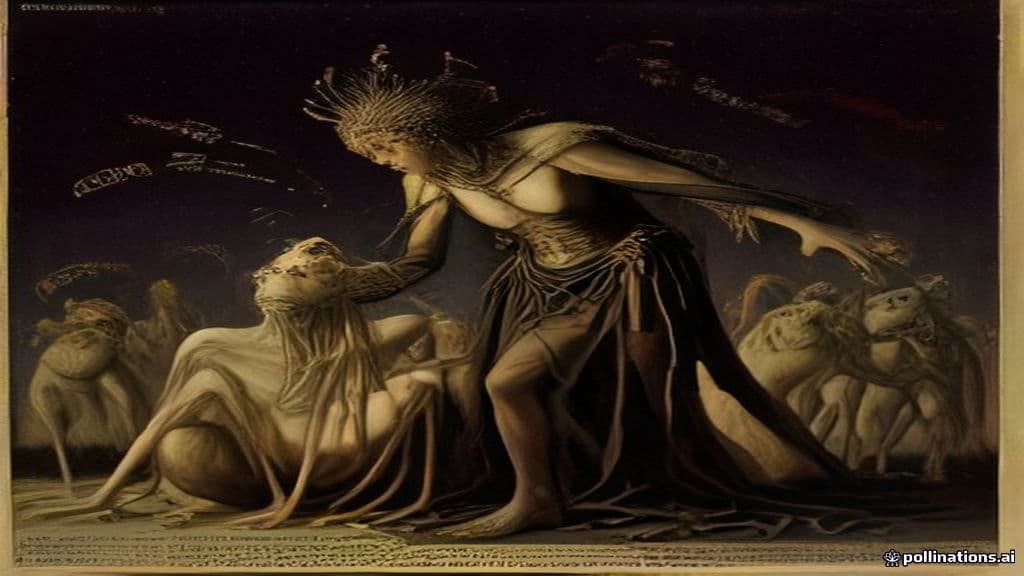
The motif appears in ancient ethnographic and literary imaginaries: Herodotus' reports of foreign peoples (notably the Scythian Androphagi) are cited by later writers as a probable inspiration for the concept. Compilers of marvels and encyclopaedias then treated the Anthropophagi as a named category of monstrous peoples; Ephraim Chambers' Cyclopædia-era usage is recorded as an example of the term's generalizing, encyclopedic employment. Shakespeare (e.g., Othello) places the Anthropophagi among other monstrous peoples in the catalog of marvels, cementing the term in English literary tradition. Over time the label became both a literal descriptor for alleged cannibals and a mythic taxon in imaginative geographies.
Primary sources in the supplied materials offer no consistent physical description beyond their defining practice of human consumption. Shakespeare's Othello mentions "The Anthropophagi" in a line that also names the headless Blemmyes; later readers and popular culture sometimes conflate the two, producing the common image of headless figures with faces on their torsos. The provided sources caution this conflation: the headless/torso-faced motif more properly belongs to the Blemmyes, while classical and early-modern references to Anthropophagi emphasize their cannibalism rather than a distinctive bodily form. Modern portrayals (including popular encyclopaedias and fandom entries) occasionally depict torso-faced, headless Anthropophagi, but that depiction is treated in the sources as likely mistaken or conflated.
Sources consistently present Anthropophagi as mythical peoples defined by cannibalistic behavior rather than as beings endowed with discrete supernatural powers. The primary attribute ascribed to them is the consumption of human flesh (the literal meaning of the Greek anthrōpophagos, "human-eater"). Literary appearances — including Shakespeare (Othello; Merry Wives of Windsor) and later writers cited in the source set (T. H. White, Rick Yancey) — reuse the figure as a monstrous other or enemy. Encyclopedic treatments (e.g., Chambers as cited on Wikipedia) sometimes generalize the term to refer to cannibalistic "savages," reflecting its role as a rhetorical and taxonomic label in literary and reference traditions rather than a catalogue of supernatural abilities.
Community Record
- [1]Anthropophage — Wikipedia. Wikipedia contributors, 'Anthropophage', Wikipedia, The Free Encyclopedia.wiki
- [2]Anthropophage — Wikidata Q4773920. Wikidata entry Q4773920 summary.wiki
- [3]Le voyage de M. Dumollet (Albert Robida) [archive item showing cultural use]. Albert Robida, Le voyage de M. Dumollet (archival copy).other
- [4]Tupi or not (radio program references). Radio programme listing referencing anthropophagy in cultural contexts.other
- [5]Tupi or not (radio program references). Radio programme listing referencing anthropophagy in cultural contexts.other
- [6]Oswald de Andrade : Manifeste anthropophage / Anthropophagie zombie (Les presses du réel listing). Les presses du réel listing for works invoking anthropophagy as cultural metaphor.other
- [7]FEM Dictionary: anthropophage. FEM Dictionary entry for anthropophage.other
- [8]Jean-Luc Raharimanana — Wikipedia (author using the term in a title). Wikipedia entry noting works such as L'arbre anthropophage.wiki
- [9]The 'Excruciating Freedom' of Literary Migrancy in Jean-Luc Raharimanana's L'arbre anthropophage. Scholarly article discussing modern literary uses of the anthropophage motif.literary
- [10]Monster Wiki — Anthropophage (fandom). Fandom/Monster Wiki entry on Anthropophage (popular-culture depiction).other