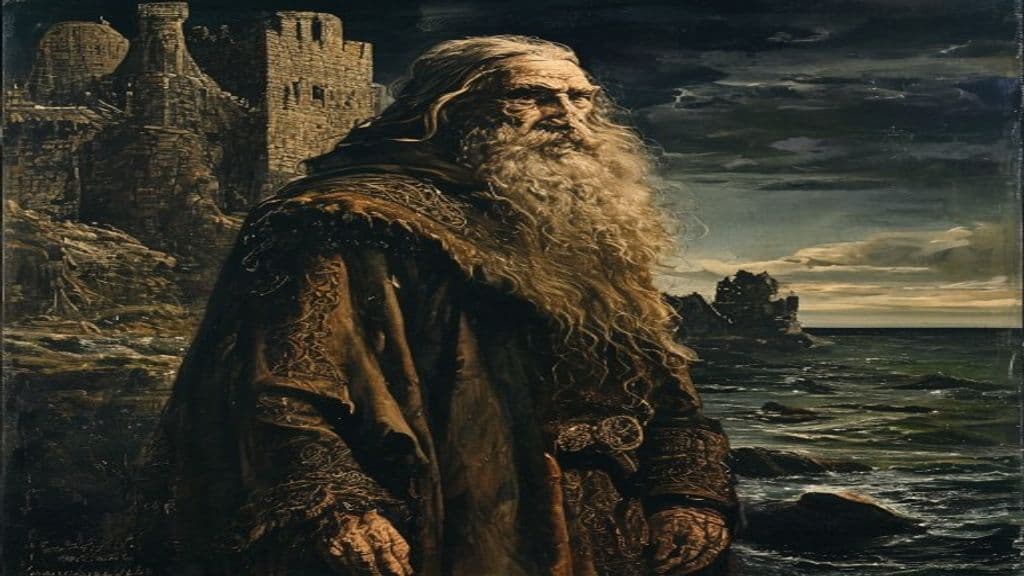
Medieval and early-modern sources present Aonghus mac Úmhór as an eponymous leader of the Tuath mhac nUmhoir and ruler of the Fir Bolg of Connacht. According to the tradition preserved in such sources, after being driven out by warfare with Clann Chuian and the kindred of the Gaoidhil (Gaels) he led his people to the coast of Galway Bay and the Aran Islands, where he is credited in legend with founding or occupying sites including Dún Aonghasa on Inishmore. Modern scholars (for example O'Rahilly) have attempted to historicize these traditions and have proposed dates (O'Rahilly places events in the 2nd century BC), but such datings are scholarly reconstructions rather than direct claims from the medieval sources.
The surviving summaries and genealogical accounts do not preserve a physical or supernatural description of Aonghus mac Úmhór. He is treated in the sources as a legendary/mortal ruler and ancestral figure rather than as a described supernatural apparition, and no contemporaneous physical details are recorded in the cited material.
Sources attribute to Aonghus political and military leadership: he led the Tuath mhac nUmhoir to new territory after being expelled by warfare, ruled the Fir Bolg of Connacht, and is linked etiologically to place‑names and fortifications (legend states he built Dún Aonghasa). His actions recorded in the tradition are political and foundational; the provided materials do not ascribe supernatural powers or magical abilities to him. He is also named as father of Conall Caol, who settled in the kingdom of Aidhne with his people.
Ao Guang (Dragon King of the East Sea)
Ao Guang is the Dragon King (Dragon God) who presides over the East Sea (Dōng Hǎi) in Chinese mythology, literature, and folk-religion. He is presented in sources as a regional aquatic deity associated with water and weather and appears as a named supernatural figure in classical vernacular novels such as Journey to the West and Fengshen Yanyi.
Ao Kuang
Ao Kuang (also attested as Ao Guang) is the Dragon King of the East Sea in Chinese mythology and folk religion, one of a quartet of sea-dragon sovereigns associated in folklore with the cardinal seas. He appears in classical literature and later popular media as a ruler of maritime waters whose favor or displeasure is connected to tides, rain, floods and storms.
Aoandon
Aoandon (青行灯, "blue andon") is a yōkai figure represented in Edo-period yokai iconography, best known from Toriyama Sekien's Konjaku Hyakki Shūi. It personifies the eerie apparition said to appear at the conclusion of the Hyakumonogatari Kaidankai storytelling ritual and is visually depicted as a blue-skinned woman with horns and sharp teeth.
Aobōzu
Aobōzu (青坊主, "blue priest") is a Japanese yōkai whose depiction and behavior vary by locality. Appearing as a priestly humanoid with blue coloration or as a priest-faced apparition, it functions in regional legends as a frightening presence that can kidnap, threaten, or haunt people—especially children and schoolchildren—and is sometimes identified as a disguised animal or a mountain deity.
Aoede
Aoede (Ancient Greek: Ἀοιδή, literally 'Song') is an ancient Greek personification named among early lists of Muses. Attested in literary sources as an inspirer of song and poetry, she appears in variant local traditions (three or four Muses) later supplanted by the canonical nine.
Aoi Mac Ollamain
Aoi Mac Ollamain (also Ai Mac Ollamain; recorded as Mac Ollamo and Mac Ollavain) is attested in early Irish material as a member of the Tuatha Dé Danann and is identified specifically as a god of poetry. Surviving references are brief and provide little detail beyond name, group affiliation, and a narrative detail about his birth and survival.
Aonyōbō
Aonyōbō (青女房) is a yōkai in Japanese folklore described in legend as a blue-skinned, ogre-like spirit who appears as an ancient court noblewoman and haunts the ruined houses of fallen nobles, embodying poverty, abandonment, and social decline.
Aora
Aora (Ancient Greek: Ἀώρα) is attested in the classical Greek mythic record as a nymph and eponymous ancestress: the town of Aoros in Crete was said to have been named for her, and aristocrats of Eleutherna claimed descent from her and her husband Eleuther, one of the Kouretes.
Aos Sí
Aos Sí are a broad class of supernatural beings in Gaelic (Irish and Scottish) folklore associated with the mounds and liminal places of the landscape. They are variously described as descendants or later forms of the Tuatha Dé Danann, ancestral or nature spirits, or otherworldly folk who coexist with humans and can be helpful or dangerous when offended.
Aosaginohi
Aosaginohi (also Aosagibi or Goi no hi) is a Japanese hikarimono — a night luminous phenomenon traditionally associated with a kind of heron (ao sagi/goi sagi). Recorded in Edo-period yōkai compendia and folkloric accounts, it is described as a ball or patch of blue flame or lantern-like glow often explained either as a gleaming heron in flight or as an uncanny light.
Aotea (Canoe)
Ancestral waka in Māori tradition, significant in the migration of the Māori people to New Zealand. (Note: - Power tier should be at least Greater (deity-level), considering Aotea is associated with significant spiritual and cultural importance to the Māori people's migration. - Abilities should include de)
Aotearoa (Canoe)
An ancestral vessel in Māori tradition, associated with the migration and settlement of New Zealand. (Note: 1. Power tier should be Ancient, not Primordial. 2. Remove "Historical significance" from sensory cues as it is a general statement rather than a specific cue. 3. Add "Its presence is often associated)
Community Record
- [1]Aonghus mac Úmhór — Wikipedia. Wikipedia, 'Aonghus mac Úmhór'wiki
- [2]Wikidata entry for Aonghus mac Úmhór. Wikidata Q4778695wiki