Medieval literature often equates the aes síde or fír síde with the Tuatha Dé Danann, interpreting the Aos Sí as the later literary or folkloric forms of those older pre-Christian deities; other traditions describe them as nature spirits, ancestral or familial spirits, or in some accounts as fallen angels not damned. Their identity is tied to their dwelling-place (the sídhe, i.e. mounds or hillocks), and sources present multiple overlapping origin notions rather than a single canonical provenance.
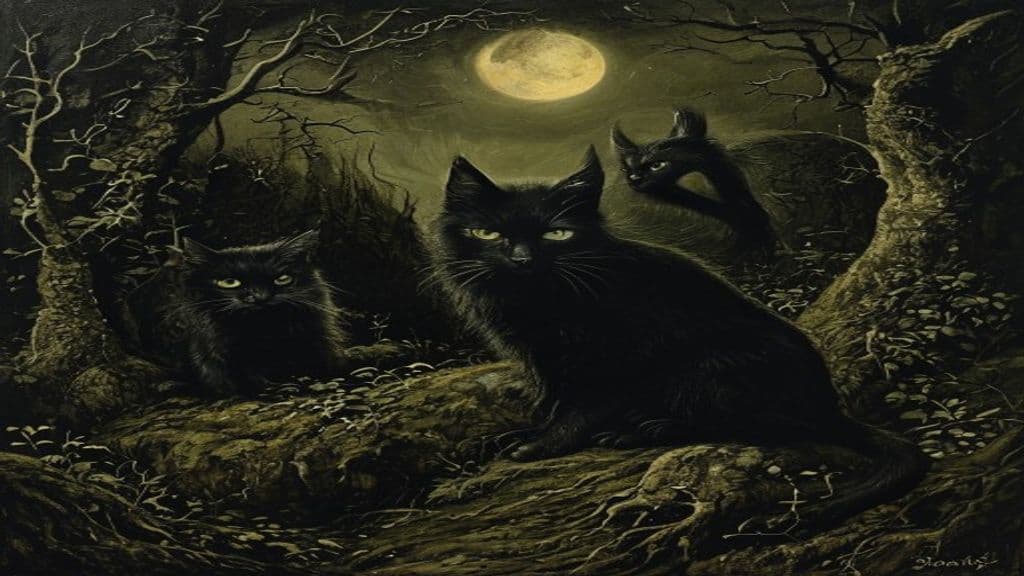
Accounts are variable and general: the Aos Sí are commonly said to be stunningly beautiful but can also be terrible or hideous. Specific named subtypes carry particular forms (for example cat-sìth as a fairy cat, cù-sìth as a fairy dog), but the supplied sources do not provide consistent anatomical detail. Linguistically, older Irish usage distinguishes the sídhe as the residences (halls/mounds) and later English usage sometimes conflates the dwellings with the people.
Aos Sí inhabit an Otherworld that interpenetrates the human landscape and interact with people in varied ways: they guard their abodes fiercely and may retaliate against those who infringe sacred places, can abduct trespassers and appear in changeling narratives (replacing or stealing children), and include subtypes with specialised roles (bean sídhe/banshee who keens to announce death; bean-nighe who washes the clothes of those about to die; leanan sídhe as a fairy lover; sluagh as an airborne host). Their activity is liminal and seasonal — they come nearer at dawn and dusk and around festival times — and moral ambivalence is a constant theme: they may help or harm depending on how they are treated.
Weaknesses
- conditionavoidance and appeasement as folk strategy
Wards
- ritualeuphemistic speech and offerings
- conditionavoidance of liminal times and places
Abarta (Ábartach)
Abarta (also Ábartach) is a figure of Irish myth who, in surviving accounts, tricks Fionn mac Cumhaill's warriors by giving them a supernatural grey horse that bears them into the Otherworld. Sources variably identify him as a member of the Tuatha Dé Danann or as a Fomorian; after the incident he is compelled to release the captured warriors and is refused entry to the Fianna.
Abcán (Abhcán)
Abcán (modern spelling Abhcán) is a named dwarf poet and musician of the Tuatha Dé Danann in Irish myth. He appears in a small number of narratives as a musician whose art has soporific power and as the ferryman who brings the goddess Ruad from the Otherworld to the human world.
Abhean
Abhean is a named poet of the Tuatha Dé Danann in medieval Irish literature, described as a poet in particular of Lugh and recorded as having been killed by Óengus before Midir in a poem by Fland Mainistreach preserved in the Lebor Gabála Érenn.
Achtland
Achtland is a figure from Irish tradition who, according to the surviving account, was a mortal woman famed for rejecting mortal suitors who married a member of the Tuatha Dé Danann and crossed into the síde to become immortal as his wife.
Aed (Aodh)
Aed (Old Irish Aodh) is a named supernatural figure in Irish myth attested in variant genealogies: in some traditions he is one of the Children of Lir, while in others he appears as a son of the Dagda. His name derives from the Old Irish word for 'fire' and he appears in narratives that place him among the aristocratic households of the Tuatha Dé Danann/Daoine Sidhe.
Aengus
Aengus (Óengus, Aonghus) is a member of the Tuatha Dé Danann in Irish myth, portrayed as a youthful, attractive figure associated with love, youth, poetic inspiration and seasonal/solar symbolism; he is linked to Brú na Bóinne (Newgrange) and appears as fosterer, protector, enchanter and avenger in multiple tales.
Ailill Angubae
Ailill Angubae is a human figure in the Irish tale The Wooing of Étaín, presented as the brother of High King Eochaid Feidlech who falls desperately in love with his brother's wife, Étaín. His unrequited passion leads to a wasting illness and a failed rendezvous when the Tuatha Dé Danann figure Midir casts him into an enchanted sleep.
Airmed
Airmed (Airmid) is a healer and keeper of herbal knowledge among the Tuatha Dé Danann in Irish myth. Daughter of Díán Cécht and sister of Miach, she preserves the lore of healing plants, gathers herbs at Miach's grave, and is named among enchanters who sang over the well of Sláine to restore the wounded.
Badb
Badb is an Irish supernatural female figure associated with warfare, death, and prophecy. She commonly appears as a crow or raven and as a wailing omen, acts on battlefields to sow confusion and foretell slaughter, and is often treated as one member of the triadic Morrígna.
Banba
Banba (modern spelling Banbha) is a matron goddess of Ireland in Irish mythology, daughter of Delbáeth and Ernmas of the Tuatha Dé Danann. She forms a triad of matronal personifications of the island with her sisters Ériu and Fódla, is associated with sovereignty and the land, and appears in origin and heroic narratives linked to specific Irish landscapes.
Bauchan
A household-associated hobgoblin from Scottish Highland folklore, the bauchan is portrayed as ambivalently belligerent and helpful; in at least one recorded tale it accompanies a human household across the Atlantic and can shapeshift into a goat.
Beithir
In Scottish Gaelic tradition the beithir is a very large snakelike creature—often called a serpent or dragon—associated with mountains, corries and bodies of water. It is portrayed as venomous and deadly in local tales, linked in etymology and interpretation to lightning/thunderbolt imagery, and classed among water-associated monsters (fuath).
Community Record
- [1]Aos Sí — Wikipedia. Wikipedia: 'Aos Sí' entry (summary of folklore variants, etymology, places, subtypes, festivals, and practices)wiki
- [2]Aos Sí — Wikidata. Wikidata item for Aos Sí (classification as supernatural race in Irish and Scottish mythology)wiki
- [3]Aos Sí – Ancestors of Ireland — SymbolSage. Popular secondary summary reiterating folkloric associations and receptionother
- [4]Aos Si | Villains Wiki | Fandom. Fan-wiki summary reflecting modern retellings; treated as secondary reception in the provided notesother