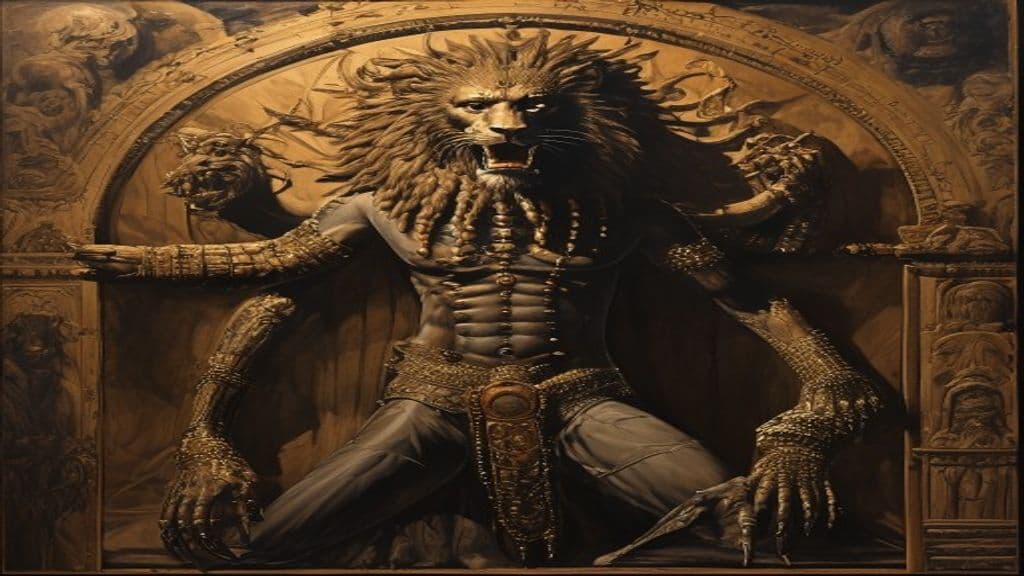
Apedemak is attested as a principal deity in the Meroitic period; temple evidence such as the Lion‑Temple at Musawwarat es‑Sufra (late 3rd century BCE contexts) is cited as the earliest known representation. Some scholars and source summaries hypothesize cultural antecedents in earlier Kerma lion imagery (inlays and burial motifs), suggesting a possible trajectory from zoomorphic lion symbolism to an anthropomorphized royal-war deity, but such antecedents are presented as plausible hypotheses rather than established fact in the supplied materials.
The deity is commonly depicted in leonine form — often as a figure with a male human torso and a lion's head — and appears in a variety of local iconographies. Attested variants include a serpent‑bodied form with a lion's head at Naqa, a three‑headed leonine form with four arms in some reliefs, martial dress such as leather armour or a cuirass and weapons (bow and arrow), and scenes showing him standing upon or holding elephants or lions on leashes. At Naqa he is also represented in a motif combining a flying hawk with the winged sun‑disc, which conveys a solar aspect in that local depiction.
Apedemak is chiefly associated with martial power, military conquest and the legitimation of kingship: temple reliefs show him active in battle scenes, killing enemies, holding chains of captives, and participating in investiture imagery (for example, touching a ruler's elbow during scenes of royal bestowal). Hymnic material from the Lion‑Temple addresses him with life‑giving and fertility language (e.g., 'who provides nourishment for all mankind' and 'lord of life'), and some reliefs depict cereal offerings. In the syncretic religious environment of Napatan and Meroitic Kush he appears alongside Egyptian deities (Amun, Satis, Horus, Isis) and shares overlapping functions of rulership, fertility and water/solar symbolism in certain representations.
Apam Napat
Persian deity associated with water, creation, and the natural world. (Note: 1. Power tier: Apam Napat is mentioned in the Rig Veda, which is an Indo-Iranian text, but he is not described as a cosmic creator figure; rather, he is specifically credited with creating all things.)
Apanuugak
Apanuugak is an Inuit legendary figure presented in modern summaries as a culture-hero who is narratively ambivalent: sometimes an error-prone or long-lived warrior and elsewhere depicted as a dastardly villain or cunning trickster.
Apaosha
Apaosha (Avestan apaoša; Middle Persian Aposh/Apaush) is the personified cause and adversary of rainfall and prosperity in Zoroastrian literature. Depicted as a malign Daeva embodied as a black horse, Apaosha battles the rain-bringing divinity Tishtrya and causes drought when successful; his defeat (often aided by correct worship or Ahura Mazda's intervention) brings rain and renewal.
Aparajita (Wisdom King)
Aparajita is named in secondary sources as a member of the broad class of East Asian Buddhist 'wisdom kings'—wrathful protective emanations associated with Buddhas and bodhisattvas. The supplied materials do not provide a focused, primary textual profile for an individual Aparajita; most attestations address the wisdom-king category and the protective powers of dharani/mantra (notably the Shurangama Mantra).
Apasmara
Apasmara is a diminutive mythological figure in Hindu iconography who personifies loss of memory, ignorance, and the ego-faculty (ahamkāra); simultaneously, apasmāra is a classical Ayurvedic disease category used for seizure- and memory-related neurological disorders. In temple imagery Apasmara is eternally subdued beneath the right foot of Shiva (as Natarāja or Dakṣiṇāmūrti), symbolizing the necessary suppression of ignorance for the possibility of liberation.
Apate
Apate is the personification and divine power of deceit in ancient Greek myth: a named theonym that functions as the embodiment of guile, illusion, and perjury. She appears in mythic narrative (notably in Nonnus' Dionysiaca where she supplies a magical girdle) and in philosophical commentary (Neoplatonic readings) as an explanatory category for deception and illusion.
Apemosyne
A mortal Cretan princess in Greek myth, daughter of King Catreus and sister of Althaemenes, whose flight from Crete to Rhodes and subsequent encounter with the god Hermes result in her rape and death at her brother's hands. Her story appears in genealogical accounts tied to the house of Minos and is preserved in summaries of Apollodorus.
Apep
Apep (also Apophis or Aphoph) is the ancient Egyptian serpent-like embodiment of chaos and darkness who recurrently assaults the solar barque of Ra, representing the ongoing threat to cosmic order (Maat). Ritual texts in the Egyptian corpus contain spells framed to smite or repel Apep and protect the sun's passage.
Apesh
Apesh is an Ancient Egyptian god of the night associated with the head of a turtle or tortoise and attested in funerary literature as opposing the sun-god Ra. Sources describe Apesh in negative terms tied to cultural attitudes toward turtles and cite funerary formulae that rhetorically wish the turtle’s death in favor of Ra’s life.
Aphaia
Aphaia is a local Greek goddess worshipped chiefly on the island of Aegina, associated in the sources with fertility, the agricultural cycle, and huntress attributes through identification with Britomartis/Diktynna and later with Artemis and Athena. Her cult was centered on a single prominent sanctuary and temple on a 160 m peak at the northeastern end of Aegina, with a monumental Late Archaic temple rebuilt ca. 500 BCE on the site of an earlier shrine destroyed by fire c. 510 BCE.
Aphareus
Aphareus (Ancient Greek: Ἀφαρεύς) is an ancient Greek anthroponym attested for several distinct figures in myth and history (a Messenian king, a Centaur, a Greek warrior at Troy, and an Athenian rhetor/tragedian) and separately as a modern taxonomic genus of fish. The name does not denote a single autonomous supernatural being in the supplied sources but is used across multiple narrative registers.
Aphareus of Messenia
Aphareus (Ancient Greek: Ἀφαρεύς) is a legendary king of Messenia attested in Greek mytho-historical genealogies. He appears in literary and local traditions as a member of heroic-age lineages, a regional ruler, and an ancestral figure used to anchor Messenian dynastic claims.
Community Record
- [1]Apedemak. Wikipedia: 'Apedemak' article (summarizing archaeological and scholarly literature)wiki
- [2]Apedemak (Global Egyptian Museum glossary). Global Egyptian Museum entry on Apedemakother
- [3]Roman Kiosk and Temple of Apedemak, Naqa (Archive.org). Archive collection documenting Naqa monuments and drawingsother
- [4]Apedemak, Lion god of Meroe: a study in Egyptian-Meroitic syncretism (Archive.org). Archive: collected studies and publications on Apedemak and syncretismother
- [5]Musawwarat Photo Gallery (Brian McMorrow, pbase). Photographic documentation of Musawwarat es‑Sufra reliefs and the Lion‑Templeother
- [6]Naqa. Wikipedia entry for Naqa archaeological site (context for Apedemak sanctuary)wiki
- [7]Interview: Apedemak (Universität Münster). University of Münster interview notice referencing research into Meroitic kingship and cultsother
- [8]Neferchichi — Apedemak summary. Popular web summary describing iconography and motifsother
- [9]Sudan heraldic and site notes (Hubert Herald). Overview of Sudanese archaeological sites including Meroitic templesother