In Mesopotamian cosmogony Apsu is the freshwater primordial ocean that, together with the saltwater Tiamat, gives rise to earlier generations of gods (for example Lahmu and Lahamu). Apsu exists from the beginning of the cosmos as the subterranean and surrounding freshwater principle; in Enūma Eliš the younger god Ea perceives the threat Apsu poses to the new generation, slays Apsu, takes Apsu's halo, and Apsu's domain becomes the dwelling of Ea and Damkina. Enūma Eliš further locates the birth of Marduk 'in the heart of Apsu,' where Ea and Damkina beget him.
Primary texts emphasize Apsu as the primordial freshwater abyss and a hypostatic divine presence rather than offering a consistent anthropomorphic iconography. Enūma Eliš and related summaries describe Apsu as the subterranean fresh-water ocean/abyss; later references note symbolic attributes (for example a 'halo' taken by Ea) but no stable corporeal depiction is preserved in the supplied material.
Apsu functions cosmologically as the source and regulator of fresh water: lakes, springs, rivers, fountains, rain and, in flood narratives such as Atrahasis, the Flood itself are said to originate from the Abzû/Apsu. Mythically Apsu is a progenitor in the divine genealogy and, in narrative sequences, an actor whose death by Ea results in transfer of his domain and the placement of later gods; his agency thus ranges from sustaining life through water to being a locus and participant in theogonies.
Weaknesses
- otherslain by the younger god Ea (Enki) — narrative vulnerability to divine usurpation
Wards
None recorded.
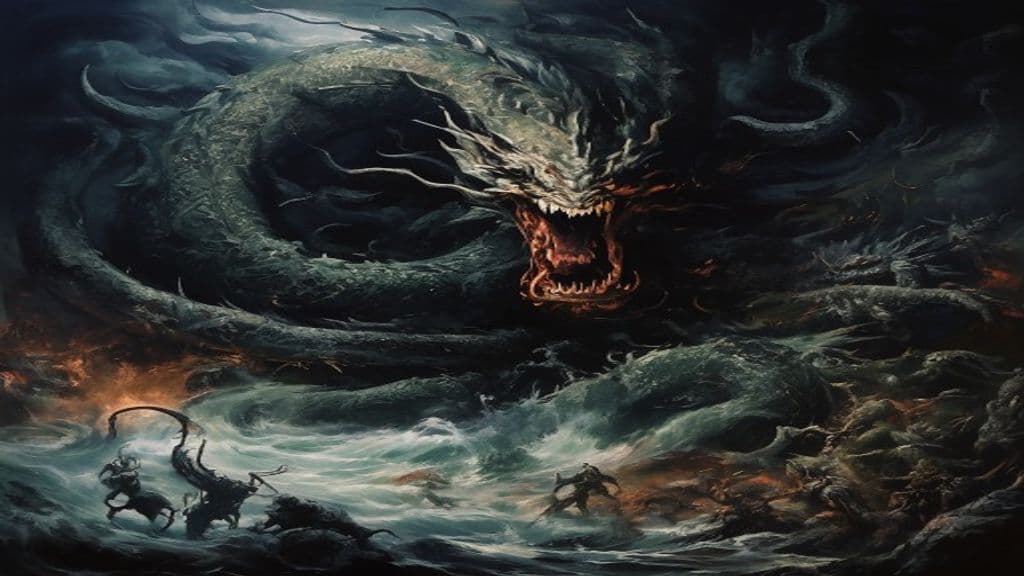
Tiamat
The primordial salt-sea dragon of Babylonian creation myth — the chaos-mother from whose slain body the universe was built, and whose blood became the first humans.

Laḫmu
Laḫmu (Laḫamu for the feminine counterpart) is an apotropaic Mesopotamian supernatural being attested both as a class of protective attendants in ritual contexts and as an individual primordial figure in some theogonies (notably variants of the Enūma Eliš). Generally regarded as protective household and temple guardians, Laḫmu are also incorporated in certain mythic genealogies.

Lahamu
Lahamu is a minor primordial figure in Mesopotamian cosmological genealogies, attested in variants of the Enuma Elish and in some god-lists as a feminine counterpart to Lahmu and an ancestor in the lineage that leads to the major sky-god Anu. She appears in literary creation contexts rather than as a focus of cultic practice.
Community Record
- [1]Abzu (Apsu) - Wikipedia. "Abzû or Apsû is the name for fresh water from underground aquifers which was given a religious fertilising quality in ancient near eastern cosmology... It was believed that all lakes, springs, rivers, fountains, rain, and even the Flood, as described in Atrahasis, originated from the Abzû."wiki
- [2]Enūma Eliš (Enuma Elish) — creation epic (summary and excerpts). "Ea took Apsu's halo and wore it himself, slew Apsu, and chained Mummu. Apsu became the dwelling place of Ea, together with his wife Damkina. Within the heart of Apsu, Ea and Damkina created Marduk." / "In the heart of Apsu was Marduk created, In the heart of holy Apsu was Marduk created. He who begot him was Ea, his father, She who conceived him was Damkina, his mother."literary
- [3]Tiamat — Alchetron entry (context on pairing with Apsu). Summary material referencing the cosmogonic pairing of Apsu (freshwater) and Tiamat (saltwater) and their progeny (e.g., Lahmu and Lahamu) and cultic connections (Enki's Abzu at Eridu).other