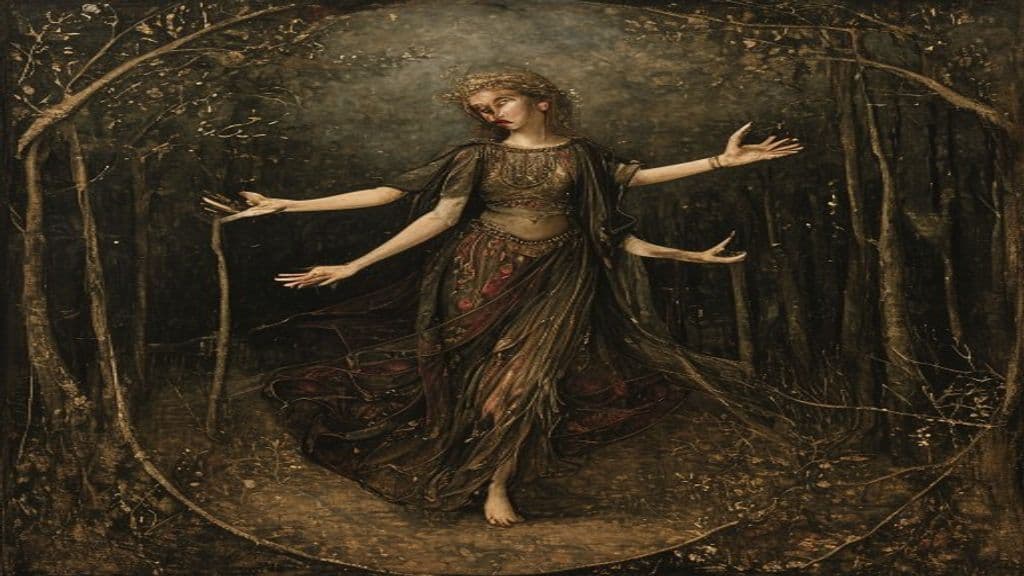
Two overlapping strands appear in the sources. In Charles G. Leland's 1899 book Aradia, or the Gospel of the Witches, Aradia is presented as a daughter of Diana (and in Leland's narrative linked to Lucifer) sent to earth to teach oppressed people witchcraft as a means of liberation; Leland frames his text as a 'Gospel' of a Tuscan witch tradition. Separately, comparative folklorists (including Magliocco and Eliade in cited summaries) trace cognate names in Italian and Sardinian records (Arada/Araja/s'Araja) and identify an association with the medieval figure Herodias (Italian Erodiade), who in medieval tradition becomes a nocturnal spirit condemned to wander the sky. Scholars note that Leland's claims about a continuing Tuscan witch religion and the provenance of his text are disputed by historians, and that regional traditions show multiple, sometimes divergent, local forms rather than a single unified origin.
Leland's narrative emphasizes Aradia's role and origin (daughter of Diana) rather than providing a detailed physical description. Medieval and folkloric accounts that connect cognate names to Herodias/Diana's train describe the related figures functionally as nocturnal, flying women who wander the sky and rest in treetops between midnight and dawn; appearance in those contexts is therefore tied to nocturnal flight and membership in a female supernatural company rather than to a consistent personal portrait.
In Leland's text Aradia functions as a teacher of witchcraft, instructing those who 'fain would study witchcraft' and promising liberation from slavery; the Gospel contains spells and invocations and an account of witches' meetings (Leland's 'Tregunda' or Sabbat) which he said outlined doctrine and rites. In wider folkloric materials cognate figures are associated with night-journeys and aerial movement as members or patrons of Diana/Herodias's nocturnal train; Eliade's summary links Arada/Irodiada with a Romanian 'Queen of the Fairies' who patronized ritual dance groups (calusari). Sources stress that Leland's literary presentation and folkloric attestations are distinct kinds of evidence and that the extent to which Leland preserved preexisting folk belief is contested.
Pricolici
A Romanian folkloric revenant that combines lupine characteristics with vampiric, post-mortem hostility; typically represented as a wolf- or dog-like attacker associated with violent deaths, werewolves, and other harmful undead in rural tradition.
Vampire (tradition)
A class of revenant beings in southeastern and eastern European folk belief that subsist by feeding on the vital essence (generally blood) of the living. Recorded chiefly in early modern to modern oral traditions, these vampires are typically described as reanimated corpses whose presence explains unexplained illness, death, and post-mortem disturbances in their communities.
Aqualad
Aqualad is a modern American fictional superhero mantle published by DC Comics and appearing across comics, animation, live-action television, film, and games. The name denotes youthful water-associated protégés of Aquaman — chiefly Garth (an Atlantean who later becomes Tempest) and Jackson Hyde / Kaldur'ahm (a reimagined, partly human version created for Young Justice).
Aquaman
Aquaman is a fictional superhero appearing in American comic books published by DC Comics. An Atlantean-human hybrid who serves as king of Atlantis and a founding member of the Justice League, Aquaman has been a recurring protagonist across comic-book eras and adapted into animation and live-action media.
Ar-Pharazôn
Ar-Pharazôn is the twenty-fifth and last King of Númenor in J. R. R. Tolkien's legendarium; a mortal ruler whose political and military leadership, and whose acceptance of Sauron's counsel, precipitated the rebellion of Númenóreans against the Valar and the Downfall of Númenor.
Ara
Ara (Sumerian: A) is a minor Mesopotamian goddess attested as a servant or attendant of the god Enki. Earlier scholarship sometimes conflated her theonym with the attendant deity Isimud, but modern treatments distinguish Ara as a separate divine household figure.
Arachne
Arachne is a mortal woman from classical Greco-Roman myth (best known from Ovid's Metamorphoses, Book 6) whose unrivaled weaving skill and challenge to the goddess Athena/Minerva lead to her metamorphosis into a spider; the tale functions as an etiological myth explaining why spiders spin webs and as a cautionary exemplum about hubris toward the gods.
Arae (Arai)
In Greek myth the Arae (Αραι, Arai) are female chthonic spirits who personify curses—especially imprecations of the dead—and act as underworld enforcers of vengeance and blood-redress. They are often treated as interchangeable with or closely related to the Erinyes (Furies) and are invoked in dramatic and ritual speech when murder, household pollution, or ancestral guilt demand retribution.
Arahura (Māori canoe)
Divine Māori canoe made of pounamu, associated with the Ngāi Tahu tribe and spiritual significance. (Note: * Power tier: Not specified, assume Lower or Lesser as it's associated with the tribe and not described as a deity-level being * Abilities: Remove the mention of spiritual significance and connection )
Aralez (Aralezner)
Aralez (Aralezner in plural) are ancient Armenian dog-like spirit-beings traditionally credited with resurrecting fallen warriors by licking their wounds. Described in source material as part of the older strata of Armenian sacred imagination, they occupy a liminal role between animals, spirits, and ancient gods.
Aram (Nahapet)
Legendary leader and patriarch in Armenian tradition who united Armenians into one state. (Note: - Power tier: Primordial (given cosmic/unifying abilities) - Summary: Expand to include "unification of Armenians" as a key aspect of his leadership - Abilities: More specific and detailed description)
Arang (Korean folklore)
Vengeful spirit driven by a desire for justice in Korean folklore, particularly during the Joseon Dynasty. (Note: 1. Power tier should be Primordial since it is described as having a cosmic level of influence in causing fear among magistrates. 2. The description for weaknesses is missing; add that Arang's weaknes)
Community Record
- [1]Aradia (Wikipedia). Wikipedia contributors, 'Aradia', Wikipedia, The Free Encyclopediawiki
- [2]Aradia, or the Gospel of the Witches (Charles Godfrey Leland, 1899) — cited excerpts. Leland, Charles Godfrey, Aradia, or the Gospel of the Witches (as summarized and quoted in secondary sources)literary
- [3]Magliocco on Arada/Araja variants in Italian and Sardinian records (as summarized). Magliocco (scholarship summarized in the cited article) tracing s'Araja dimoniu and s'Araja justa; sa Rejusta connectionsacademic
- [4]Mircea Eliade on Arada/Irodiada and Romanian Fairy-Queen (as summarized). Eliade (summary citation in the article) noting the Romanian Doamna Zînelor identificationacademic