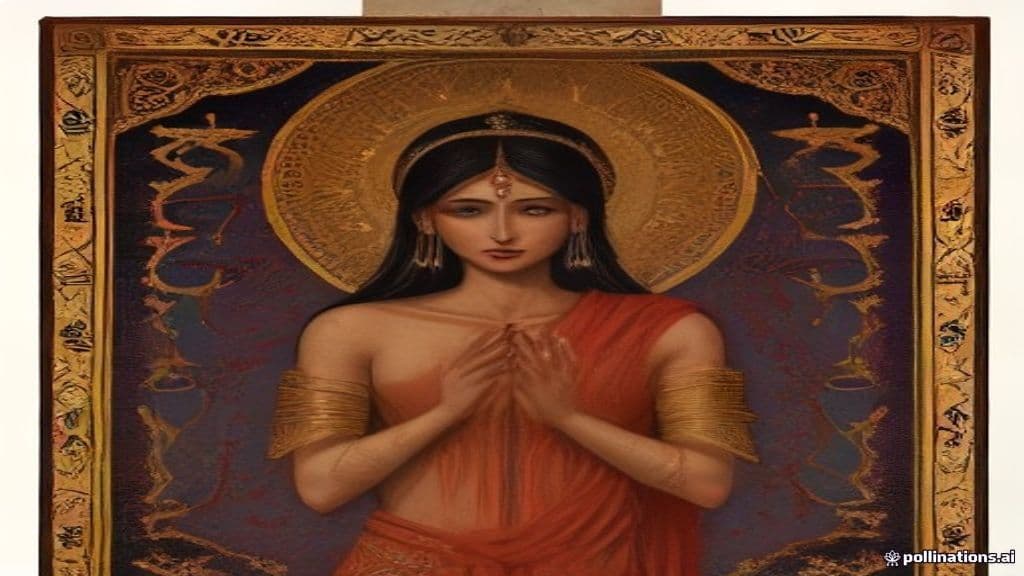
In Hurrian mythic tradition preserved in fragmentary form (the Kumarbi Cycle), Aranzaḫ is one of the deities produced when Kumarbi bit off the genitals of the sky god Anu and became impregnated with multiple gods. Surviving lines enumerate the River Tigris among the divine offspring alongside the storm-god (Teshub) and Tašmišu. Scholarly reconstructions vary over the precise mechanics and sequence of the birth: Volkert Haas proposed that Kumarbi spat Aranzaḫ out on the mountain Kanzura, Gary Beckman reads the sources as indicating Kumarbi spits out one son on Kanzura but treats Aranzaḫ as born later by unclear means, and Erik van Dongen argues that linking Kanzura to Aranzaḫ's birth is implausible. The account thus places Aranzaḫ within the cosmogonic conflict surrounding Kumarbi, Anu, and Teshub while admitting that the fragmentary textual record permits multiple interpretations.
The surviving Hurrian texts do not provide a consistent anthropomorphic iconography for Aranzaḫ. No sustained physical description is preserved. In the Gurparanzaḫ narrative one modern reading (Mary R. Bachvarova) interprets a passage as describing Aranzaḫ assuming the form of an eagle to travel, but this avian depiction is attested only in that interpretive reading of the fragmentary text and cannot be taken as a canonical or exclusive depiction. Overall, sources emphasize the river-personhood of Aranzaḫ rather than a fixed bodily form.
Aranzaḫ functions mythologically as the divine personification of the Tigris and appears among the roster of gods whose births and relations shape the Kumarbi Cycle's divine drama. In the tale of Gurparanzaḫ he acts as an ally and protective divine figure for the human hero/king, intervening on his behalf, traveling to question him, and consulting fate goddesses on his behalf. The texts imply agency appropriate to a major river-numen — movement, intervention in human affairs, and membership in the divine cohort — but do not furnish specific magical abilities, elemental formulas, or enumerated powers beyond these narrative roles. Scholarly treatments infer his alignment with Teshub's faction in the Kumarbi Cycle, though this remains a reconstruction rather than a fully settled textual fact.
Community Record
- [1]Aranzaḫ (Wikipedia). Wikipedia, "Aranzaḫ"wiki
- [2]Aranzaḫ (Wikidata). Wikidata entry Q117468674wiki
- [3]Hurrian religion (Wikipedia). Wikipedia, "Hurrian religion"wiki
- [4]Discussion and popular summaries referencing the Kumarbi Cycle. TheCollector, "The Ancient Hurrian Myth That Inspired the Greek Gods"other
- [5]Popular / blog references repeating identification of Aranzaḫ with the Tigris. Balladeer's Blog (April 2014)other
- [6]Popular / blog references repeating identification of Aranzaḫ with the Tigris. Balladeer's Blog (April 2019)other