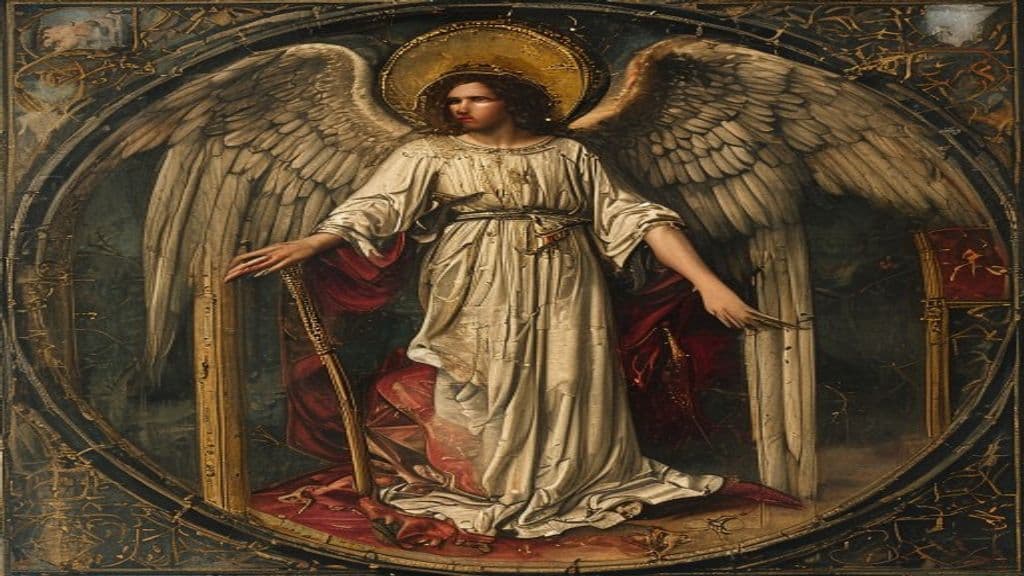
The conceptual origins rest on the Hebrew term malakh (מַלְאַךְ, 'messenger') used in the Hebrew Bible to denote divine messengers, with later post‑biblical Jewish and Christian texts individuating and naming higher angels. Explicit hierarchical schemes—placing archangels at a defined rank—are most clearly memorialized in Pseudo‑Dionysius' medieval Christian De Coelesti Hierarchia, which lists archangels as the second‑lowest rank in his ordered celestial hierarchy. Additional named archangels and expanded roles appear in later Jewish apocryphal and mystical texts (for example, works that recognize Michael, Gabriel, Raphael, Uriel, and others), and Islamic tradition likewise preserves named high angels (Jibra'il/Gabriel, Mika'il/Michael, Israfil, Malak al‑Mawt) though lists and roles vary by corpus.
The supplied sources do not offer a single canonical phenomenological description. Medieval theological texts and the Greek etymology contributed to imagining archangels as 'chief messengers,' and later literature and popular culture (including John Milton's writings and modern media) have shaped contemporary visual images. The research notes emphasize that no unified primary visual description is provided in the cited materials.
Across the sources archangels function primarily as divine messengers and agents who carry out missions on God's behalf, including delivering announcements, guiding and protecting communities, and—within certain traditions—executive roles such as leadership of heavenly hosts (e.g., Michael) or specialized functions attested in particular corpora. Specific portfolios vary by tradition and text: Michael is associated with leadership and protection in Daniel and later Christian texts; Gabriel with annunciation and revelation; Raphael with healing in Tobit; Islamic lists include named high angels with their own roles (including an angel identified as the Angel of Death, Malak al‑Mawt, in Islamic tradition). The comparative literature likens archangelic roles to Zoroastrian Amesha Spentas as protective, guiding celestial benefactors.
Michael
Michael is presented in the supplied sources as a masculine given name and disambiguation headword applied to people, historical rulers, cultural works, places, and other uses; the provided material treats it as an onomastic item rather than as a single supernatural being.

Gabriel
A principal heavenly messenger in Jewish, Christian, and Islamic literatures, Gabriel is portrayed as an archangel who reveals and explains divine messages, announces births and divine intent, and executes certain divine judgments in apocalyptic texts.

Amesha Spenta
Amesha Spenta (Avestan Aməša Spəṇta) are a canonical heptad of divine, bounteous principles in Zoroastrian thought, described as the first emanations of Ahura Mazda and later functioning as moral ideals and protectors or guardians of portions of creation.
Community Record
- [1]Archangel - Wikipedia. Wikipedia contributors, 'Archangel,' Wikipedia, The Free Encyclopedia.wiki
- [2]Episode 212 - Mouth Sounds Attack (Sky Noises) - Archive.org. Podcast episode discussing speculative cultural associations with archangel Gabriel (trumpet motif).other
- [3]MASS EFFECT: Space Batman - Archive.org. Media archive item noting modern cultural use of the term 'Archangel' as a sobriquet in entertainment contexts.other