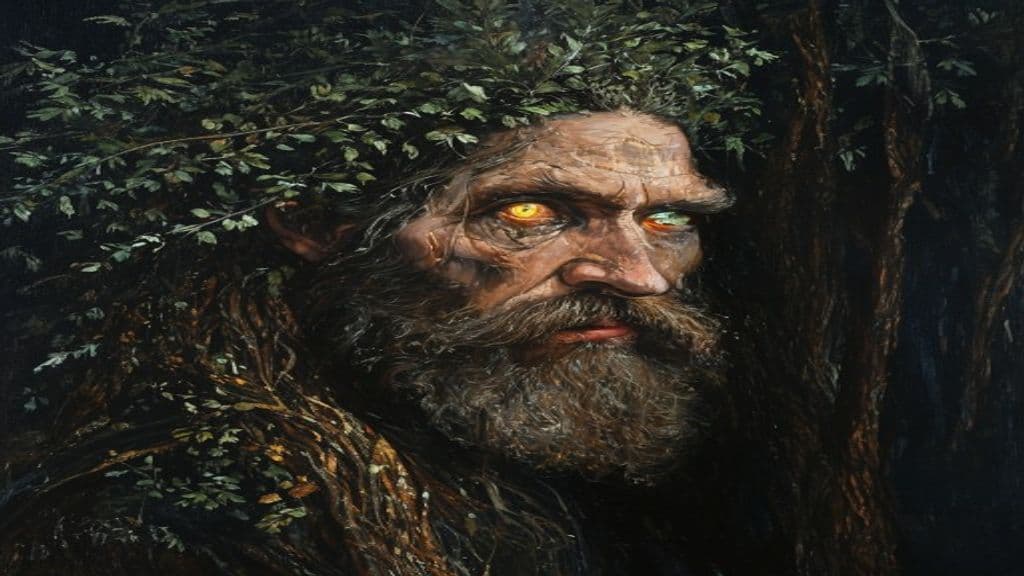
Sources do not record a creation narrative for Archura. Instead, Archura is presented in the ethnographic and folkloric record as a named member of the chura (chur(a)) class of place-spirits: a woodland or countryside spirit contrasted with household spirits such as Bichura. The name (Old Turkic 𐰀𐰺𐰲𐰆𐰺𐰀; modern Turkish Arçura) situates the being within Turkic animistic taxonomies of spirits that are attached to specific natural domains.
Accounts describe Archura most commonly appearing in human form, typically like a peasant, though the spirit is capable of drastic size changes from as small as a blade of grass to as tall as a tree. Distinctive folkloric details recorded in sources include glowing eyes, hair and beard described as made of living grass, and occasional attributes such as a tail, hooves, horns, a red scarf, and wearing the left shoe on the right foot; one source also notes that Archura has no shadow. These traits function in the tradition as identifying marks separating Archura from ordinary people.
Archura is described as a shapeshifter with a wide repertoire of forms and sizes. It can imitate voices of people known to a traveler, use mimicry and removal of waymarks to lead people astray, and has been said to 'tickle' victims to death in folktales. The spirit is portrayed as communicating with and influencing animals and birds — for example, sources state Archura tells animals when to migrate and acts to keep grazing cattle from wandering too far into forests. Archura may abduct young women in some tales and, when multiple Archura occupy a wood, they may fight over territory, knocking down trees and frightening animals.
Alaz
Alaz is the Turkic god of fire associated with hearths, flame, and the Great Fire (Ulugh Od). He is described as a powerful fire-being who sends protector-spirits (İye) to household hearths and can cause destructive fires when angered; fire under his authority is also a purifying force.
Ay Ata
Ay Ata (Ay Dede) is the personified Moon in Turkic myth and traditional Tengrism, commonly glossed as 'Moon Father.' He is paired with the sun-being (Gun Ana / Kün Ana) in a layered sky cosmology and figures in folk tales, epic traditions, and shamanic prayer contexts.
Burkut
Burkut (also Bürküt, Merküt) is a sacred eagle figure in Turkic mythic cosmology associated with the sun, rulership, and protective authority. Treated as an emblematic or quasi-divine bird rather than a mundane animal, it appears in shamanic rites, world-tree iconography, folk performance, and modern heraldic motifs.
Erkliğ Han
Erkliğ Han is a Turkic–Altai celestial lord associated with space, stars, meteorites (falling stars), and the planet Venus. Traditionally titled a Han (ruler), he is described in source material as responsible for visible stellar phenomena, linked in some lists with virility and read as a martial symbol by analogy to his action at sunrise.
Erlik
Erlik (Erlig, Erlik Khan; Mongolian Erleg/Yerleg) is the chthonic ruler of the underworld in Turkic and related steppe mythologies, associated with death, disease, and malignant spirit-agents. He functions as judge and lord of the lowest realm (Tamag), opposes upper-world figures like Ülgen, and demands sacrifices to avert his taking of souls.
Etügen Eke
Etügen Eke (also Etügen, Itügen, Etügen Ekhe) is an earth-mother goddess in Turkic and Mongolic Tengrism traditions, personifying the earth, fertility, homeland and natural forces. She is described in the sources as occupying a high place in the cosmic order, subordinate only to Kök‑Tengri, and is propitiated with seasonal sacrifices tied to pastoral and agricultural cycles.
Ev İyesi
Ev İyesi is a Turkic household spirit (İye) that functions as the unseen guardian and possessor of a house. It maintains domestic order, may assist with chores, and is placated by offerings and good household upkeep; it becomes hostile only when offended by neglect or profanity.
Grey wolf (mythology)
The Grey wolf is both the biological species Canis lupus and a mythic/symbolic animal in several Eurasian traditions. In Turkic, Mongolian, and broader Altaic contexts it is described as a sacred animal and national symbol; in other Eurasian mythic corpora wolves also appear as powerful mythic figures (e.g., Norse Fenrir) though those are distinct literary entities.
Hortdan
A Turkic folkloric figure denoting a troubled soul of the dead that rises from the grave; in older accounts a mournful grave-apparition, and in later popular retellings sometimes recast as a vampire- or zombie-like undead.
Kayra
Kayra (also Kaira; Old Turkic: 𐰴𐰖𐰺𐰀) is the supreme creator-being in Turkic mythic cosmology. Presented as the originative power who orders the world, plants the tree of life (Ulukayın), and directs fate from the seventeenth heaven, Kayra appears in some accounts as a non-human, liminal creator and a parent of other divine figures.
Komur Han
Komur Han is a named underworld functionary in Turkic myth, listed among the nine sons or subordinate 'hans' of Erlik. He is associated symbolically with coal/charcoal and darkness and is described in popular summaries as commanding evil entities and mediating between Erlik and 'dark shamans.'
Kormos
Kormos (also Kormoz; Tuvan: кормос; Turkish: Körmöz/Körmös) is a Turkic category of spirit-entities encompassing a range of post-mortem conditions — ancestral or beneficent sky-spirits, wandering suffering souls on earth, and demonic underworld spirits — variously described as helpful, harmful, or ambivalent depending on subtype and allegiance.
Community Record
- [1]Archura — Wikipedia. "Archura," Wikipedia, https://en.wikipedia.org/wiki/Archura (accessed in research notes).wiki
- [2]Archura — Wikidata entry Q1959761. Wikidata: Q1959761 (Archura), https://www.wikidata.org/wiki/Q1959761 (accessed in research notes).wiki
- [3]ARCHURA LLC v. United States (archive.org). ARCHURA LLC v. United States, archive.org record referenced in source notes.other