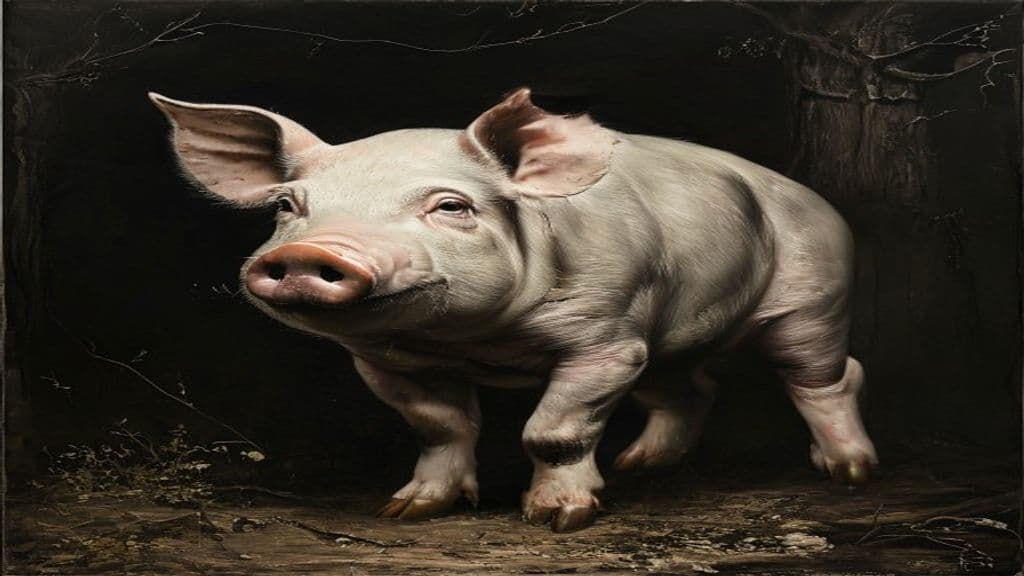
The term arkan sonney is a Manx word that in ordinary speech denotes a hedgehog. In Manx folkloric belief the same phrase was used to label a specific mythic archetype: a beneficent 'fairy animal' that takes the form of a white pig and brings luck to humans. This dual usage — a common name for a familiar creature and a label for a luck‑bringing fairy form — suggests a folk process in which everyday natural creatures and their names are folded into the unseen world of Manx fairylike beings. The supplied accounts do not give a narrative cosmogony, ancestry, or origin myth for the arkan sonney; rather, the figure appears within local belief as an interstitial animal‑spirit tied to everyday encounters and omens on the Isle of Man.
The folkloric arkan sonney is specifically described in the sources as taking the form of a white pig often called the 'lucky piggy.' No further physical details (size, markings beyond whiteness, eyes, voice, or gait) are recorded in the available summaries. Separately, the same Manx phrase refers in ordinary language to a hedgehog, but the fairy animal described in the tradition is consistently given as a white pig rather than a hedgehog in the cited accounts.
The arkan sonney functions primarily as a bearer of good fortune. Merely seeing the creature was regarded as a favourable omen. If someone managed to catch an arkan sonney, tradition recorded in the sources states that they would always find a silver coin in their pocket, indicating a material reward accompanying capture. This beneficence is conditional: holding on to the creature for too long is said to bring bad fortune. The sources do not explain the mechanism by which the omen or the silver coin appears, nor do they define how long an arkan sonney may be retained before luck reverses.
Weaknesses
- conditionHolding on to it for too long will result in bad fortune
Wards
- otherNo specific wards or protections recorded in available sources
Buggane
A large, malevolent supernatural being from Isle of Man folklore, described in tales as ogre- or giant-like and sometimes a shapeshifter. Buggane stories depict it damaging buildings and livestock, attacking people, and appearing in coastal and farm contexts; some tales limit it by sacred or liminal boundaries such as water and hallowed ground.
Moddey Dhoo
A place‑bound phantom black dog from Manx tradition, chiefly associated with Peel Castle (St Patrick’s Isle). Recorded in an 18th‑century account by George Waldron and later collected and expanded by folklorists, the Moddey Dhoo appears at dusk in the castle guardroom and returns to a secret passage at dawn; later local reports extend the motif across the Isle of Man with variant descriptions.
Aristomachus
Aristomachus (Ancient Greek: Ἀριστόμαχος) is a Greek personal name borne by multiple historical and mythological individuals rather than a single supernatural being. Bearers include mythic figures listed in genealogies, two Hellenistic tyrants of Argos, a Crotonian political actor, a writer cited by Pliny on agriculture/domestic economy, a sculptor from the banks of the Strymon, and a Byzantine official in sixth‑century Egypt.
Aristonymus (Aristonymus of Athens)
Aristonymus (Greek: Ἀριστώνυμος) is a classical Greek personal name attested for multiple historical individuals in literary and historical sources. Bearers of the name appear in political, military, familial, and literary contexts across 5th–4th century BCE Greek records and later compilations.
Arizelus
Arizelus (also attested Arizelos, Latinized Arizela) is attested in Greek literary and onomastic sources as a personal name borne by mortal figures. In epic genealogy he is known only as the father (patronym) of the warrior Harpalion; in later literature the name appears as the father of an orator Timarchus. No supernatural attributes are recorded.
Arjasp
Arjasp (Arjāsp) is a legendary Iranian antagonist attested in the Avesta, Middle Persian literature, and the epic Shahnameh. In earlier Zoroastrian hymns he appears as leader of the hostile Xyaona tribe opposed to Vishtaspa/Goshtasp's adoption of Zoroastrianism; in later Pahlavi and epic tradition he is historicized as a Turanian king and military rival who besieges Iranian strongholds and is slain by the hero Esfandiyar.
Arjuna
Arjuna is the central heroic prince of the Pandava brothers in the Sanskrit epic the Mahabharata. Son of Indra and Kunti, he is famed as the preeminent archer, recipient of divine weapons and teachings (notably Krishna's Bhagavad Gita), and a principal human exemplar through whom questions of duty (dharma), ritual kingship, and the human–divine relationship are explored.
Arkaroo
Arkaroo is a primordial ancestral serpent of the Dreaming associated with the northern Flinders Ranges (Ikara/Wilpena Pound) in South Australia. In local creation narratives it drank the waters of Lake Frome, carved valleys by reclining in the mountains, and left waterholes where it rested; the being is commemorated in place-names and rock art at sites such as Arkaroo Rock.
Arke
Arke (Ancient Greek Ἄρκη, Árkē; variant Arce) is a minor Greek messenger-divinity, daughter of Thaumas, who sided with the Titans in the Titanomachy. After the Titans' defeat she was punished by Zeus — her wings were cut off and she was cast into Tartarus — and in some traditions her severed wings were later given to Peleus and Thetis and then to Achilles.
Arkon
Arkon is a fictional extradimensional warlord and ruler (titled Imperion) of the extra-dimensional world Polemachus in Marvel Comics. He is portrayed as a superhuman warrior-leader who travels between his world and Earth (and other planes) pursuing solutions to existential crises and engaging in conquest, alliance, and romantic entanglements with Earth heroes.
Armandine
Armandine is not attested in the supplied sources as a folkloric or supernatural entity. The string 'Armandine' appears only as a modern feminine personal name, a toponym, and as the name of fictional characters in contemporary media.
Armenus
A mortal figure and Argonaut in Greek mythology, participating in the quest for the Golden Fleece. Relatively unknown in the larger mythological narrative. (Note: * Power tier should be changed to Primordial is incorrect; since Armenus is a mortal figure in human mythology. * Add sensory cues: Since there's no physical description available, it could say "None )
Community Record
- [1]Arkan sonney (Wikipedia). Wikipedia. 'Arkan sonney' entry.wiki
- [2]Arkan sonney (Wikidata). Wikidata entry Q2861560.wiki