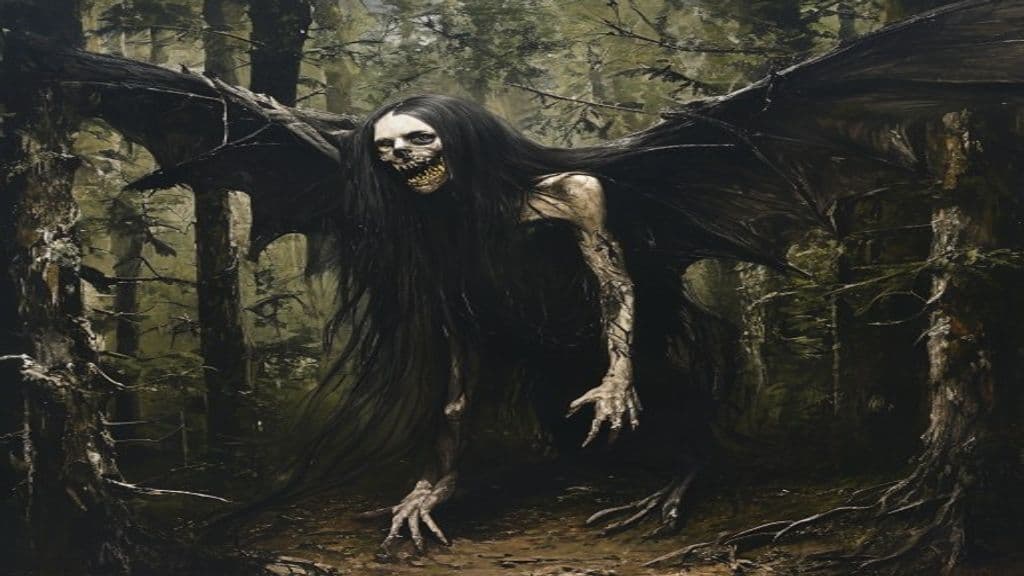
Sources provide no detailed cosmogonic origin or mythic birth narrative for the Asanbosam. In Akan narrative contexts it functions as a territorial forest being: stories frame it as a woodland enforcer that occupies trees and enacts rules of renewal within the forest. The figure also appears in diaspora contexts associated with enslaved Akan in 18th-century Jamaica in the available sources, indicating transmission of the legend outside West Africa but without a detailed origin myth recorded in the cited materials.
Accounts describe the Asanbosam as humanoid but markedly non-human: human-like in general form yet bearing distinct features such as long hair and iron teeth. Sources additionally describe bat-like attributes, including wings reported in one source as capable of reaching up to about 20 feet across. The being is conventionally presented as tree-dwelling, and museum material culture (a mid-20th-century wooden carving in the British Museum collection noted in the literature) attests to a visual tradition representing the creature.
Cited descriptions portray the Asanbosam as a predatory, blood-feeding creature that lurks in trees and ambushes people, often attacking from above. It is repeatedly labeled "vampire-like" in the sources, and narratives say it will take victims off to caves or lairs to suck their blood. The creature is also described as territorial, taking up and defending space in the forest canopy and functioning in stories as an enforcer of forest rules or rules of renewal. At least one source implies nocturnal activity by describing it as lurking in trees at night.
Anansi
The spider trickster god of Akan folklore — cunning, mischievous, and wise. Keeper of stories and teacher of human beings, brought through the slave trade into Caribbean and African-American tradition.
Asase Ya / Asase Afua
Asase Ya (Asase Yaa) or Asase Afua (Asaase Afua) is the Akan personified Earth-deity of fertility, land, truth, peace and the reception of the dead. She appears in a dual-aspect as an aged mother of the dead and as a youthful fertility-bringing woman and is central to agricultural, funerary and truth-rite practices among Akan peoples.
Kwaku Ananse
Kwaku Ananse (Anansi, Ananse) is a central spider-associated trickster and culture-bearing figure from Akan (including Ashanti) folklore of southern Ghana. Presented in oral tale cycles, songs, children’s literature, and modern media, he embodies wisdom, wit, cunning, and mischievousness and functions as a narrative teacher who both questions and ultimately reinforces social norms.
Aryan Brigade
The Aryan Brigade is a fictional group of supervillains in DC Comics, depicted as a paramilitary white‑supremacist cell composed of powered individuals. Introduced in 1994, the Brigade functions in the comics as an organized extremist threat that engages in violent attacks and bioterror plots against the modern fictional world.
Arzhang Div
Arzhang Div (Aržang Dēw; ارژنگ دیو) is presented in Shahnameh manuscript tradition as the chief or commander of the divs of mythic Mazandaran and an antagonist defeated by the hero Rustam during the episode commonly called Rustam's Sixth Feat (part of the Seven Labours). His defeat is treated by commentators as emblematic of the collapse of a demonic ruling order in the epic.
Asag
A monstrous Sumerian demon king whose ugly face made fish flee and plants wither, whose army of stone warriors nearly defeated the god Ninurta before being crushed.
Asakku
A class of Sumerian disease-demons born from the union of heaven and earth, who lodged themselves in people's bodies and caused wasting fevers and convulsions.
Asalluhi
Asalluhi (also Asarluhi, Asarluhe, Asaralimnuna, Asaralim, Asalim, Asarnuna) is a Mesopotamian deity primarily associated with incantations and exorcism. He is described in some sources as a son of the god Enki and is likely identical with an earlier figure called Asar attested from the third millennium BCE.
Asarluhi
Asarluhi (also Asalluhi, Asarluhe, Asaralimnuna, Asaralim, Asalim, Asarnuna) is a Mesopotamian deity primarily associated with incantations and exorcism who commonly operates alongside his father Enki. He is likely identical with an earlier deity attested from the third millennium BCE called Asar (Asaruludu in some modern datasets).
Asase Yaa
Asase Yaa (also Asase Afua, Asaase Yaa, Asaase Afua, Asase Efua, Asaase Aberewa) is the Akan personification of the earth in Ghana and Ivory Coast, regarded as an earth-mother figure associated with fertility, procreation, love, peace, truth, and the dry and lush earth. She is also described in sources as the 'Mother of the Dead' or Mother Earth, occupying a central moral and material place in Akan thought.
Asbolus
Asbolus is a named centaur in ancient Greek myth attested as an augur who read omens from birds and is said to have foresaw the Centaurs' battle at Pirithous's wedding; later traditions report his role in the episode where Pholus opens a communal wine-jug and Asbolus summons other centaurs, an action that precipitates a deadly confrontation in which several figures (Pholus, Chiron, Nessus) die and in some traditions Asbolus himself is struck by Heracles' arrows. In modern usage the name also designates the Centaur-class minor planet 8405 Asbolus, discovered in 1995 and measured by thermal observations.
Ascalabus
Ascalabus is an etiological figure from Greek myth: a son of Misme who, after mocking the thirsty goddess Demeter as she drank a kykeon, is transformed into a gecko (Greek ἀσκάλαβος). The tale appears in accounts tied to Demeter's wanderings searching for Persephone and has a Roman variant in which he is called Stellio.
Community Record
- [1]Asanbosam - Wikipedia. Wikipedia contributors, 'Asanbosam' (Sasabonsam) article, Wikipedia, https://en.wikipedia.org/wiki/Sasabonsamwiki
- [2]Wikidata entry Q720853. Wikidata, Q720853 Asanbosam, http://www.wikidata.org/entity/Q720853other
- [3]Secret Files Sam Peters (archive description). Archive item description, R. G. Mechanics - Secret Files Sam Peters, https://archive.org/details/r.-g.-mechanics-secret-files-sam-petersother
- [4]Secret Files Sam Peters (PC Longplay archive). Archive: PC Longplay 669, Secret Files Sam Peters, https://archive.org/details/PC_Longplay_669_Secret_Files_Sam_Petersother