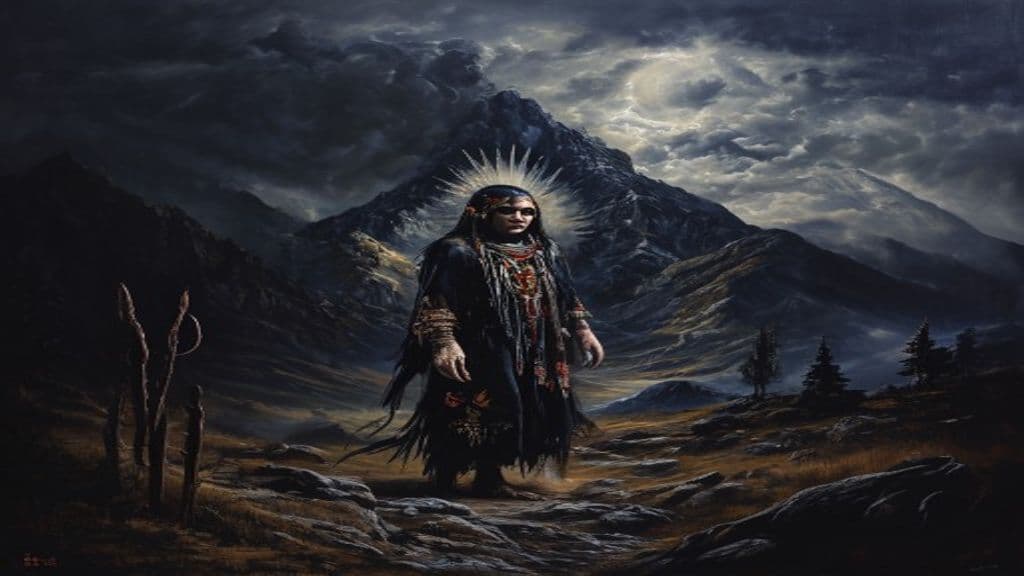
According to Navajo tradition, Asdzá́ą́ Nádleehé created the Navajo people by taking old skin from her body and using mountain soil to create four couples, who are the ancestors of the four original Navajo clans. She is also mentioned as the mother of twins Monster Slayer and Born for Water, indicating a role in the creation myth beyond just shaping the physical world.
No physical description available.
Asdzá́ą́ Nádleehé created the Navajo people and helped shape the world by taking old skin from her body and using mountain soil to create ancestors of the four original Navajo clans. She is also associated with transformation or change, as indicated by her name.
Skin-Walker (Navajo Tradition)
A malevolent entity in Navajo culture that can transform into animals or humans, causing harm to others. (Note: - Power tier should be Greater (powerful regional) instead of Primordial (cosmic). - Remove "A key characteristic" from Abilities and just state the characteristics. - No sensory cues, weaknesses, or )
Ascalaphus (son of Acheron)
Ascalaphus is a mythic underworld attendant in Greek tradition, son of the river-god Acheron and the nymph Orphne, who served as custodian of Hades' orchard. In the Persephone abduction narrative he reports that Persephone ate underworld food, a disclosure that invokes her obligation to return to Hades; later accounts recount his punishment and metamorphosis into an owl.
Ascanius
Ascanius is a legendary Trojan prince in Greco‑Roman mytho-historical tradition, presented as the son of Aeneas and a dynastic founder who links the Trojan past to Italic and Roman genealogies (notably the Julian gens). He appears in literary and historiographical sources as a youthful warrior in Virgil's Aeneid and as a founder-king of Lavinium and Alba Longa in Roman tradition.
Aschanes
Aschanes is attested in medieval and modern sources as a legendary eponymous ancestor associated with Saxon origin tales (not presented as a clearly supernatural being). The name also appears separately in biblical-commentarial material where its status as a personal name or an office is debated.
Aschenbrödel
Aschenbrödel is the German-language name and theatrical/literary manifestation of the Cinderella heroine (Aschenputtel/Cendrillon) found in European fairy‑tale tradition and adapted in ballets, films, recordings, and stage productions. The figure functions as a narrative protagonist — the mistreated but virtuous youth who is eventually recognized and rewarded — rather than a supernatural being.
Asclepigenia
Asclepigenia (Ancient Greek: Ἀσκληπιγένεια; fl. 430–485 AD) was a 5th‑century Neoplatonic philosopher and mystic active in Athens. She is attested as the daughter of Plutarch of Athens and as part of the Athenian philosophical succession; later biographical tradition reports that Proclus studied theurgy under her.
Asclepius
Asclepius is the ancient Greek divine figure and hero of medicine who personifies curing, medical expertise, and sanctuary-based therapeutic practice. Worshipped at major healing centers (notably Epidaurus), he functions as both mythic miracle-worker (including traditions of restoring life) and the patron-model for professional physicians and ritual healing procedures.
Aseatas
Aseatas (Ancient Greek: Ἀσεάτα) is an Arcadian prince in Greek myth, listed among the fifty sons of King Lycaon and traditionally cited as the eponymous founder of the town Asea. Attestations are genealogical and onomastic rather than narrative; no deeds, cult, or descriptive details survive in the provided sources.
Ash (Yuc)
Ash (Tamazight Yuc) is an Amazigh sky god recorded in Egyptian sources and worshipped by Libyan and Tehenu tribes of the Western Desert. In Egyptian texts he is presented as a named deity connected with the vineyards of the western Nile Delta, oases, and as ‘Lord of the Tehenu,’ and is sometimes associated or equated with the god Set.
Asha
Asha (Avestan aṣ̌a / arta), later personified as Asha Vahishta, is the foundational Zoroastrian cosmic and moral principle of truth, right order, and right-working; it functions both as an abstract ontological principle (truth = existence) and as one of the Amesha Spenta, the divine hypostases serving Ahura Mazda.
Ashaqlun
Ashaqlun is recorded in a single source as a Manichean demon — a hostile spiritual being situated within Manichaean dualist cosmology. The available record supplies only the name and classification without further detail on attributes, appearance, or practices.
Ashenafi
Ashenafi is attested in the supplied sources only as an Amharic personal name (Amharic: አሸናፊ). The provided materials contain no evidence that 'Ashenafi' functions as a folk demon, evil spirit, or other supernatural entity in Ethiopian tradition.
Community Record
- [1]