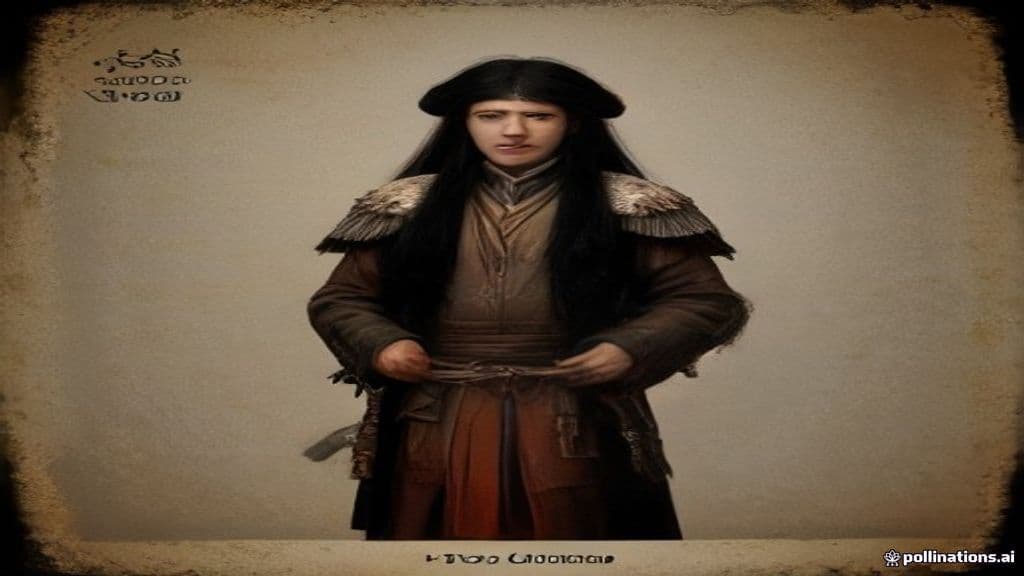
Ashina Helu appears in historical records as a scion of the Ashina house who was appointed shad by Duolu Qaghan in 633, governed constituent tribes (including Chuye, Qarluq, and Nushibi), and later led a bid for supreme authority in the Western Turkic confederation. After initial defeat by Irbis Seguy in 646 he fled to Tang China (648), served as a Tang general stationed at Mohe, and following Emperor Taizong's death (649) pursued independence, setting up his horde (by 651) and appointing his son Ashina Xiyun as crown prince. His reign culminated in defeat by Tang forces under Su Dingfang at the Battle of the Irtysh River (657), flight to Chach, transfer to Tang custody, and eventual pardon and residence in Chang'an until his death.
Primary sources provided contain no physical description of Ashina Helu. Historical summaries and chronicles record his offices, movements, and actions but do not describe his dress, physiognomy, or other physical traits.
As a historical political actor Ashina Helu exercised tribal and military leadership: he governed tribes as shad from 633, raised forces and led raids (recorded raids to Jin Ling and Pulei), received submissions from Duolu and Nushibi chiefs, appointed his son Ashina Xiyun as crown prince with the title Bagatur Yabgu, and commanded the Western Turkic confederation until Tang campaigns under Su Dingfang defeated him. He also operated within Tang patronage, having served as a Tang general after 648, illustrating his capacity to shift between imperial service and independent rule.
Weaknesses
- conditiondependence on tribal support and fractious tribal politics
- conditionvulnerability to Tang military campaigns and frontier diplomacy
- otherinternal rivalry from other Ashina claimants and Tang‑backed rivals (e.g., Zhenzhu Yabgu, Irbis Seguy)
Wards
- otherTang military suppression and creation/support of rival khagans
- otherdiplomatic arrest/transfer by neighboring rulers (example: Chach handing him over to Tang)
Community Record
- [1]Ashina Helu. Wikipedia contributors, 'Ashina Helu', Wikipedia, The Free Encyclopediawiki
- [2]Ishbara Qaghan (Wikidata). Wikidata entry Q192453 (Ishbara Qaghan)wiki
- [3]Su Dingfang. Wikipedia contributors, 'Su Dingfang', Wikipedia, The Free Encyclopediawiki
- [4]Turks & Uygurs (Imperial China Project). Imperial China Project, 'Turks & Uygurs, part 2'other
- [5]Tuqishi / Türgiš (ChinaKnowledge). ChinaKnowledge.de, 'Tuqishi (Türgiš)'other
- [6]duhu (都護) — Protectorate term (ChinaKnowledge). ChinaKnowledge.de, 'duhu (都護)'other
- [7]Tang dynasty — political and military context (Imperial China Project). Imperial China Project, 'Tang Dynasty — Political, Social, Cultural, Historical Analysis'other