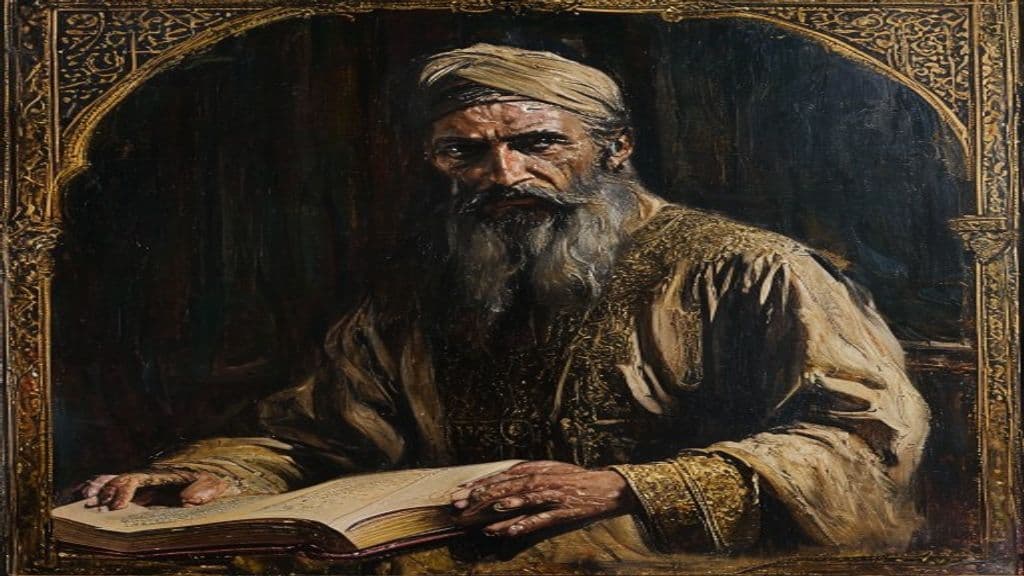
Asif appears in the Qur'anic account of Solomon and the Queen of Sheba (Surah 27). In that narrative Solomon's council asks who can bring the Queen's throne; an Ifrit of the jinn offers to bring it quickly, and then "he who possessed knowledge of the Book" (identified in tafsir as Asif, Sulayman's scribe) says he can bring it before Solomon's glance returns and effects the feat. Later exegetical tradition elaborates that Asif possessed knowledge of a letter/element of the "Greatest Name of Allah," and that by means of that knowledge (and after a brief act of purification and prayer) he contracted the distance so that the throne appeared before Solomon in a moment.
Classical scriptural and tafsir sources identify Asif by social role — the scribe or vizier of Solomon — but provide no physical description. The tradition frames him as an authoritative, knowledgeable court official (a believer and scribe) rather than as a distinct visually-marked supernatural form; no details of dress, age, or bodily features are given in the cited materials.
The core attested ability in the sources is the single Qur'anic miracle of bringing the Queen of Sheba's throne to Solomon "in the twinkling of an eye" (Qur'an 27:40). Exegetical accounts (e.g., Ibn Kathir) describe Asif as a truthful believer who "knew the Greatest Name of Allah," and they report that he performed ablution and prayed immediately before effecting the transport. Twelver Shia commentary cited in the notes states Asif knew one letter of a seventy-three-letter Greatest Name and used that letter to contract the land between him and the throne; the sources present this as a unique, God-granted efficacy tied to scriptural/esoteric knowledge rather than as a generic innate power enabling unlimited teleportation.
Ashvins
The Aśvin (Ashvins) are Vedic twin divine horsemen invoked in the Rigveda as youthful rescuers and restorers who travel in a swift chariot; they are closely associated with dawn/twilight, healing, and medicine and are repeatedly called upon to save, restore, or bring home those in peril.
Asháninka
The Asháninka are an Arawakan-speaking Indigenous people of the central Amazon rainforests of Peru and parts of Acre in Brazil, organized in dispersed small residential groups with deep ancestral ties to riverine and interfluvial forest territories and a subsistence economy based on swidden agriculture, hunting, fishing and gathering.
Asia (Asiê / Ἀσία)
Asia (Asiê / Ἀσία) is an Oceanid — a daughter of the primordial Titans Oceanus and Tethys — attested in Greek mythic name-lists and modern summaries as an eponymous nymph associated with Lydia/Anatolia (West Asia). Sources identify her as an Oceanid and regional eponym; one modern compilation also presents a later tradition naming her as the wife of the Titan Prometheus.
Asian dragon (long / loong)
The Chinese or Asian dragon (Chinese: long or loong) is a legendary creature in Chinese mythology, folklore, and culture, widely represented as an auspicious, potent being most commonly associated with control over water and weather. It appears across myth, art, and modern public performance rather than as a single folkloric apparition with standardized ritual responses.
Asiaq
Asiaq is a Greenlandic Inuit weather-controlling supernatural figure described in sources as a weather goddess (and more rarely as a god) who is invoked by ritual specialists (Angakoq) to influence wind, snow, rain and the timing/quantity of snow and ice melt. In Greenlandic accounts she is called the “mother of weather” and is petitioned pragmatically to secure favorable seasonal conditions.
Asiatic black bear
The Asiatic black bear (Ursus thibetanus), also called the Asian black bear, moon bear, or white-chested bear, is a medium-sized, largely arboreal bear species native to much of Asia. Sources present it as a biological species of conservation concern, listed as Vulnerable on the IUCN Red List and threatened by habitat loss and poaching for body parts used in traditional medicine.
Asiman
A nocturnal, shape‑changing predatory luminous spirit known from West African accounts; presented in sources as the Dahomey counterpart to the Ashanti obayifo, capable of inhabiting humans by day and manifesting as phosphorescent lights or a flying ball of light by night.
Asira
Asira is described in the available source material as a local god worshipped in pre-Islamic northern Arabia, specifically revered at the oasis-town of Taima (Tayma). The deity is noted as having been strongly influenced by Egyptian culture and is only minimally attested in the historical record (mentioned only by name by the Babylonian king Nabonidus).
Asius
Asius (Ancient Greek: Asios) is a personal name borne by several mortal leaders allied with Troy in Greek epic and mythographic tradition. The figures called Asius appear in leader-lists, genealogies, and battle narratives of the Trojan War cycle rather than as a distinct supernatural entity.
Asiya bint Muzāḥim (Asiya)
Asiya is the Qur'anic figure presented as the wife of the Pharaoh in the era of Moses who secretly embraced monotheism, adopted and preserved the infant Moses, and is venerated in Islamic tradition as an exemplary righteous woman promised a house in Paradise for her faith and steadfastness.
Ask and Embla
In Norse myth Ask (Askr) and Embla (Embla) are the first human man and woman, fashioned from wood/trees by the gods at the beginning of the cosmos and endowed with the gifts that make them human; they serve as the progenitors of humankind in the Norse cosmological narrative.
Askafroa
A female tutelary spirit identified as the localized soul or guardian of an individual ash tree in southern Swedish folk belief (notably Scania). Traditionally propitiated annually on Ash Wednesday to prevent illness or damage that was believed to follow injury to the tree.
Community Record
- [1]Asif ibn Barkhiya — Wikipedia. Wikipedia entry 'Asif ibn Barkhiya' as cited in research noteswiki
- [2]Wikidata: Asfi bin Barkhiya. Wikidata item Q4806937 as cited in research notesother
- [3]Qur'an 27:39-40 (account of Solomon and the Queen of Sheba). Qur'an 27:39–40 (quoted in research notes)literary
- [4]Ibn Kathir — Tafsir excerpt (on Asif). Ibn Kathir (tafsir) as cited in research notes: identifies Asif as Sulayman's scribe and reports he "performed ablution and prayed" and "knew the Greatest Name of Allah."academic
- [5]Kitab al-Kafi — Twelver Shia commentary (as cited). Kitab al-Kafi citation as reported in research notes: states the Greatest Name has seventy-three letters and that Asif knew one letter which he used to contract the land to bring the throne before Solomon.academic