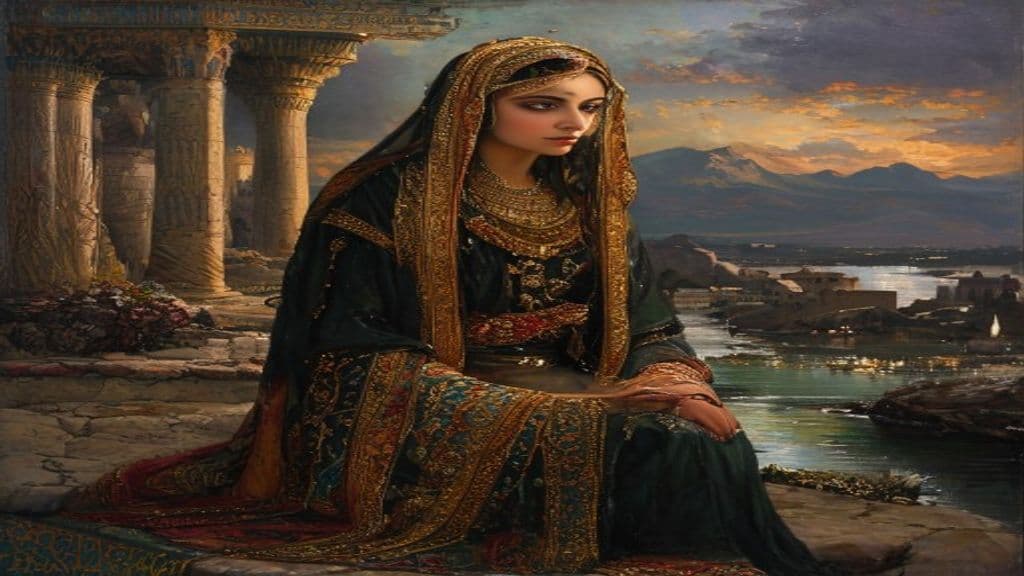
In the Qur'anic narrative and subsequent Islamic tradition, Asiya appears as the royal wife of the Pharaoh during the time of Moses (Musa). She discovers the infant Moses in a crate on the Nile, intervenes to spare his life, and arranges for his upbringing. Having privately accepted the monotheism preached by Moses, she worshipped God in secret within the hostile, idolatrous environment of Pharaoh's court. When confronted over the torture of a believer, she declared her faith and, according to Islamic tradition, was tortured to death by the Pharaoh for her refusal to renounce her belief. Medieval exegetical traditions also record later, secondary claims about her (for example, al-Tha'labi's report that the continent Asia was named after her), but the core origin narrative is scriptural and exegetical, rooted in Qur'anic passages (e.g., the exemplar passage about Pharaoh's wife) and hadith that cite her as among the most perfect of women.
Classical Qur'anic and hadith sources as summarized in the provided materials do not supply a physical description of Asiya (no details of clothing, stature, or coloration). Descriptions in the sources emphasize her royal status as the wife of Pharaoh, her role within the royal household and court, and her moral demeanor — her protective, maternal action toward the found infant Moses, her hidden private worship, and later public declaration of faith under persecution. Thus portrayals centre on status, actions, and spiritual character rather than on bodily or sartorial detail.
No supernatural powers are attributed to Asiya in the supplied sources. Her 'abilities' are moral and narrative: she rescues and adopts the infant Moses (or ensures his upbringing), seeks and arranges a wet nurse and hospitality for him, practices secret monotheistic worship within an idolatrous household, offers a supplication recorded in the Qur'an asking God for a house in Paradise, and publicly professes faith in the face of torture. Her significance in the tradition is as an exemplary believer whose steadfast faith is promised eschatological reward; the Qur'anic promise of a house in Paradise is presented as divine recompense rather than an innate supernatural faculty.
Abraham
Abraham (originally Abram) is the foundational patriarchal ancestor in the Hebrew Bible whose life establishes a covenantal relationship between his family/people and God. He functions as an exemplar of faith, the progenitor of promised descendants, and a narrative anchor for claims of land, blessing, and communal identity in later religious traditions.
Abraham (Ibrāhīm) in Islam
Ibrāhīm (Abraham) in Islam is a human prophet and messenger chosen by God, a paradigm of pure monotheism (hanīf), patriarchal ancestor to later peoples and prophets, and traditionally regarded as having helped establish the Kaʿbah with his son Ismāʿīl. He is called Khalīl Allāh ('Friend of God') and is central to rites commemorated in Hajj and Eid al‑Adha.
Adam (ʾĀdam)
In Islamic theology Adam (Arabic: آدم, ʾĀdam) is presented as the first human being and the first prophet (nabī), created by God from earth/clay, granted life by God's spirit, placed in a paradisal Garden, taught knowledge (the "Names"), tested by divine command, tempted by Iblīs, and ultimately sent to live and die on Earth while remaining eligible for repentance and forgiveness.
Allah
Allah is the Arabic-language term for the singular monotheistic God of the Abrahamic tradition as used in Islamic theology and by Arabic-speaking Jews and Christians. Linguistically related to other West Semitic divine names, the term in Islamic usage functions as God's unique proper name (Lafẓ al-Jalālah) and denotes the transcendent creator and sovereign of the universe.
Al‑Yasa (Elisha)
Al‑Yasa (Elisha) is a prophetic figure attested in Abrahamic scriptural traditions. In the Hebrew Bible he is described as an Israelite prophet and 'wonder‑worker'; later traditions in Christianity and Islam also recognize him among the line of prophets.
Angels (Malāk) in Islam
Heavenly beings in Islamic doctrine created from light, part of the unseen (ghayb) and the divine order, who obey God and perform functions such as conveying revelation, recording deeds, and executing divine commands. Belief in angels is one of the six articles of faith in Islam and they occupy roles across cosmology, eschatology, and devotional teaching.
Archangel
An archangel is a ranked heavenly messenger in Abrahamic and related religious literatures, understood in many traditions as a high‑level angelic agent charged with carrying out divine missions. The term and ranked office are framed by Greek etymology (archángelos, 'chief messenger') and by medieval Christian angelology (notably Pseudo‑Dionysius), while named figures such as Michael, Gabriel, and Raphael appear across Jewish, Christian, and Islamic texts and liturgies.
Azrael
Azrael is the canonical angel of death in Islamic tradition and appears earlier in apocryphal Christian literature; portrayed as a high‑ranking, God‑ordained psychopomp who removes and transports souls, keeps a register of human fates, and acts only under divine command. In some extra‑Quranic and exegetical accounts he is depicted with vast, awe‑inspiring physical attributes and in a few apocryphal Christian texts he is associated with punitive afterlife functions.
Bearers of the Throne (ḥamlat al‑arsh)
The ḥamlat al‑arsh are a class of angels in Islamic textual tradition whose primary role is to carry or support God’s Throne (al‑ʿArsh). Descriptions vary across transmissions, emphasizing their cosmic scale, proximity to the divine Throne, and symbolic features drawn from a range of hadith and exegetical reports.
Bibi Seshanbe
Persian holy angel associated with saving and curing people, particularly the poor and desperate. (Note: - The power_tier should be Greater, as Bibi Seshanbe is described as a "holy angel" which typically suggests deity-level abilities. - The summary mentions she is associated with saving and curing peop)
Bonga/Bong
Mythological figure from Bengali mythology considered the progenitor of the Bengalis, with conflicting accounts in Hindu and Muslim literature. (Note: 1. Power tier: Primordial is likely an overestimation given the conflicting descriptions and lack of clear abilities. 2. Appearance: Should be stated as "No physical description provided" instead of ")
Cherub
In Abrahamic religious literatures a cherub (Hebrew kərūḇ, pl. kərūḇīm; English cherub/cherubim) is a class of exalted celestial being associated with the divine presence, guardianship of sacred space, and service near God. Descriptions range from the composite, winged hybrid creatures of prophetic visions and Near Eastern art to later Western artistic renderings as chubby winged putti; their rank and appearance vary across Jewish, Christian, and Islamic traditions.
Community Record
- [1]Asiya. Wikipedia entry 'Asiya' (summary of Qur'anic narrative, hadith reference, and exegetical traditions)wiki
- [2]Wikidata: Asiya. Wikidata item for Asiya bint Muzahimother
- [3]Are Muslims permitted to name their daughter Asija (Asiya)?. Islam.StackExchange question regarding contemporary naming practice and permissibility (used as evidence of naming/memory practice)other
- [4]Asiya: The Wife of Pharaoh (Answering Islam / injil.de mirrors). Popular apologetic/exegetical discussion of the Qur'anic figure 'Asiya, the wife of Pharaoh'other
- [5]Al-Tha'labi (reported exegetical claim). Wikipedia summary noting medieval commentator al-Tha'labi's report that the continent Asia was named after Asiya (marked as a secondary exegetical/folkloric claim)wiki