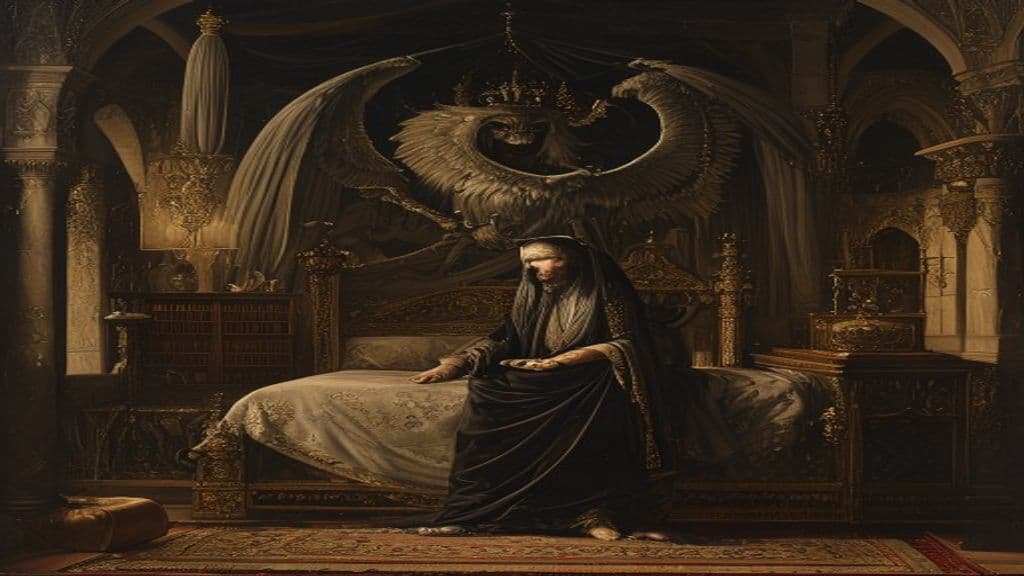
The figure appears in multiple Near Eastern textual traditions rather than a single origin tale. In Jewish and Christian deuterocanonical literature he is attested as Ashmedai/Asmodeus (Hebrew ʾAšmədāy; Greek Asmodaios) and functions as a named princely spirit; later Islamic legend identifies him with Sakhr, a king of divs/ifrits banished into a rock by Solomon. Some scholars have proposed that the name reflects Iranian influence, linking it to an Avestan compound *aēšma-daēva ('aēšma' = wrath, 'daēva' = demon), but the etymological route is contested in the sources (scholarly proposals of Iranian influence are reported alongside cautions about direct phonological derivation).
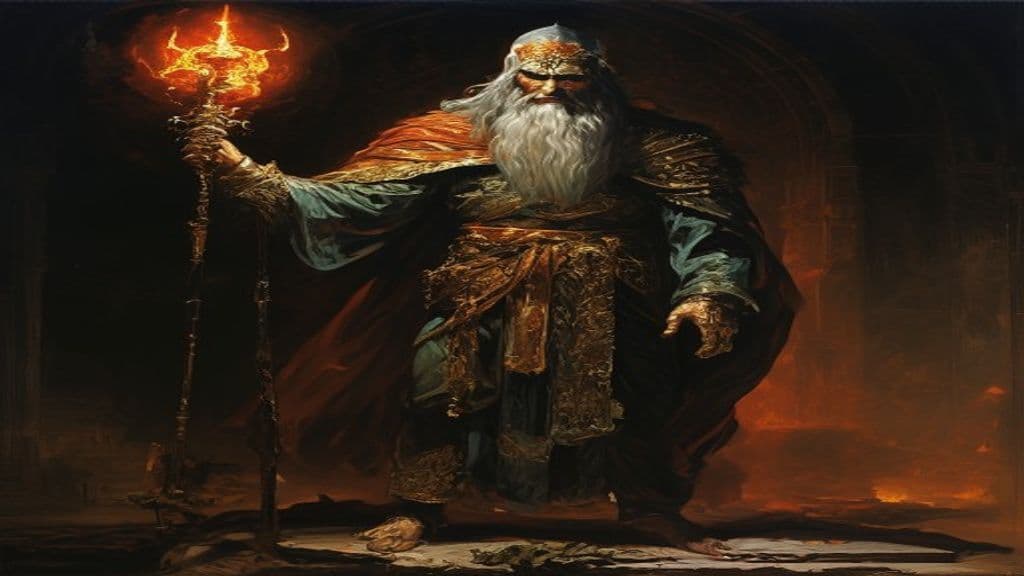
Traditional texts summarized in the provided sources give little consistent bodily description. Rather than a stable visible form, Asmodeus is presented as an active spirit‑king (described in rabbinic stories as 'king of the shedim' and in Islamic legend as a div/ifrit king called Sakhr). Narrative episodes (Book of Tobit, Testament of Solomon, Talmudic tales) treat him as a spirit who interacts with the material world—able to be affected by fumigation and bound or imprisoned—without prescribing a single canonical physical morphology. Later modern popular culture supplies varied visual portrayals, but these are later appropriations not attested in the traditional texts summarized here.
Across the traditions cited, Asmodeus is attributed with agency to interfere fatally in human intimate life (Book of Tobit: slaying seven successive husbands on their wedding nights), with obsessive erotic desire in rabbinic tales (Talmudic stories centering on Bathsheba and Solomon's wives), and with prodigious magical or physical power in Solomon legends (e.g., throwing or displacing Solomon, assuming his place for a time in some accounts). He can be compelled to reveal information (Testament of Solomon) and can be driven away, bound, or imprisoned through ritual fumigation and by angelic or kingly authority (Raphael in Tobit; Solomon's binding or banishment in other accounts).
Weaknesses
- substanceheart and liver of a fish (Tobit: fish heart and liver burned on hot coals)
- substanceAssyrian sheatfish liver/gall mixed with white storax (Testament of Solomon recension)
- ritualangelic binding/banishment (e.g., Raphael binds him; Solomon banishes him into a rock in Islamic legend)
Wards
- ritualfumigation with fish viscera
- ritualangelic invocation/intervention
Shedim
In Jewish tradition, Shedim are spirits associated with foreign deities and idolatrous worship, embodying a theological context where monotheistic devotion is threatened by other divine entities. (Note: 1. Factual claim "Primordial" power tier should be adjusted to "Ancient", as Shedim are described as tied to foreign deities and do not appear to possess cosmic-level powers. 2. Remove reference to "m)
Ifrit
One of the most powerful classes of jinn in Islamic and pre-Islamic Arab tradition — a fire-born being of immense strength and cunning, capable of great works of engineering and terrible violence.
Lilith
Lilith is a feminine night‑spirit in Jewish mythic, magical, and folkloric traditions associated with harmful nocturnal activity, especially threats to sleeping people and infants. The figure appears both as a class of night‑spirits (lilit/lilītu) in Near Eastern demonologies and as an individualized dangerous woman in later medieval Jewish narratives and amulets.
Aeshma
Aeshma is the Zoroastrian hypostasis of wrath — a fiendish being who personifies rage and functions as an ontological opponent to Ahuric principles and ritual discipline. In scripture and later tradition he distracts worship, foments violence and drunkenness, can be driven off by prayer or by divine agents such as Sraosha and Mithra, and will be overthrown or flee at the final renovation.
Alukah
In Jewish tradition, Alukah is a blood-lusting monster or vampire described in the Hebrew Bible's Proverbs 30:15. (Note: 1. Power tier should be Minor Spirit (or possibly Lesser) since it feeds on animals and doesn't match the Primordial description. 2. Abilities don't accurately reflect "blood-lusting monster" or vampi)
Ananias son of Nedebeus
Ananias son of Nedebeus (Hebrew: חנניה בן נדבאי, Ḥananyá ben Nadváy) is presented in Jewish and early Christian sources as the historical high priest of Jerusalem who served c. 47–58 CE. He appears in the Acts of the Apostles as the presiding official at parts of the legal proceedings against Paul and is discussed in later historical commentary (including Josephus under the variant 'Ananias ben Nebedeus').
Angel of the Presence
A high-ranking heavenly attendant described in Hebrew and Second Temple literature as one who "stands in the presence" of God and acts on God's behalf toward Israel. Sources treat the figure either as an elite created angelic office (one of the attendants who enter before the Lord) or, alternately, as a scriptural idiom referring to God's own saving presence.
Broxa
A nocturnal bird entity in Jewish folklore that sucks milk from goats and human blood at night. (Note: - Power tier: Greater (broxa's sucking of human blood suggests a higher power level than Minor Spirit) - Weaknesses: not specified in source material - Wards: not specified in source material)
Hashmal
In the supplied Jewish textual materials, Hashmal (Hebrew חַשְׁמַל; pl. Hashmallim) appears both as a luminous element in Ezekiel's prophetic theophany and as the name of an angelic rank in later Jewish angelology, described in secondary sources as administrative officers of Heaven.
Ishim
Ishim is attested in the supplied sources solely as a label for a rank or class of angels within Jewish angelic hierarchies. The provided material contains no theological, narrative, descriptive, or ritual detail about this rank beyond that classificatory identification.
Aslan
Aslan is the singular, talking lion figure at the center of C. S. Lewis's The Chronicles of Narnia, functioning as creator, king, judge, savior, and moral authority within that fictional cosmology. The name also appears in unrelated contexts (personal names, a lion-like alien in Traveller RPG) but those are distinct referents.
Aslaug
Aslaug (Old Norse: Áslaug), also called Aslög or by the byname Kráka ("Crow"), is a legendary woman of Old Norse saga tradition, presented in medieval narratives (notably the Tale/Saga of Ragnar Lodbrok and the Völsunga material) as a noble-born figure raised in concealment and later married to the hero Ragnar Lodbrok.
Asmodai
Asmodai (variants: Asmodeus, Asmodaeus, Ashmedai) is a named, kingly malign spirit attested in late-antique and medieval Judaeo-Christian narrative traditions — most prominently the deuterocanonical Book of Tobit and legends about Solomon — where he functions as a leading hostile spirit who troubles humans.
Asopis
Asopis is the name borne by two distinct women in ancient Greek genealogical traditions: (1) a naiad listed among the daughters of the river-god Asopus and Metope, and (2) a Thespian princess, one of the fifty daughters of King Thespius, who bore Heracles a son named Mentor. The name is explicitly glossed as 'daughter of Asopus' in the cited sources, marking it primarily as a patronymic/eponymic identifier within Greek mythic genealogies.
Asopus
Asopus is a Greek river-eponym: both the name of several rivers and of mythic personages identified with those rivers. Traditions alternately present Asopus as a divine river-god (often as a child of Oceanus and Tethys, or in variant genealogies a son of Poseidon or Zeus), and as a local founding king; he functions as progenitor of many eponymous daughters and as an agent in myths explaining springs, city origins, and river characteristics.
Aspalis
Aspalis is a local heroine and cultic eponym from Melite (Melitaea) in Phthia, Thessaly. According to the tradition preserved via Antoninus Liberalis (summarized in modern compendia), she hanged herself to avoid enforced concubinage under a tyrant; her body vanished and was said to have been replaced by a wooden statue that became a cult image of Artemis, giving rise to an annual ritual in the city.
Community Record
- [1]Asmodeus - Wikipedia. Wikipedia, article 'Asmodeus' (summary items on name, etymology, Talmudic stories, Islamic identification as Sakhr, and relationship to shedim/divs).wiki
- [2]Book of Tobit (summary as provided). Summary excerpt provided in research notes: Tobit narrative describing Asmodeus slaying seven husbands, Tobias using fish heart and liver on red‑hot cinders, and Raphael binding the demon (Book of Tobit summary).literary
- [3]Testament of Solomon (summary as provided). Summary excerpt provided in research notes: Testament of Solomon recounting Solomon's interrogation of Asmodeus, prophecy about Solomon's realm, and fumigation recipe involving Assyrian sheatfish viscera and white storax.literary