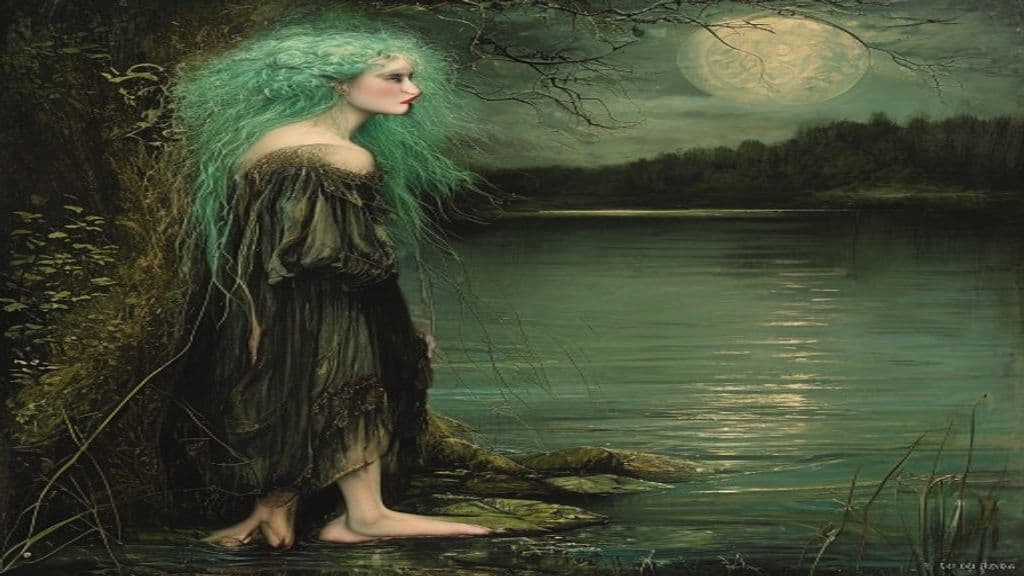
The clearest early appearances of the asrai in the provided materials are literary. The figure first appears in print in Robert Williams Buchanan's poetry: the poem "The Asrai" (first published April 1872) and a related narrative poem, "The Changeling" (1875), in which a male asrai becomes a changeling seeking a human soul (Buchanan 1872; Buchanan 1875). Late 19th- and 20th-century folklorists and storytellers, most notably Ruth Tongue, later presented material about beings called "asrai" in Cheshire, Shropshire and the Welsh border; modern summaries (e.g., Wikipedia) and retellings (e.g., Nancy Arrowsmith, Rosalind Kerven) draw on both Buchanan and Tongue. Scholars and editors cited in the sources caution that Tongue's collecting practices and the early literary origins mean the asrai's provenance is ambiguous: it may be chiefly a modern myth produced through interaction between Buchanan's fiction and later folklore-style retellings rather than a clearly attested longstanding oral tradition (Wikipedia; source commentary on Buchanan and Tongue).
Descriptions vary by source. In Buchanan's poems the asrai are depicted as pale, gentle, feminine lake-dwellers (Buchanan 1872). Ruth Tongue's collected versions describe them as very beautiful, with green hair, webbed feet, and great longevity, and sometimes aging only when exposed to moonlight (Tongue, as cited in later retellings). Nancy Arrowsmith's reprinting of Tongue-style material gives a small stature of about 2–4 ft (0.61–1.22 m). In at least one retelling recorded by Rosalind Kerven an asrai is given a fishtail (mermaid-like) rather than legs; other accounts retain legs with webbing. The corpus shows disagreement on size and whether the lower body is a fishtail or webbed feet (Buchanan; Tongue; Arrowsmith; Kerven).
Reported abilities and behaviors are inconsistent across sources and often derive from narrative episodes. Buchanan portrays asrai as long-lived—"older than humanity" in his poetry—and as fearing light; his poem "The Changeling" includes a male asrai entering a human body, suggesting changeling-like inhabitation in that literary context (Buchanan 1872; Buchanan 1875). Tongue's versions and later retellings emphasize extreme longevity (living for hundreds of years), a habit of surfacing "once each century to bathe in the moonlight," and a vulnerability to sunlight or prolonged exposure to daylight (Tongue; later retellings). Narrative motifs include timidity and shyness, vulnerability to human vulgarity (which can frighten them away), the ability to lure humans with promises of treasure (Kerven), and a damaging cold wet touch when captured (a captured asrai's hands burned a fisherman's skin in Tongue's capture story). These elements are presented as variant and sometimes contradictory traits rather than a single coherent powerset.
Weaknesses
- conditionExposure to sunlight / daylight (lethal or dissolving effect in narrative accounts)
- conditionAversion to coarse or vulgar human behavior (behavioral deterrent in stories)
Wards
- conditionSunlight or exposure to daylight (narrative method of causing an asrai to dissolve; not attested as a folk protective ritual)
- otherCoarse or vulgar behavior (narrative deterrent; attested in a tale where vulgarity frightens the creature away)
Asmodai
Asmodai (variants: Asmodeus, Asmodaeus, Ashmedai) is a named, kingly malign spirit attested in late-antique and medieval Judaeo-Christian narrative traditions — most prominently the deuterocanonical Book of Tobit and legends about Solomon — where he functions as a leading hostile spirit who troubles humans.
Asmodeus
Asmodeus (Heb. Ashmedai/Ashmeday; Gr. Asmodaios; Arabic Sakhr in some accounts) is a named malignant spirit appearing in Near Eastern Jewish, Christian deuterocanonical, and later Islamic storytelling. Traditions portray him as a princely or kingly figure among malevolent spirits who intervenes in human affairs—notably hostile to marriages and in contest with King Solomon—and who can be driven off or bound by ritual fumigation and angelic agency.
Asopis
Asopis is the name borne by two distinct women in ancient Greek genealogical traditions: (1) a naiad listed among the daughters of the river-god Asopus and Metope, and (2) a Thespian princess, one of the fifty daughters of King Thespius, who bore Heracles a son named Mentor. The name is explicitly glossed as 'daughter of Asopus' in the cited sources, marking it primarily as a patronymic/eponymic identifier within Greek mythic genealogies.
Asopus
Asopus is a Greek river-eponym: both the name of several rivers and of mythic personages identified with those rivers. Traditions alternately present Asopus as a divine river-god (often as a child of Oceanus and Tethys, or in variant genealogies a son of Poseidon or Zeus), and as a local founding king; he functions as progenitor of many eponymous daughters and as an agent in myths explaining springs, city origins, and river characteristics.
Aspalis
Aspalis is a local heroine and cultic eponym from Melite (Melitaea) in Phthia, Thessaly. According to the tradition preserved via Antoninus Liberalis (summarized in modern compendia), she hanged herself to avoid enforced concubinage under a tyrant; her body vanished and was said to have been replaced by a wooden statue that became a cult image of Artemis, giving rise to an annual ritual in the city.
Aspidochelone
A massive sea creature in Arabian tradition that lures sailors to their deaths with its 'island' appearance, emitting a sweet smell to attract fish. (Note: 1. Power tier should be Primordial (as it's described as a "giant sea monster" and its appearance is often mistaken for an island). 2. No source material mentions any connection to the symbolism of Sa)
Assaracus
Assaracus is a mytho-historical king of Dardania in ancient Greek genealogical tradition, presented as a mortal ancestor within the royal house that connects to the foundation and lineage of Troy (Ilium). He is primarily attested as a dynastic progenitor—son of Tros, brother of Ilus, and father of Capys—and is not described in the supplied sources as a supernatural being.
Assessors of Maat
A collective of forty-two minor divine figures in ancient Egyptian funerary religion who act as judicial assessors in the post-mortem tribunal of Osiris. They are each associated with one of the 'Negative Confessions' in Chapter 125 of the Book of the Dead and serve to determine the deceased's conformity to Maat (truth, justice, and cosmic order).
Astacia
Astacia is attested in a brief encyclopedic note as a nymph in Greek mythology after whom, according to that note and a referenced Pauly‑Wissowa entry, Dionysus named a city. Attestation in the supplied materials is extremely limited: a one-line Wikipedia entry and a bibliographic pointer to Paulys Realencyclopädie der classischen Altertumswissenschaft (RE).
Astarion Ancunín
Astarion Ancunín is a fictional player-controllable character from Larian Studios' Baldur's Gate 3 (2023). Presented as a High Elf rogue who was infected by an Illithid tadpole and revealed to be a vampire spawn, he functions in-game as a companion/protagonist with a personal quest concerning his former master, Cazador Szarr.
Astaroth
Astaroth is a named adversarial spirit in Christian demonological literature, commonly catalogued as a high-ranking infernal officer (described in sources as a 'Great Duke' or 'Grand Duke' of Hell). The figure represents the Christian polemical reception of ancient Near Eastern goddess-names (Astarte/Ashtoreth) recast within narratives and demonological lists and appears in medieval legendary episodes as well as later occult imagery and modern popular culture.
Astarte
Astarte (Ancient Northwest Semitic ʿAṯtart; Hellenized Ἀστάρτη) is a major Bronze–Iron Age Levantine goddess worshipped in Canaanite and Phoenician contexts and widely syncretized across the ancient Mediterranean. Sources portray her with martial, erotic, and civic associations and attest organized cultic worship (temples, shrines, coin iconography) rather than folkloric anti‑spirit traditions.
Community Record
- [1]Asrai — Wikipedia. Wikipedia contributors, 'Asrai,' Wikipedia, https://en.wikipedia.org/wiki/Asrai (summary of literary and folkloric material including Buchanan and Ruth Tongue; accessed in provided research notes)wiki
- [2]Robert Williams Buchanan, 'The Asrai' (1872) and 'The Changeling' (1875). Buchanan, Robert Williams. 'The Asrai' (first published April 1872) and 'The Changeling' (1875). Cited in source material as earliest clear literary appearances describing asrai as pale, gentle, older than humanity, fearing light, and involving a changeling motif.literary
- [3]Ruth Tongue (collected material as summarized in later retellings). Ruth Tongue (as presented in later retellings and summaries): accounts describing asrai as timid, very beautiful, green-haired, web-footed, long-lived, surfacing once per century to bathe in moonlight, and perishing if exposed too long to the sun; capture story of melting away. Tongue's reliability is questioned in the sources.folk
- [4]Nancy Arrowsmith (reprint of Tongue-style material). Arrowsmith (reprinting Tongue-style material): notes asrai are always female and small, about 2–4 ft (0.61–1.22 m) tall, as cited in the provided research notes.folk
- [5]Rosalind Kerven retelling. Rosalind Kerven retelling (as cited in research notes): records an asrai with a fishtail attempting to lure a man with promises of gold and jewels into the lake; notes that similar tales had been told of a Shropshire mermaid before the term asrai was applied.folk
- [6]Miscellaneous archive mentions (band name, incidental OCR). Archive instances included in the provided materials (one CIA document and one music archive listing) that mention the string 'asrai' but contain no folkloric content; cited in research notes to indicate presence of the term in unrelated records.other