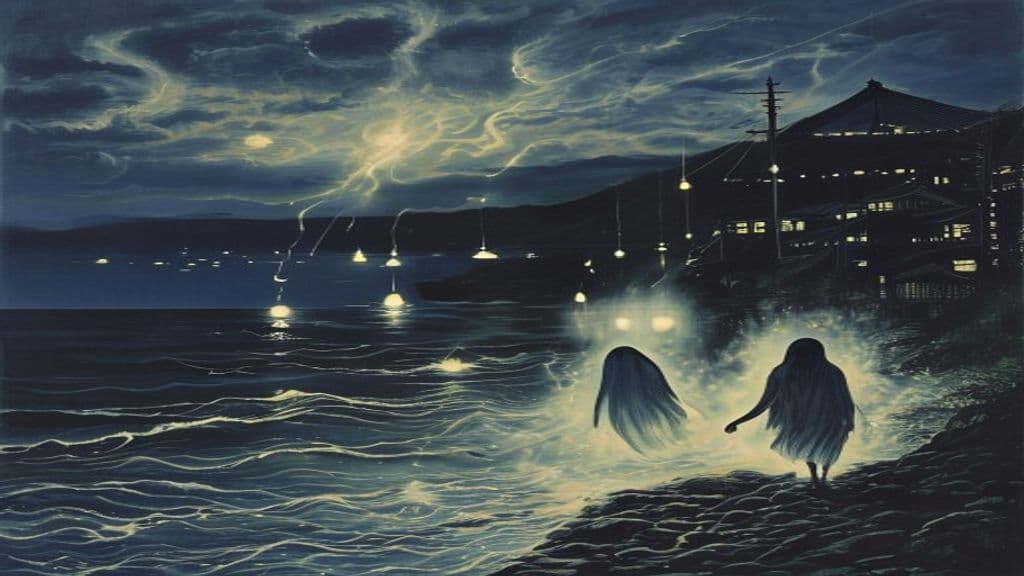
The sources treat ayakashi not as a single origin narrative but as a folkloric category: a collective name for uncanny phenomena seen above water. Regional accounts link some ayakashi to the vengeful spirits of those who died at sea (western Japan) and other accounts present ayakashi as luminous or animal-like phenomena; in Edo-period anecdote collections they appear as apparitional human figures. Scholarly and folkloric commentary frames ayakashi as part of coastal yōkai/kaidan traditions rather than a unique mythical progenitor.
Descriptions vary by region and source. In Nagasaki and coastal reports ayakashi appear as atmospheric ghost lights or 'mountains' of light that can block a shore-path; on Tsushima Island they are described as evening phenomena 'like a child walking in the middle of a fire.' Sekien Toriyama's Konjaku Hyakki Shūi illustrates ayakashi as a large sea snake (possibly conflated with an ikuchi). An Edo-period anecdote (Kaidanoi no Tsue) records an ayakashi taking the form of a 'beautiful woman' who approaches boats. Folk usage also applies the term to natural occurrences such as a sharksucker adhering to a hull.
Accounts attribute to ayakashi a range of behaviors rather than a single power: luminous ayakashi can obstruct travel by appearing as mountains of light; some regional traditions (western Japan) regard ayakashi as vengeful sea-spirits attempting to capture additional victims; in an Edo-period tale an ayakashi in human guise is said to have bitten a ship's hull. Some sources note folk conflation with real marine impediments (e.g., sharksuckers) that can immobilize boats.
Weaknesses
- conditionConfrontation or deliberate contact (attested anecdote: 'disappears if one does not avoid the mountain and tries to bump into it intently')
- otherPhysical force from boatmen (attested anecdote: driven off by striking with an oar)
Wards
- otherStriking/repelling action (boatmen drove an ayakashi away by striking it with an oar)
- conditionDeliberate approach/contact (coastal belief that a 'mountain' of light disappears if one deliberately bumps into it)
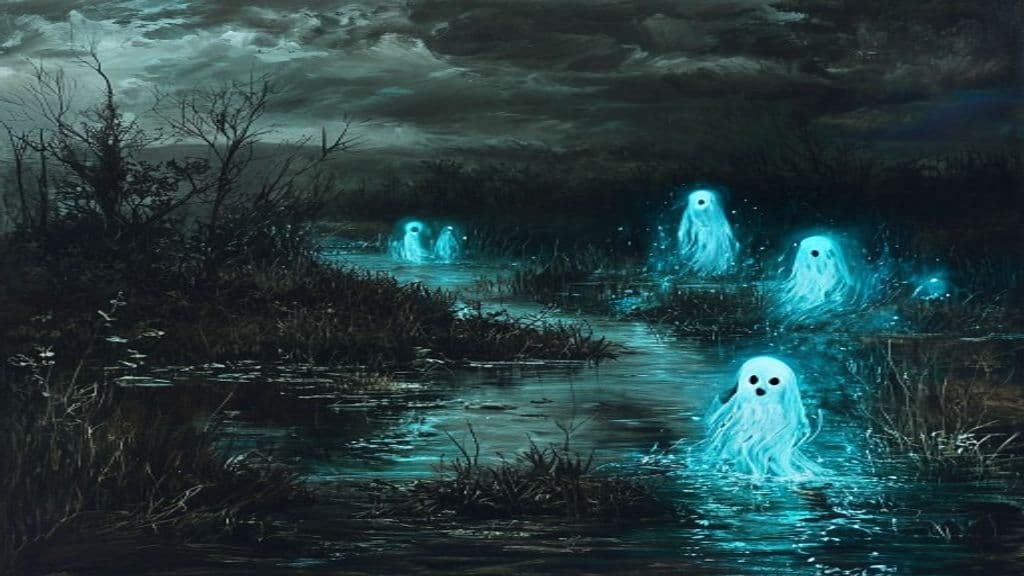
Will-o'-the-Wisp
A wandering light seen over marshy ground at night, leading travellers astray into bogs and fens. Possibly a spirit, possibly the soul of the unbaptised dead, possibly the devil himself.
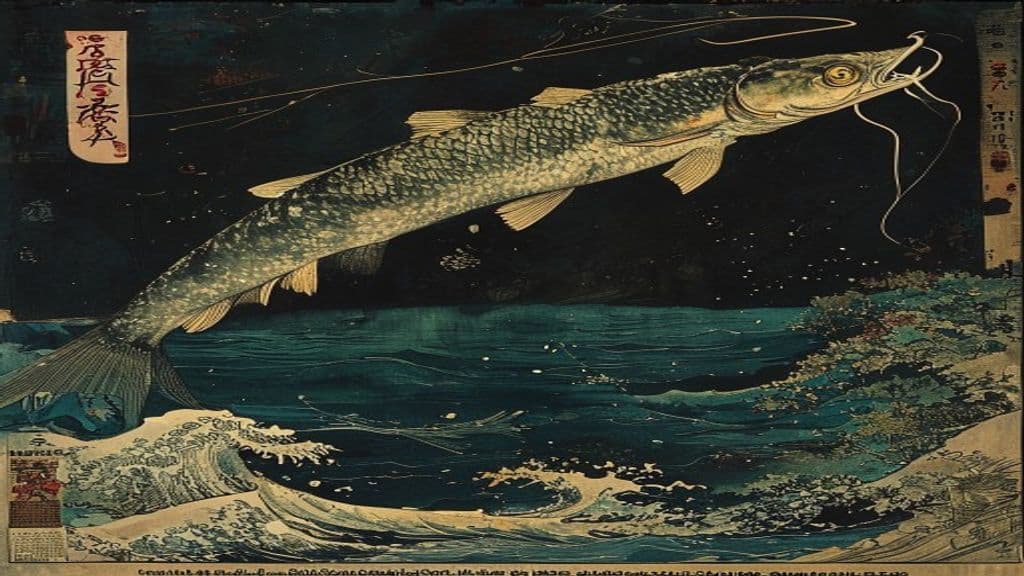
Ikuchi
An Edo-period Japanese maritime yōkai reported as an enormously long sea creature that appears at night to slither over ships and deposit copious viscous oil, forcing crews to bail and cleanse their vessels to avoid sinking.
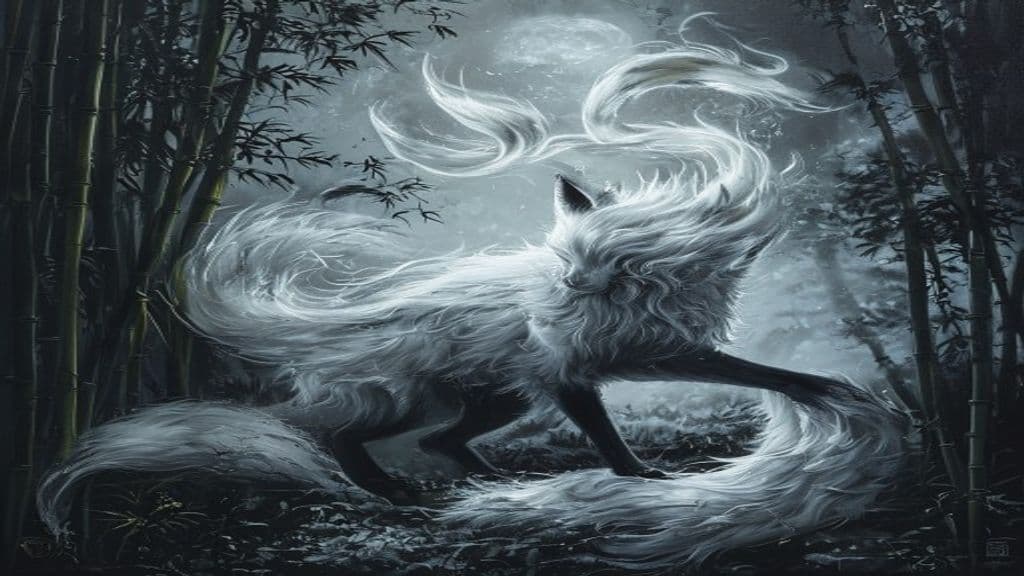
Kitsune
Fox spirits of Japanese mythology — intelligent, long-lived beings who gain additional tails (up to nine) as they age and grow in power. They serve as messengers of the god Inari and as powerful tricksters.
Akugyo
Akugyo (悪魚) are a class of monstrous aquatic yōkai in Japanese tradition: enormous sea creatures—described in different accounts as giant fish, gigantic ningyo-like merfolk, or fire‑breathing sea monsters—that threaten sailors and fishermen by capsizing boats and devouring drowning people.
Aoandon
Aoandon (青行灯, "blue andon") is a yōkai figure represented in Edo-period yokai iconography, best known from Toriyama Sekien's Konjaku Hyakki Shūi. It personifies the eerie apparition said to appear at the conclusion of the Hyakumonogatari Kaidankai storytelling ritual and is visually depicted as a blue-skinned woman with horns and sharp teeth.
Dodomeki
A Japanese yōkai depicted in Toriyama Sekien’s collections as a woman cursed with unusually long arms covered in many bird-eye–like marks; the form is described in source material as tied to habitual theft and appears in a Muromachi-period tale where religious preaching leads to its repentance.
Axtya
Evil sorcerer in Zoroastrian mythology, posing intellectual challenges to humans with his riddle-crafting and solving abilities, rivaling or surpassing deities. (Note: - Power tier: Axtya should be classified as Greater (powerful regional), not Primordial (cosmic). - Abilities: Axtya poses intellectual challenges, but his ability is specifically riddle-crafting and )
Axylus
Axylus (Ancient Greek: Ἄξυλος) is a Trojan warrior featured in Homer's Iliad (Book VI). Portrayed as a wealthy and hospitable man from Arisbe, he is slain in battle by the Greek warrior Diomedes, a brief episode used by Homer to underscore themes of hospitality, mortality, and the costs of war.
Ay Ata
Ay Ata (Ay Dede) is the personified Moon in Turkic myth and traditional Tengrism, commonly glossed as 'Moon Father.' He is paired with the sun-being (Gun Ana / Kün Ana) in a layered sky cosmology and figures in folk tales, epic traditions, and shamanic prayer contexts.
Aya
Aya is a Mesopotamian goddess associated with the dawn and worshiped as the consort of the sun god Shamash. She is principally attested in the city of Sippar, appears in royal inscriptions there, and was incorporated into Hurrian religion as the wife of the Hurrian sun Šimige.
Ayagunna (Yoruba Tradition)
A manifestation of Obatala, the Sky Father, embodying martial prowess and a desire for global peace through domination. (Note: - Power tier should be Greater (Ayagunna is described as manifesting the Sky Father's "fierceness" and having achieved global conquest). - Appearance needs clarification or deletion, as there is no ex)
Ayar Anca (unconfirmed)
Ayar Anca is a queried name for which no direct attestation appears in the supplied source corpus. The materials provided document Inca creation and founding figures (e.g., Viracocha, Manco Cápac, Mama Ocllo) and note variant traditions; within that context the name Ayar Anca is not found and must be treated as unconfirmed pending primary-source evidence.
Ayar Auca
Ayar Auca is named in modern accounts as one of the Ayar siblings in the Inca origin cycle who emerge from the cave at Paqariq Tampu; in the provided sources he appears as a member of the founding-ancestor group rather than as a separately detailed supernatural class.
Ayar Cachi
In Inca mythology, Ayar Cachi is one of the brothers of Manco Cápac and a significant figure in the origin myth of the Incas. (Note: 1. Power tier: Lower to Ancient (deity-level) since Ayar Cachi is described as one of Manco Cápac's brothers and shares an origin myth, but does not appear to possess cosmic powers. 2. Abilities: The )
Ayar Uchu
Ayar Uchu is a name that appears in at least one modern web listing as an 'Inca God of Mystery' but lacks corroboration in the supplied primary and reference sources. There is no reliable ethnographic or classical mythic documentation for an entity by this exact name in the provided materials.
Community Record
- [1]Ayakashi (yōkai) — Wikipedia. Wikipedia, 'Ayakashi (yōkai)'wiki
- [2]Ayakashi — Wikipedia (general page). Wikipedia, 'Ayakashi'wiki
- [3]Kaidanoi no Tsue (Edo-period anecdote) — summarized in Wikipedia entry. Summary of Kaidanoi no Tsue anecdote as presented in the Wikipedia article on ayakashiliterary
- [4]Sekien Toriyama, Konjaku Hyakki Shūi (illustration context) — noted in Wikipedia summary. Discussion of Sekien Toriyama's depiction (Konjaku Hyakki Shūi) as cited in the Wikipedia articleliterary
- [5]What Does Ayakashi Mean in English? | Hyakumonogatari Kaidankai. Hyakumonogatari Kaidankai, 'What Does Ayakashi Mean in English?' (summary/interpretive blog citing traditional usages)folk
- [6]How does ayakashi, あやかし = 妖 or 罔像? — Japanese Stack Exchange. Japanese Stack Exchange discussion on kanji representation and meanings for 'ayakashi'other