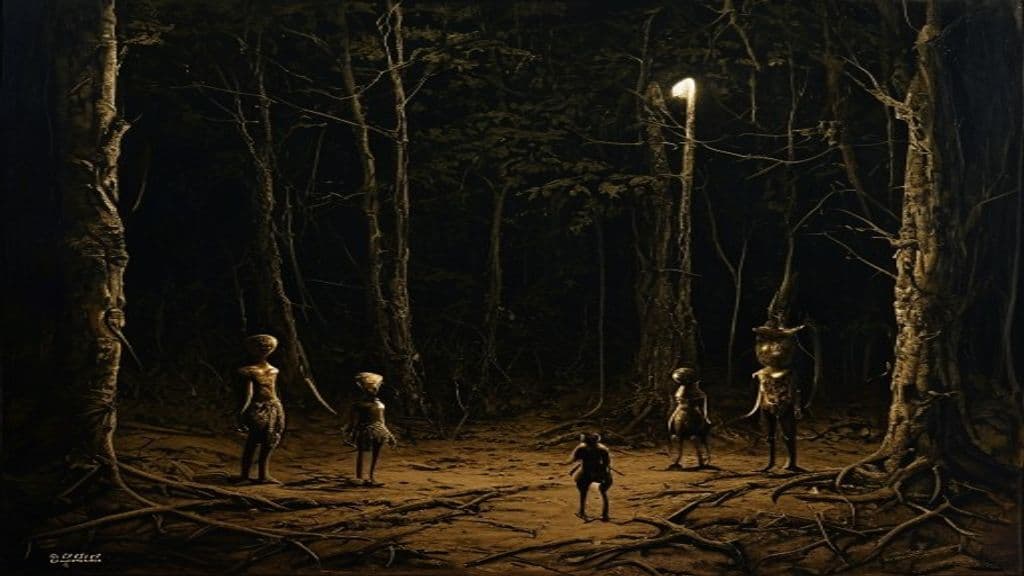
The cited source does not record a single origin myth for the Aziza. Rather than a narrated cosmogony, the available material presents them as an established category of forest inhabitants within West African cosmologies: small supernatural beings long recognized as part of the unseen population of the forest who interact with humans. This positional origin suggests cultural antiquity tied to forest environments and subsistence practices (particularly hunting), where specialized knowledge and techniques are sometimes explained as coming from relationships with non-human forest intelligences rather than solely human invention.
The Aziza are described in the source as 'little people.' No further physical detail is provided in the cited material. From that description alone one can only note that they are conceived as diminutive humanoid beings associated with woodland dwelling; they are specifically said to live in anthills and in silk‑cotton (kapok) trees. The documentation does not elaborate on variant appearances, clothing, or distinguishing features, and thus any detailed visual reconstruction would go beyond the provided source.
According to the source the Aziza provide 'good magic for hunters' and have been known to give practical and spiritual knowledge to people. Their functions are therefore both pragmatic (assistance connected to hunting success and forest survival) and instructive (transmission of spiritual or technical knowledge). The source frames their interactions as beneficent and does not describe malevolent behavior, hostility, or predatory practices.
Weaknesses
- otherNo specific weaknesses recorded in the cited source
Wards
- otherNo wards, protections, or prohibitions against Aziza are described in the cited source
Community Record
- [1]Aziza (mythology) — Wikipedia. Wikipedia contributors. "Aziza (mythology)." Wikipedia, The Free Encyclopedia.wiki