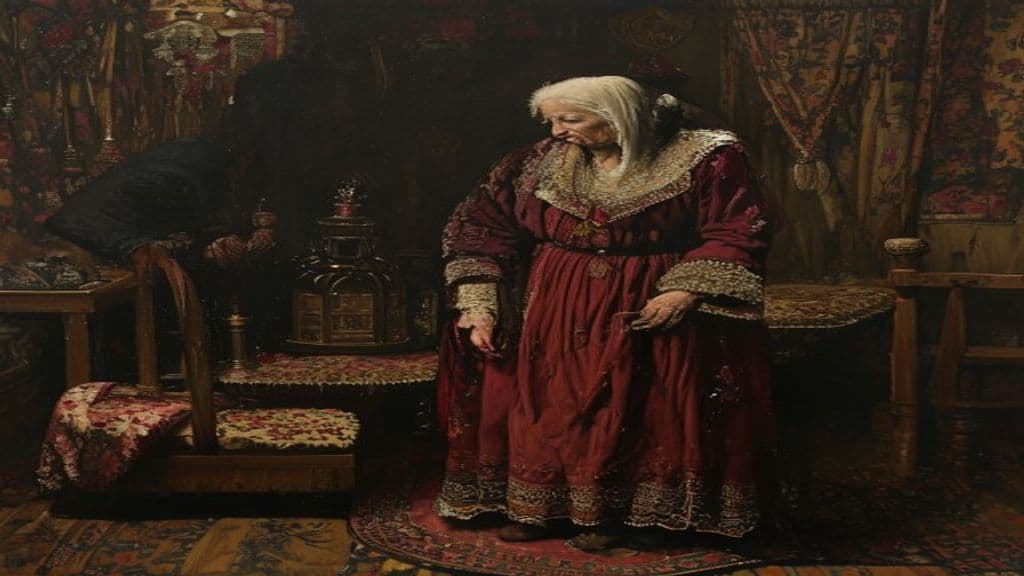
Baba Marta is named for the month of March and appears in Bulgarian folk cosmology as the grandmotherly figure who brings the end of winter and the beginning of spring. Sources present her as a domestic, anthropomorphic actor whose actions and moods explain late-winter variability; she is celebrated on March 1 with a centuries-old custom of exchanging red-and-white martenitsi. Comparative remarks in the sources note resemblance to other European seasonal female figures (for example Frau Holle / Mother Hulda) and a regional cognate in the Romanian Mărțișor, but the material does not present those as direct origins.
Sources characterize Baba Marta as an older, grandmotherly woman with a feisty, grudging temperament—particularly toward her two brothers, January and February. Specific corporeal details (clothing, size, supernatural markers) are not elaborated in the cited material; instead her appearance is signalled through familial role and behavior (she 'smiles' to let the sun out; she 'shakes her mattress' to produce the last snow).
In folk accounts Baba Marta is an agent of seasonal change: she 'brings with her the end of the cold winter and the beginning of the spring' and her mood is said to affect the weather (the sun 'only comes out when she smiles'). A common tale attributes the year's last snowfall to her household action of shaking her mattress before spring. The cultural practice of exchanging and wearing martenitsi on Baba Marta Day is treated in the sources as a talismanic custom that symbolizes health and happiness and functions as a communal charm against evil influences.
Weaknesses
None recorded.
Wards
- symbolMartenitsa (martenitsi)
Ba (Egyptian soul)
The ba is one element of the ancient Egyptian multipart conception of the person: an individuated, mobile aspect of a human that survives death, is commonly depicted as a human-headed bird, and moves between tomb, body, and the afterlife. It is distinct from other components such as the ka and the akh and is central to funerary practices that maintain continued identity after death.
Baal
Baal (bāʿal) is a Northwest Semitic title meaning 'owner' or 'lord' that served as a theonym in the ancient Levant; in Ugaritic and Canaanite texts it appears as the name/title of a prominent storm and fertility god (often rendered Baʿal Haddu) who features centrally in the Baal Cycle and in regional cults tied to rain, fertility, and kingship. In later monotheistic literatures the term becomes a polemical label for rival or foreign deities and is reinterpreted in various receptions.
Baal-berith
Baal-berith (also attested in some reference works as El Berith) is a named deity-title from ancient Canaanite religion, attested in Biblical sources and later reference literature as a local god or title worshiped at Shechem and associated with covenants—commonly glossed as "Baal of the Covenant." Later reception reuses the name polemically or in modern occult and cultural contexts.
Baalat Gebal
Baalat Gebal (Phoenician bʿlt gbl, "Lady of Byblos") is the tutelary goddess and principal civic deity of the ancient Phoenician city of Byblos. Her long-lived temple at the city's center and attestations in Egyptian, Akkadian (Amarna), and later Greek sources show her role as city-protector, focal point of royal veneration, and an object of cross-cultural identification with foreign goddesses.
Baalshamin
Baalshamin (literally "Lord of Heaven[s]") is a Northwest Semitic theonym/title used across the Levant and adjacent regions to denote a supreme sky/heavenly lord. Depending on time and place it functions as an epithet of other deities (notably Hadad/Baal) or as a distinct civic/sky deity associated with weather, lightning, and sometimes solar aspects; attested in inscriptions from Ugarit, Phoenicia, Safaitic Arabia, Palmyra, Nabataea, and in treaty and stele texts.
Baatar Bayan
The name Baatar Bayan was requested for documentation, but the provided source material contains no mention of this entity or of Mongolian mountain guardian spirits. No folkloric details (origin, appearance, abilities, or rituals) can be derived from the supplied document.
Baba Yaga
Baba Yaga is an ambivalent female figure of East Slavic folktale tradition, depicted variously as a fearsome, child-eating crone or as a helpful, maternal donor. She is associated with the deep forest, a hut described as standing on chicken legs, and the motific accoutrements of a mortar and pestle.
Babalon
A central goddess-figure in the Thelemic system founded by Aleister Crowley; simultaneously an archetypal Great Mother/Binah, a sacralized principle of liberated female sexuality, a ritual vessel (the Grail), and an office manifested historically as the "Scarlet Woman."
Babay (Slavic folklore)
A Slavic night spirit that abducts misbehaving children who stay awake at night, embodying societal values of discipline and conformity. (Note: 1. Power tier: Given the ability to abduct and punish misbehaving children, Babay's power level should be at least Greater Spirit. 2. Appearance: Since no physical description is provided in the sourc)
Babi
Babi (also Baba) is the ancient Egyptian deification or divine personification of the hamadryas baboon, associated in funerary and mythic texts with the netherworld, posthumous judgment, and sexual virility. Texts portray him as a violent, meat‑eating figure who could devour the unjust after judgment, while some funerary spells also appropriate his virile power positively for the dead.
Babi Ngepet
In Indonesian mythology, the Babi Ngepet is a boar demon associated with malevolent intentions towards humans. (Note: * Power tier: Downgrade to Ancient (deity-level) as there's no indication of Primordial powers. * Abilities: Specify what malevolent intentions towards humans implies, e.g., ability to curse or cause )
Baboon
Baboon refers to primates of the genus Papio (family Cercopithecidae). The sources treat baboons as living Old World monkeys with distinct anatomy, complex social systems, omnivorous diets, and a primarily African (and partly Arabian) distribution.
Community Record
- [1]Baba Marta. Wikipedia, 'Baba Marta'wiki
- [2]March (Wikidata). Wikidata, 'March' entrywiki
- [3]Archive: Radovan Bećirović Trebješki .... Archive.org item referenced in research notesother
- [4]Archive: self/noise #9: «résistance(((s)))on» (2014-06-04). Archive.org item referenced in research notesother