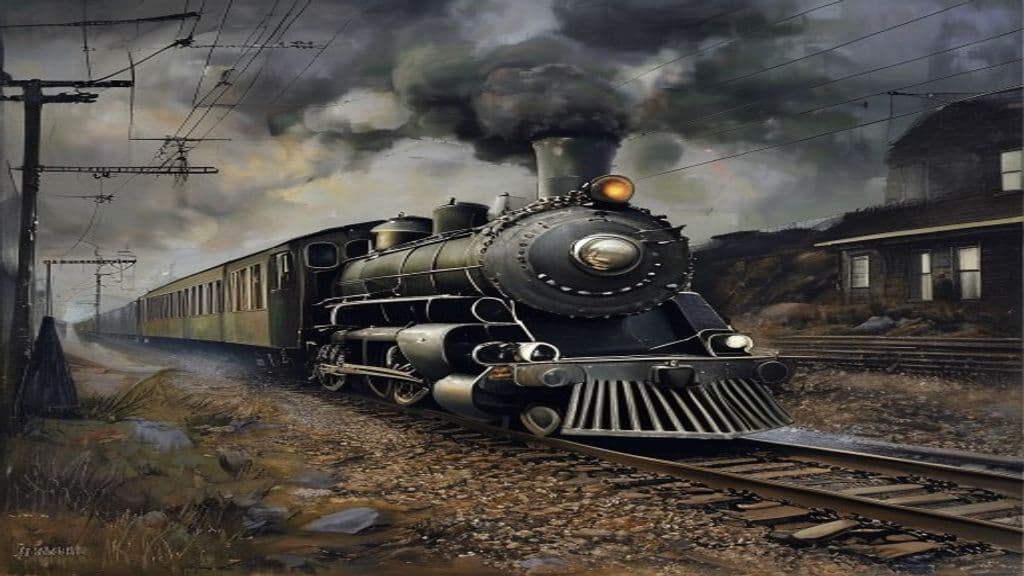
The Baby Train does not have a mythic or supernatural origin story; it arises as a humorous explanatory anecdote in modern English-language sources. Earliest cited literary attestation in the provided notes appears in Christopher Morley (1939, Kitty Foyle) where a small town hears an early train whose whistle is said, jokingly, to 'do a good deal to keep up the birth-rate.' The motif recurs in mid-20th-century joke anthologies (e.g., Bennett Cerf, 1946) and is catalogued by folklorists (Jan Harold Brunvand) and feature writers (Bill Scott, 1985) as an example of the explanatory rumor that links a punctual disruptive sound to elevated local fertility.
As a narrative the Baby Train typically appears as a compact anecdote set in a small town adjacent to a main railway line (or, in variants, a coastal town exposed to a foghorn). Common textual details include a scheduled early-morning freight or mail train that 'blows its whistle' as it passes; variants substitute foghorns or other repetitive loud early-morning noises. Specific literary/localized settings cited in sources include 'Manitou' and the early Q train to Chicago (Christopher Morley, 1939), a town 'near Charleston' (Bennett Cerf, 1946), and a coastal Australian town 'not too far north of Sydney' (Bill Scott, 1985). The tale circulates in joke anthologies, newspaper columns, and folklorist collections rather than as a description of any physical or supernatural entity.
Within the tale the 'ability' attributed to the Baby Train is strictly narrative: the train's whistle (or a foghorn) reliably wakes residents at an hour described as 'too early to get up and too late to go back to sleep,' and that enforced idle time in bed is said to prompt sexual activity, producing a local spike in births. Sources emphasize the motif's function as humorous, proximate causal explanation for demographic anomalies and link it conceptually to modern rumors that disruptive communal events (blackouts, storms, major incidents) cause baby booms. No supernatural powers or agency are ascribed in the cited materials; the causal mechanism is human behavior responding to a punctual noise.
Weaknesses
- otherNot applicable — motif has no supernatural vulnerabilities
Wards
- otherNot applicable — no protective rituals or talismans recorded in cited sources
Killer in the Backseat
A modern urban-legend narrative in which a concealed human attacker hides in the rear passenger area of an automobile, discovered or exposed when another driver or attendant warns the lone driver (often by flashing high beams) or when she stops and is checked. The tale functions as a late-20th/21st-century cautionary story about solitary travel rather than a supernatural entity.
Babalon
A central goddess-figure in the Thelemic system founded by Aleister Crowley; simultaneously an archetypal Great Mother/Binah, a sacralized principle of liberated female sexuality, a ritual vessel (the Grail), and an office manifested historically as the "Scarlet Woman."
Babay (Slavic folklore)
A Slavic night spirit that abducts misbehaving children who stay awake at night, embodying societal values of discipline and conformity. (Note: 1. Power tier: Given the ability to abduct and punish misbehaving children, Babay's power level should be at least Greater Spirit. 2. Appearance: Since no physical description is provided in the sourc)
Babi
Babi (also Baba) is the ancient Egyptian deification or divine personification of the hamadryas baboon, associated in funerary and mythic texts with the netherworld, posthumous judgment, and sexual virility. Texts portray him as a violent, meat‑eating figure who could devour the unjust after judgment, while some funerary spells also appropriate his virile power positively for the dead.
Babi Ngepet
In Indonesian mythology, the Babi Ngepet is a boar demon associated with malevolent intentions towards humans. (Note: * Power tier: Downgrade to Ancient (deity-level) as there's no indication of Primordial powers. * Abilities: Specify what malevolent intentions towards humans implies, e.g., ability to curse or cause )
Baboon
Baboon refers to primates of the genus Papio (family Cercopithecidae). The sources treat baboons as living Old World monkeys with distinct anatomy, complex social systems, omnivorous diets, and a primarily African (and partly Arabian) distribution.
Babr-e Bayān
Babr-e Bayān is the name of a legendary suit or armor associated with the Iranian hero Rostam in Persian epic tradition. In most accounts it is an extraordinary protective garment (sometimes said to be made from a slain creature’s hide) that confers invulnerability when worn.
Baby Wildebeest
Baby Wildebeest is a fictional character from DC Comics' New Teen Titans series: a juvenile, wildebeest-themed created host-body who serves as an adopted child-member of the Teen Titans, noted for great strength and durability. Introduced in 1992, the character was killed during Infinite Crisis and later appeared briefly as a Black Lantern in Blackest Night.
Babys
Babys (Ancient Greek: Βάβυς, Bábus) is a sparsely attested figure in Greek mythology identified in available sources as the brother of the Phrygian satyr Marsyas; surviving references associate him only fragmentarily with a flute and place him within the Marsyas–Apollo musical contest tradition.
Bacab
In Yucatec Maya tradition the Bacab are a fourfold office of aged interior-earth deities who stand at the four cardinal points as holders of the world, associated with subterranean waters, thunder, rain, calendrical Year Bearer days, divination, and curing rituals.
Bacchis
Bacchis is not attested in the provided sources as a supernatural being; the name appears in historical, literary, and scientific contexts (the Bacchiadae clan of ancient Corinth, a modern biological genus, and titles/characters in classical drama collections). No folkloric cosmology, powers, appearance, or rituals for a spirit called Bacchis are documented in the supplied material.
Bacchus
Bacchus is the Roman identification of the Greek god Dionysus, a deity associated with wine, vegetation and fertility, ritual ecstasy and theatrical performance. In Roman religion he is conflated with the Italic Liber and known for rites that induce possession, frenzy (baccheia), and group revelry.
Community Record
- [1]Baby Train (Wikipedia). Wikipedia, 'Baby Train' entry (accessed via provided research notes)wiki
- [2]Wikidata: Baby Train (Q4838416). Wikidata item for 'Baby Train' (referenced in research notes)other
- [3]Kitty Foyle (quote) — Christopher Morley, 1939. Christopher Morley (1939), Kitty Foyle: 'The first thing you hear mornings in Manitou is the early Q train to Chicago. It's too early to get up and too late to get back to sleep again. They have a legend out there that the morning yells of that rattler do a good deal to keep up the birth-rate.' (quoted in research notes)literary
- [4]Anecdote — Bennett Cerf, 1946. Bennett Cerf (1946) anecdote as cited in research notes: traveler shown the tracks where 'That damned train rushes by here every morning at seven o'clock. It's too early to get out of bed, and too late to go back to sleep.'literary
- [5]Australian variant — Bill Scott, 1985. Bill Scott (1985) summarized version cited in research notes: coastal town near Sydney with main railway line; government investigator; train whistle wakes adults who 'had to find something to do in bed while waiting,' leading to high birth rates.folk
- [6]Urban legend scholarship — Jan Harold Brunvand, 1993. Jan Harold Brunvand (1993) catalogs the Baby Train as an urban legend motif in modern rumor collections (cited in research notes).academic
- [7]Reader's Digest 'foghorn' variant (1967, cited). Reader's Digest anecdote referenced in research notes noting variants that replace trains with foghorns ('It's the foghorns').folk