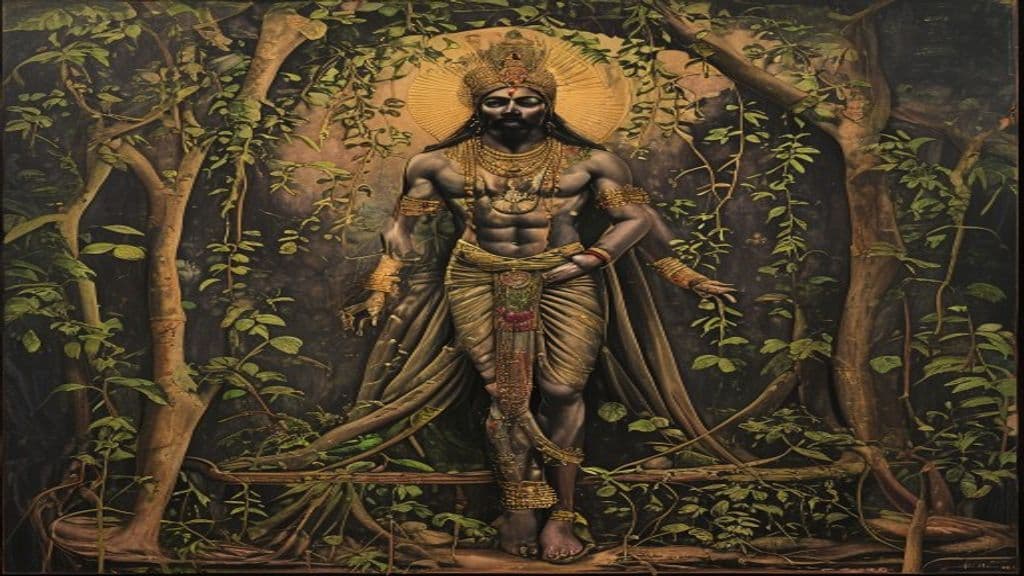
According to Jain texts summarized in the provided sources, Bahubali was born to Rishabhanatha and Sunanda of the Ikshvaku dynasty in Ayodhya and was granted the kingdom of Asmaka (capital Podanapur). After a series of non‑lethal contests with his elder brother Bharata and growing disgust with worldly power, he abandoned kingdom, clothes and ornaments to become a monk and undertake prolonged standing meditation (kayotsarga). By destroying the four kinds of inimical karmas through ascetic practice he attained omniscience (kevala jnana) and later attained liberation (moksha) to become a siddha; his final liberation is narrated as occurring at Mount Kailasha.
Narratives and iconography present Bahubali in the kayotsarga (standing meditation) posture, frequently shown motionless while creeping plants or vines grow around his legs — the creepers being a key identifying motif in early reliefs (e.g., Badami Cave 4, Ellora). Monumental monolithic images (Gommateshwara) depict him standing in the same ascetic posture; textual summaries also note nature overtaking his immobile body (vines, and in some accounts ants and dust are mentioned) during his long meditation.
Within Jain soteriology as reported in the sources, Bahubali's primary 'powers' are spiritual: resolute ascetic endurance that allows the destruction of the four kinds of inimical karmas (including knowledge‑obscuring karma), attainment of kevala jnana (omniscience), and eventual moksha (liberation) as a siddha. Earlier in his life he is portrayed as a princely figure skilled in medicine, archery, floriculture and knowledge of gems; narrative episodes include non‑lethal contests with his brother Bharata (staring contest, water contest, wrestling) and the relinquishing of royal authority.
Bagh Bhoot
No folkloric information about an entity called 'Bagh Bhoot' is available in the provided source. The only occurrence in the source is the film title Bhooth Bangla (2026), which does not supply ethnographic, descriptive, or ritual data about a supernatural being by this name.
Bagha Qaghan
Bagha Qaghan (reign c. 587–588) was the seventh khagan of the First Turkic (Göktürk) Khaganate, recorded in Chinese sources under transcriptions such as 莫何可汗 and the personal name 阿史那处罗侯 (Ashina Chuluohou). He is represented in the sources as a historical political ruler who continued alliance policies with the Sui dynasty, acted as a viceroy of the eastern wing, and led military actions against rivals such as Apa Qaghan and Western Göktürk leaders.
Bagha Shad
Bagha Shad (Old Turkic: 𐰉𐰍𐰀𐱁𐰑, baγa šad; Chinese 莫贺设/莫賀設, mòhè shè) was an early 7th-century Göktürk shad (dynastic prince/general), a close kinsman and subject of the Western Turkic khagan Tong Yabghu, attested in Chinese sources as sojourning in China in 618–626 and probably the father of Böri Shad.
Bahamut
In medieval Islamic cosmographical and tafsir traditions Bahamut is a vast aquatic creature—described as a giant fish or whale—that lies deep beneath the earth and functions as a structural support in a layered model of the cosmos, bearing a bull which in turn bears a gemstone slab and angel that shoulder the earth.
Bahkauv
Aachen-area monstrous figure in Rhineland folklore depicted as an elongated or deformed calf with sharp fangs that lurks near wells, springs, sewers and fountains and traditionally ambushes intoxicated men at night, latching onto their shoulders before attacking. The creature is tied to urban water features in Aachen and appears in civic memory (notably a statue placed over an associated well in 1902 and replaced in 1967).
Bahram (Shahnameh)
Bahram is an Iranian heroic figure in Ferdowsi's Shahnameh, presented as a human warrior and counselor. He is named as a son of Goudarz and brother of Rohham, Giv, and Hojir, and appears in the episode of Siavash as one of Siavash's counselors alongside Zange-ye Shavaran.
Bai Baianai
Bai Baianai is a Turkic‑Altaic protective spirit and sometimes goddess associated with forests, animals, hunters, fishing, fertility and material wealth. In the Yakut/Altai tradition she functions as a patron of hunters and a provider of abundance, yet in some accounts she can punish humans with drought, crop‑burning or livestock disease if offended.
Bai Longma (White Dragon Horse)
A dragon-being from the 16th-century Chinese novel Journey to the West who serves as the monk Tang Sanzang's steed during the pilgrimage and is later ordained to the Buddhist office Babu Tianlong Guangli Bodhisattva. Presented in the narrative as a dragon in horse form or a dragon who takes on the role of a horse/servant.
Bai Suzhen (White Snake)
Bai Suzhen (白素貞), commonly called the White Snake, is a cultivated snake spirit who attains human form and is the central figure of the Legend of the White Snake. Sources present her as a one‑thousand‑year‑old snake spirit who transforms into a beautiful woman, engages in a romantic marriage with a human (Xu Xian), is opposed by Buddhist exorcism in many variants, and in some local traditions is venerated as Madam White Snake (白蛇娘娘).
Bai Ze
Bai Ze (白澤, Báizé; Japanese Hakutaku) is a legendary sacred creature in Chinese tradition famed as an authoritative recorder of ghosts and gods whose illustrated compendium (Bái Zé Tú) was employed as a household prophylactic against spirit-world harm. The creature’s image and diagrams were used in China and later Japan to identify, ward off, and prescribe avoidance of spectral calamities.
Bai-Ülgen
Bai-Ülgen (often shortened to Ülgen) is a high creator-deity in Turkic religious cosmology, presented in available sources as a magnificent and wealthy divine figure who occupies a top position in the pantheon and is sometimes identified with the overarching sky god Tengri. Some modern references also list him within Mongolian contexts.
Baiame
Baiame is a principal creator/ancestral Sky Father in the Dreaming traditions of several south‑eastern Australian Aboriginal peoples. He is credited with shaping landscape, instituting law and ceremony (notably the first bora initiation), and returning to the sky while remaining present in sacred sites and rock art.
Community Record
- [1]Bahubali - Wikipedia. Wikipedia article 'Bahubali' (accessed via provided excerpt)wiki
- [2]Adipurana (summaries cited in provided material). Summary of Jinasena's Adipurana as cited in the provided excerpts (narrative details on renunciation, kayotsarga, and Bharata's worship)literary