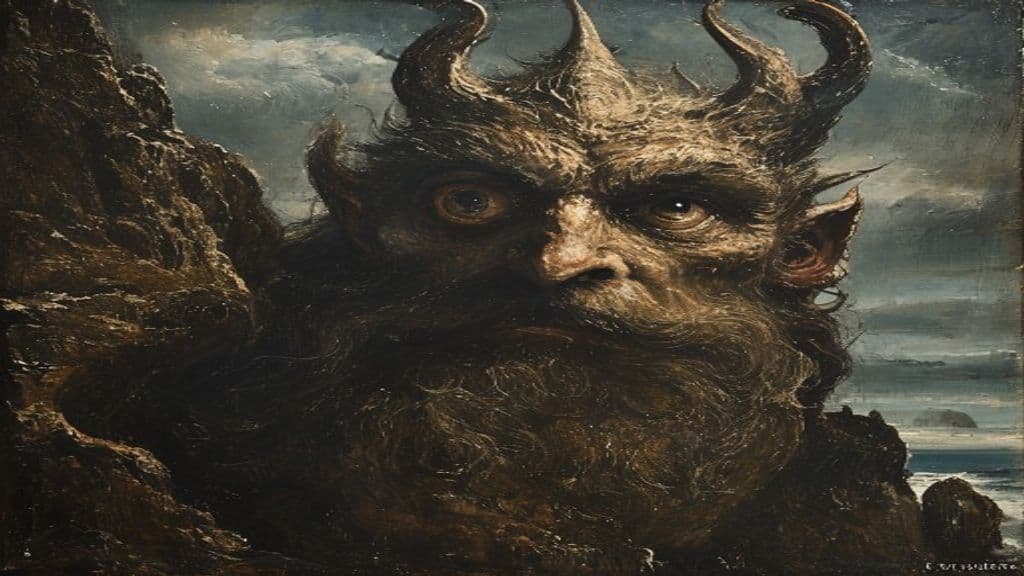
In the medieval Mythological Cycle Balor is presented as a leader and champion of the Fomorians, identified in genealogical phrasing as Balor son of Dot son of Néit (e.g., Balor mac Doit meic Néid) and acting as an adversary to the Tuatha Dé Danann. In later folktale variants collected in the 19th century he is recast as a tyrannical warrior living on Tory Island whose daughter Ethnea/Eithne is secreted away and becomes the mother of Lugh; those folktales narrate a prophecy that Balor will be killed by his grandson and Balor’s attempt to prevent that fate by imprisoning his daughter in a tower.
Medieval accounts depict Balor as a giant and a chief of the Fomorians; core medieval narratives emphasize him as a one‑eyed champion. Later folkloric variants show variation: one, two, or three eyes are recorded in different tales (including an extra eye in the middle of the forehead or an eye at the back of the head). Folklore describes tangible accoutrements in some versions, for example an eye covered by nine leather shields and an eyelid with a ring or handle that required exceptional strength to lift.
Balor’s primary power in the tradition is his baleful eye: when opened it wreaks destruction on those it falls upon. Descriptions vary across sources: the eye is said in some accounts to be venomous, incendiary, or to issue a beam likened to a basilisk‑like force; one narrative assigns the eye its power after exposure to fumes from a druidic potion. Balor is likewise a formidable martial leader—large enough that when slain his body crushes many foes—and in folklore he acts as a cattle‑stealing warrior whose actions set the human events leading to Lugh’s birth. His narrative behaviour includes attempts to avoid prophecy (imprisoning his daughter) and employing shields or coverings over the evil eye in some tale variants.
Weaknesses
- conditiondisabling or destroying the baleful eye
- otherphysical immobilization or covering of the eye (e.g., layered shields in a folktale)
Wards
- othercoverings over the eye (nine leather shields recorded in a folktale variant)
- otherdestruction of the eye by weapon (sling‑stone or spear driven through the eye in mythic accounts)

Community Record
- [1]Balor — Wikipedia. Wikipedia entry 'Balor' (summary of medieval Mythological Cycle and 19th‑century folklore variants).wiki
- [2]Balor — Wikidata. Wikidata item Q805514 (classification and identifiers).other
- [3]Lorecast 11 - Mythcast: Fomorian (archive). Podcast episode mentioning Fomorian material and modern cultural echoes of the Balor name (archival recording).other