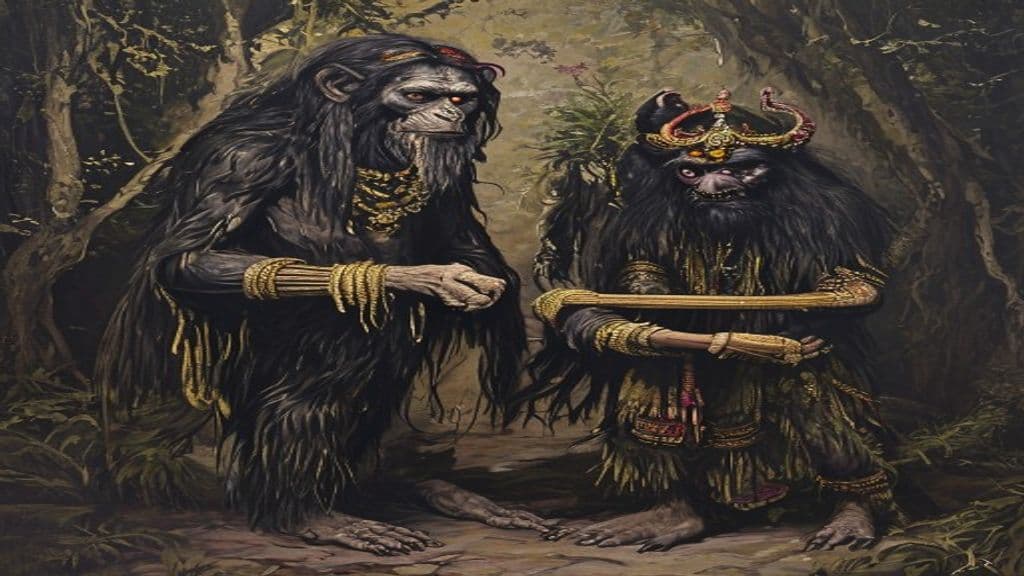
Accounts vary: some traditions treat Banjhākri as an original or founding teacher of Nepali shamanism who dwells in the forest and instructs human aspirants; other versions allow for numerous ban-jhākri and ban-jhākrini. In many tellings Banjhākri locates children with shamanic potential, takes them back to his cave, and trains them; those who pass Banjhākrini's initiation return home empowered. A few accounts describe Banjhākri as a descendant of the Sun, but this lineage is reported only in some sources.
Banjhākri is described as short (about 1–1.5 metres / 3–5 feet), wild and simian in form: long matted hair covers his body except the face and palms, he has large ears and feet that point backward, and he plays a golden dhyāngro (frame drum). Banjhākrini is described as ursine-humanoid with long hair on her head, long pendulous breasts, backward-pointing feet, and is usually depicted carrying a symbolic golden sickle.
They act as forest shamanic beings who locate and train human children with shamanic potential. Banjhākri trains trainees in a cave; Banjhākrini functions as an initiatory danger who may attempt to consume those who fail. Trainees who survive and return are said to acquire powerful shamanic abilities and may be more effective than shamans trained by humans. They are visible in the ordinary world in some accounts, though sight is generally restricted to powerful shamans. Banjhākri is often characterized as a trickster, and some scholars have suggested therianthropic aspects in interpretation of his form.

Yeti
A Himalayan legendary apelike humanoid—large, hairy, bipedal—embedded in pre‑Buddhist and local Himalayan folklore and later incorporated into Tibetan Buddhist classificatory schemes; it is variably described in local terms as a 'man‑bear' or 'wild man' and has been reinterpreted in modern popular culture as the 'Abominable Snowman.'

Churel (Chudail)
A South Asian female revenant or vengeful ghost associated with women who die cruelly or unpurified; often said to target male relatives and sometimes described as latching onto trees, producing a tree‑attached tree‑spirit variant in local tales.
Bandicoot
A group of more than 20 species of small to medium-sized, largely nocturnal, omnivorous marsupials (order Peramelemorphia) endemic to the Australia–New Guinea region. The English name is an Anglicised borrowing ultimately from Telugu and was historically applied to unrelated Indian rodents before being transferred to Australasian marsupials.
Bandua
Bandua is a theonym attested in Roman‑period epigraphic sources from north‑west Iberia (Galaico‑Lusitanian area). The name appears with many localizing epithets and is reconstructed by scholars as a local tutelary or protective divine figure (or a set of closely related local figures) with occasional Roman syncretism to Mars.
Banebdjedet
An ancient Egyptian ram deity worshipped at Mendes (Djedet), understood as the local 'Ba' or soul‑manifestation tied to fertility, virility, and aspects of rulership; depicted commonly as a ram or ram‑headed man and sometimes as a four‑headed ram representing multiple Bas of the sun god.
Bangpūtys
Bangpūtys is a reconstructed masculine sea-and-storm deity from Lithuanian mythology. Known from very scanty sources, modern mythologists portray him as an austere, vindictive master of winds and the sea and as the reconstructed father-figure of the cardinal wind-gods.
Banjara / Banjari (wandering-gypsy spirits)
No primary or secondary evidence for a distinct supernatural entity explicitly called 'Banjara' or 'Banjari' (wandering gypsy spirits) is present in the supplied sources. The materials document the Banjara (Lambadi/Sugali) as a nomadic tribal community and their ethnobotanical knowledge, but they do not record descriptions, powers, appearances, or rituals directed at a spirit entity by this name.
Banjee
Banjee is a social identity and performance category from urban LGBTQ+ ball culture—especially New York City voguing/ball scenes—denoting a person who embodies an urban, tough swagger and a street-presentational form of masculinity used as a judged category (e.g., 'banjee realness') in balls and related events.
Bannik
A place-bound spirit of the Slavic banya (bathhouse) that inhabits the steam room and related spaces; he mediates divination, presides over births within the banya, and must be appeased by offerings or he may harm or otherwise vex users and the building.
Banshee
A female spirit of Irish and Scottish folklore whose wail heralds an impending death in a family of Gaelic descent. Not a cause of death — a witness to it.
Banu Goshasp
Important heroine in Iranian mythology, appearing in several Persian epics including the Banu Goshasp Nama. (Note: - The power tier should be Ancient, not Primordial, as there's no indication that she has cosmic-level abilities. - There are no sensory cues, weaknesses, or wards listed, but they could potentially b)
Baobh-shìth
A female fairy of Scottish Highland folklore portrayed as a beautiful but deadly supernatural woman who seduces and kills lone men at night. Tales place her within the Highland sidhe corpus while linking her actions to a motif in which nighttime wishes made without invoking divine protection are answered by malevolent agencies.
Baobhan Sith
A Scottish Highland vampire fairy — a beautiful woman in a green dress who appears to men alone in the wilderness and drains their blood, her deer hooves hidden beneath her skirts.
Baphomet
Baphomet is a mutable Western esoteric and cultural figure: in medieval inquisitorial records the name labels an alleged idol or head invoked in accusations against the Knights Templar; in 19th‑century occultism Éliphas Lévi reimagined Baphomet as a symbolic androgynous human‑goat figure embodying reconciled opposites; in modern culture the term and imagery are widely repurposed across conspiracy discourse, art, and fiction.
Community Record
- [1]Banjhakri and Banjhakrini - Wikipedia. Wikipedia contributors, 'Banjhakri and Banjhakrini', Wikipedia, The Free Encyclopedia, https://en.wikipedia.org/wiki/Banjhakri_and_Banjhakriniwiki
- [2]Wikidata: Banjhakri and Banjhakrini. Wikidata entry Q4855838, 'Banjhakri and Banjhakrini', http://www.wikidata.org/entity/Q4855838wiki