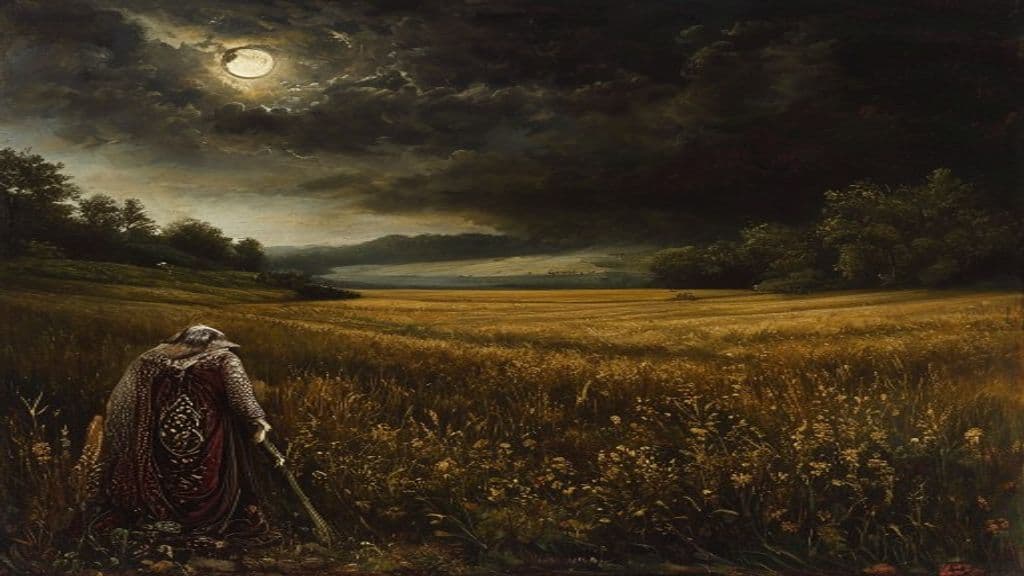
Beowa is mentioned in the Anglo-Saxon royal genealogies as the son of Scyld and grandson of Sceafa, indicating its importance in the ancestral lineage.
There is no description of Beowa's physical appearance in the source material. Its association with agriculture and fertility suggests a connection to the natural world.
Beowa may be associated with ensuring a bountiful harvest or protecting crops from disease and pests, although its role in these processes is not fully understood.
Brittia
In Germanic tradition, Brittia is a mythological concept and physical location associated with the afterlife, where souls of the dead are transported. It exists as both an island and an Isle of the Blessed. (Note: 1. Power tier should be Primordial since Brittia is associated with the afterlife and its description implies a cosmic or transcendent level. 2. Add sensory cues: Brittia's association with death and )
Cold Higham
A village in Northamptonshire, England with a long history dating back to Roman times. It lacks any associated mythology or supernatural significance. (Note: * Power tier: Not specified or implied in source material. * Origin story: Summary already covers the historical background; consider removing the duplicate information. * Appearance, Abilities, Senso)
Deor
A poet and subject of an Old English poem found in the Exeter Book, reflecting on misfortune attributed to him. (Note: 1. Power tier should be Primordial, as it's an Old English poem and subject, not a supernatural entity with defined abilities. 2. Add description of Deor's reflection on misfortune from Source 1 as se)
Fossegrim
A water spirit or troll in Scandinavian folklore, associated with music and enchantment. (Note: 1. Power tier: Lowered from Greater to Lesser, as it's described as a local spirit. 2. Origins story: Clarify that it's rooted in Scandinavian cultural values, but more specifically mention the Old No)
Gaut
Mythical ancestor and national god with significant cultural and symbolic significance in Germanic tradition, associated with the Geats and Goths. (Note: * Power tier should be Primordial, given that Gaut is described as a mythical ancestor and national god, suggesting a higher level of power and influence. * Abilities section should be removed or revi)
Hundings
A legendary tribe or clan in Germanic tradition, known for their conflict with the Wulfings. (Note: * Power tier should be Ancient (deity-level) is too high; given the lack of supernatural powers and behaviors associated with the Hundings. * The article incorrectly states that no physical descriptio)
Interpretatio Slavica
A cultural practice among Slavic peoples to identify and equate their deities with those of neighboring cultures and Christian saints. (Note: - Power tier should be Ancient (deity-level), as it's a cultural practice rather than a supernatural being. - Sensory cues, weaknesses, and wards are not applicable to this entity, as it's an abstract)
King Laurin
Supernatural being from South Tyrolean saga associated with explaining natural phenomena through mythological stories in the Dolomites. (Note: - Power tier: Primordial (since it involves natural phenomena and shaping mountain landscapes) - Abilities: Add detail that he possibly influences optical phenomena such as alpenglow - Weaknesses: Non)
Knucker
A type of water dragon in Germanic tradition, said to inhabit knuckerholes in Sussex, England. (Note: 1. Power tier should be changed to Lesser, as the Knucker is described as a local water spirit. 2. Add sensory cues from knuckerholes in Sussex, England (e.g., strange noises, eerie feelings). 3. Note)
Proto-Frigg-Freyja Entity (Hypothetical)
A hypothetical entity proposed to be the common origin of Old Norse goddesses Frigg and Freyja, based on similarities between them. (Note: 1. Power tier should be Ancient (deity-level) rather than Primordial (cosmic), as the entity is hypothetical and not explicitly stated to have cosmic powers. 2. The appearance section is missing entir)
Wade's Causeway
An archaeological site of uncertain origin and purpose located in the North York Moors national park, England. (Note: 1. The power tier should be set as "Minor Spirit" or even lower since it's an archaeological site with unknown origin and purpose. 2. The summary needs correction: it currently says the site is of "un)
Beorn
A fictional individual in J. R. R. Tolkien's legendarium: a 'skin-changer' who is a man able to assume the form of a great black bear. He is a solitary chieftain who aids the company in The Hobbit and becomes the ancestor of the Beornings, a people retaining diminished bear-shaping power.
Community Record
- [1]Wikipedia: Beowawiki