There is no attested mythological origin for Berehynia in the supplied sources. Modern descriptions that place Berehynia among Slavic goddesses reflect scholarly and popular reconstructions based on fragmentary evidence: a small number of chronicles and letopises, Christian anti-pagan sermons, and survivals in names, place-names, folk holidays and sayings. The reconstruction of Berehynia as a named female supernatural figure arises from this broader methodology rather than from a continuous, well-documented native narrative; the provided material contains no primary origin myth, genealogy, or traditional story for Berehynia.
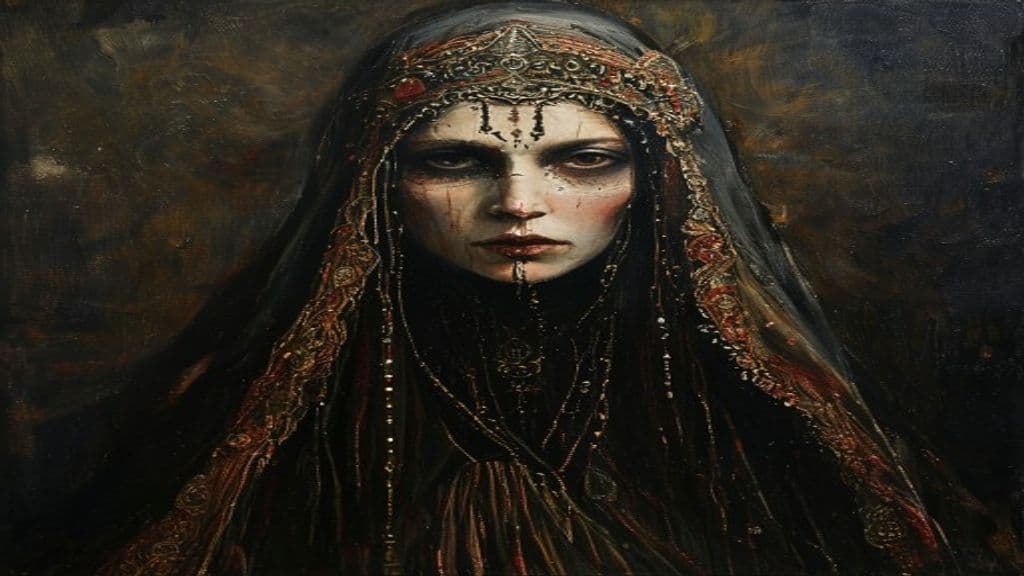
The provided sources offer no primary descriptions, iconography, or consistent visual traits for Berehynia. There are no attested accounts in the supplied material that describe her physical form, dress, or symbolic attributes. Any attempts to portray Berehynia visually in modern media or popular literature are therefore reconstructions or later inventions not supported by the cited excerpts.
No specific powers, behaviors, or roles are documented for Berehynia in the supplied material. The only supported statement is that Berehynia is treated in modern discourse as a female Slavic divine figure or protective spirit within a reconstructed pantheon; beyond this classificatory placement, the sources contain no primary evidence detailing abilities, spheres of influence, actions, or interactions with humans.
Berbalang
Berbalangs are a class of corpse‑eating, astral‑projecting beings described in a late‑19th‑century ethnographic account from the island of Cagayan Sulu (Mapun). The report portrays them as a village community whose members are said to dig up graves to eat corpses and, by entering trance, liberate an astral body to possess and feed on the living; protective measures recorded include lime and a coconut pearl talisman.
Berbalang
The Berbalang are legendary creatures from the Philippines described in available sources as corpse-eating ghouls associated with grave-digging; some accounts also report they can fly or send a spirit to do so. Documentation is limited and drawn from summarised folkloric reports.
Berberoka
A water-associated swamp spirit or creature from northern Luzon (Philippines) said to prey on people at ponds, lakes, rivers, and swamps by manipulating water—draining and reflooding sites to drown victims. Described in summaries as a 'swamp creature' or 'water ogre'; some modern adaptations portray it as a scaled ogre.
Berchta (Perchta)
Berchta (also Perchta/Percht) is an Alpine and Upper Germanic female supernatural figure tied to midwinter/Christmastide customs. In surviving folkloric and folkloristic sources she appears as a polyvalent mother-earth/seasonal figure who rewards industrious household behavior and punishes neglect, and who is associated with wintertime movements and textile work (spinning/distaff).
Berchtold
Berchtold is primarily a Germanic personal name; in one brief folkloric attestation from 16th‑century German sources the name Berchtold is recorded as the leader of the Wild Hunt, replacing the female figure Perchta. Beyond this isolated mention there is no sustained folkloric tradition, description, or ritual corpus for a supernatural Berchtold in the provided sources.
Bereet
Bereet is a fictional extraterrestrial character from Marvel Comics, a Krylorian techno-artist/filmmaker who produces techno-art films and who in stories documents or dramatizes adventures (notably of the Hulk). She first appeared in The Rampaging Hulk #1 (Jan. 1977) and made her Earth-616 debut in The Incredible Hulk vol. 2 #269 (March 1982); she also appears briefly in the Marvel Cinematic Universe film Guardians of the Galaxy (2014).
Beren
Beren is a named mortal man and protagonist in J. R. R. Tolkien's legendarium whose questing life and love for the Elf Lúthien form one of the central tales of the Elder Days. His story, treated largely from an Elvish perspective, exemplifies human mortality, courage, and tragic heroism within the wider cosmology of Middle-earth.
Beren and Lúthien
Beren and Lúthien are the central protagonists of a foundational First‑Age tale in J. R. R. Tolkien’s legendarium about the love between a mortal Man (Beren) and an immortal Elf‑maiden (Lúthien), their quest to take a Silmaril from Morgoth’s crown, Beren’s death and unique return, and Lúthien’s choice to become mortal.
Bergeist
No information about an entity called 'Bergeist' appears in the provided source materials. The supplied excerpts contain no descriptions, traditions, rituals, or cultural contexts for a Bergeist; any assertions beyond absence of evidence would be speculative and are not supported by the given sources.
Bergelmir
Bergelmir is a jötunn in Norse mythology, attested as a descendant of the primordial giant Aurgelmir (Ymir) and portrayed as the survivor who preserves the frost-jötunn line after the primeval flood caused by Ymir's death. He appears in two primary Old Norse contexts: the poem Vafþrúðnismál (where he is implied to be an infant laid in a lúðr) and Snorri Sturluson's Gylfaginning (where he and his wife escape on a lúðr).
Berggeist
A German-language term denoting a mountain-spirit: an immanent, place-bound personality associated with a specific mountain. The concept is discussed in 19th-century German folkloristic classification of nature-spirits (Mannhardt) and appears in 20th-century artistic representation (Josef Madlener's painting "Der Berggeist").
Bergmönch
A German mountain spirit associated with pits and mines; described as a hooded, giant figure who aids favored miners and punishes those who offend him or violate mining-community mores. He appears in mining locales and may manifest as a monk-like giant, a miner, a horse, or become invisible.
Community Record
- [1]List of Slavic deities (Wikipedia). Wikipedia, entry listing Slavic deities (includes Berehynia among named figures); used here only as a modern catalogue reference reflecting secondary and popular treatments.wiki
- [2]Wikidata: Berehynia (note on ambiguity). Wikidata entry Q4039798 — in the supplied material this entry refers to an astronomical object and is unrelated to the folkloric figure; cited to note ambiguity in the label's uses.wiki
- [3]Summary source on Slavic paganism (excerpt). Excerpt describing methodology for knowing Slavic gods: 'The pagan Slavs were polytheistic... The gods of the Slavs are known primarily from a small number of chronicles and letopises, or not very accurate Christian sermons against paganism. Additionally, more numerous sources in which Slavic theonyms are preserved include names, proper names, place names, folk holidays, and language, including sayings.'other