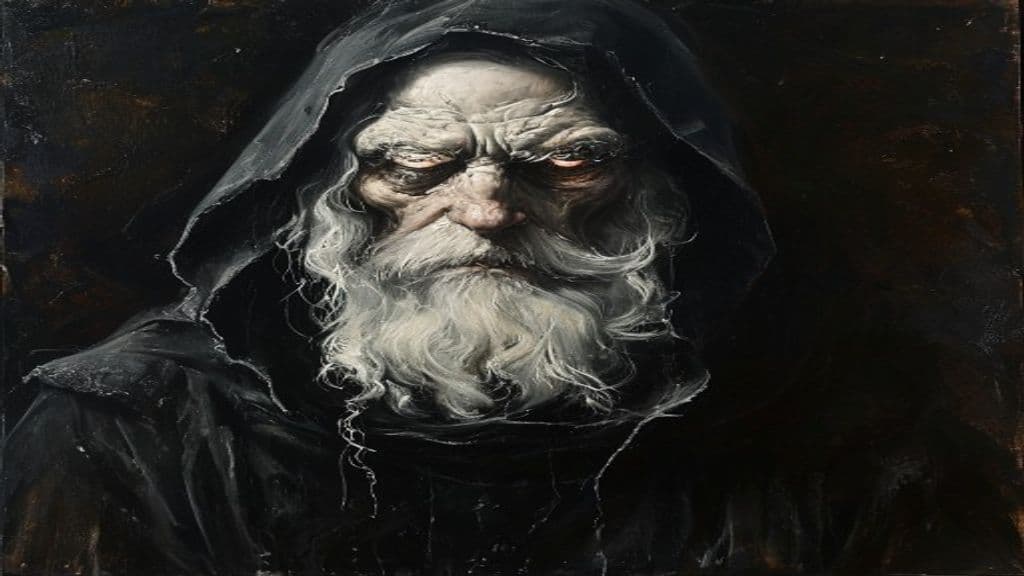
The Bergmönch is presented in German folkloric sources as one of a family of mountain and earth spirits that inhabit mines and pits. Rather than arising from a single cosmogonic origin, the Bergmönch functions within occupational and regional lore as a personified presence of the mountain-work environment: a spirit who dwells in the unseen mountain realm and interacts directly with miners. Sources situate him alongside dwarves (Zwerge), Bergmännchen, Erdkobolde and other localized spirits (for example the Swabian Halgeist), indicating a broad cultural pattern in which subterranean wealth and miner safety are imagined as mediated by sentient beings who reward industriousness and punish vice.
Accounts describe the Bergmönch as giant in size with white hair and very large, fiery-looking eyes "as large as dining plates." He is said to wear a black hooded cowl like a monk (the feature giving rise to the name Bergmönch) and may also appear dressed like a miner—under that style he is called Meister Hämmerling. Variants record that he can take the shape of a horse with a long neck and "terrible looking eyes," and that he is able to become invisible.
Reported behaviors and powers center on activity in pits and mines: he is active both deep in excavations and on the surface above them, filling excavated ore from one bucket to another and at times performing the work of miners. One account claims he can excavate more ore in an hour than miners can in a week. He may assist favored miners by excavating ore for them, revealing hidden lodes of gold and silver (on condition that the miner throw some of his mining tools into the offered lode) and by offering aid such as lamp oil that reportedly never diminishes if the recipient keeps the source secret. He enforces community morals by punishing vices named in the tradition—whistling, cursing, egoism, infidelity and idleness—and is described as hot-tempered and fond of hoaxes. Punishments attributed to him include violently maiming or displacing miners (one report says he can grasp a miner and put him down elsewhere with such force that the miner's limbs are shattered) and a poisonous breath said to be able to kill twelve people at once.
Weaknesses
- conditiondo not offend or mock the Bergmönch
- conditionavoid vices listed in tradition (whistling, cursing, egoism, infidelity, idleness)
- conditionmaintain secrecy about any supernatural boon (e.g., oil) received from him
Wards
- conditionrespectful behavior and non-mockery toward the mountain spirit
Abraun
Abraun is an attested name in German-language plant-legend scholarship (Der abraun, ein beitrag zur pflanzensagenkunde, 1916) and a short database entry (Wikidata) labels it as a spirit from German mythology. Surviving accessible documentation is extremely limited: the principal academic treatment is a 1916 contribution to pflanzensagenkunde (plant-saga studies), but the excerpts available here contain only bibliographic metadata and do not record tales, descriptions, or rituals.
Alp
A German-speaking folkloric figure associated with nocturnal disturbance of sleepers. Historically tied to the broader Germanic family of 'elves' and treated variously as an eerie nature-being in medieval glosses and as a male nocturnal spirit in later folk accounts that sits on sleepers' chests and causes nightmares (Alptraum) and 'elf-pressure' (Alpdruck).
Aufhocker
The Aufhocker is a German folkloric shapeshifting 'pressure' or 'perching' spirit that leaps upon the backs or shoulders of solitary travelers, weighing them down with each step until victims become exhausted, incapacitated, or—in some variants—killed. It is associated with liminal places (bridges, crossroads, hollow paths, cemeteries) and exists in multiple narrative roles including punitive agent, nightmare embodiment, and theriomorphic attacker.
Bieresel
A German household/local spirit associated with beer, breweries, inns and cellars, the Bieresel alternates between helping by performing chores in exchange for a nightly portion of beer and causing mischief or harm when neglected; some regional variants in Thuringia and former German‑speaking Bohemia depict street‑roaming, aufhocken behavior.
Buschgroßmutter
A female wood/forest spirit of German folklore, especially attested in Thuringia, Saxony, German Silesia and parts of Bohemia and Transylvanian Saxon tradition. She is an ancient, ambivalent grandmotherly figure of the underwood who may reward respectful helpers or punish mockery and transgression of forest norms.
Drak
The Drak is a household spirit in German folklore, attested under several regional names and frequently identified with the kobold or the devil (Teufel). Surviving references are brief and primarily classificatory, indicating a household-associated supernatural figure with variable local naming and associations.
Elwetritsch
A regional legendary chimera reported in southwestern Germany (especially the Palatinate): a bird‑like, chicken‑sized imaginary creature assembled from parts of different animals and embedded in local mock‑hunts and folk identity. One scholarly interpretation traces the modern motif to a linguistic and cultural miniaturization of older night‑pressure spirits (Albdrude/Albdruck), though this continuity is presented in sources as an interpretation rather than uncontested fact.
Erdhenne
The Erdhenne (German: 'Earth Hen') is a German house spirit from Alpine, Upper Palatinate, and Bavarian folk tradition that usually remains unseen but communicates by loud clucking to warn households of danger. When it becomes visible it is regarded as an omen of death—tradition records death within a year, often of the person it shows itself to.
Ewiger Jäger
A spectral huntsman from German, Belgian and Pennsylvania Dutch folklore condemned to an unending hunt. Usually portrayed as a formerly human hunter bound by oath, curse, sacrilege, or a dying injunction to pursue quarry ceaselessly, the figure is a local variant of the European wild hunt motif.
Feldgeister
Feldgeister are a class of German agricultural spirits or 'field spirits' associated with cereal crops, harvest processes and weather. The category groups many named local types (animal, human, and hybrid forms) implicated both in fertility of fields and in hazards such as child-stealing, illness, spoilage and storm phenomena.
Feuermann
A German-language folkloric luminous apparition described as a "fire man" or "fiery ghost," known in regional dialects by several synonymous names that emphasize burning, glowing, or flickering qualities. The Feuermann is presented in the supplied sources primarily as a named class of luminous phenomenon rather than through detailed narratives, rituals, or functions.
Klabautermann
A ship-bound household/ship spirit from North Sea and Baltic coastal folklore (Frisian, German, Dutch) that aids sailors and fishermen in work and warns of a ship's doom; normally unseen and helpful, its visible appearance is traditionally an ill omen.
Community Record
- [1]Bergmönch (Wikipedia). Wikipedia contributors. "Bergmönch." Wikipedia, The Free Encyclopedia.wiki
- [2]Bergmönch (Wikidata). Wikidata entry Q30308019.wiki
- [3]Introduction und Variation über ein Thema aus der Oper: "Der Bergmönch" von Wolfram : componirt für das Pianoforte : Op. 11. Archive.org catalog entry for a musical piece titled "Der Bergmönch."other