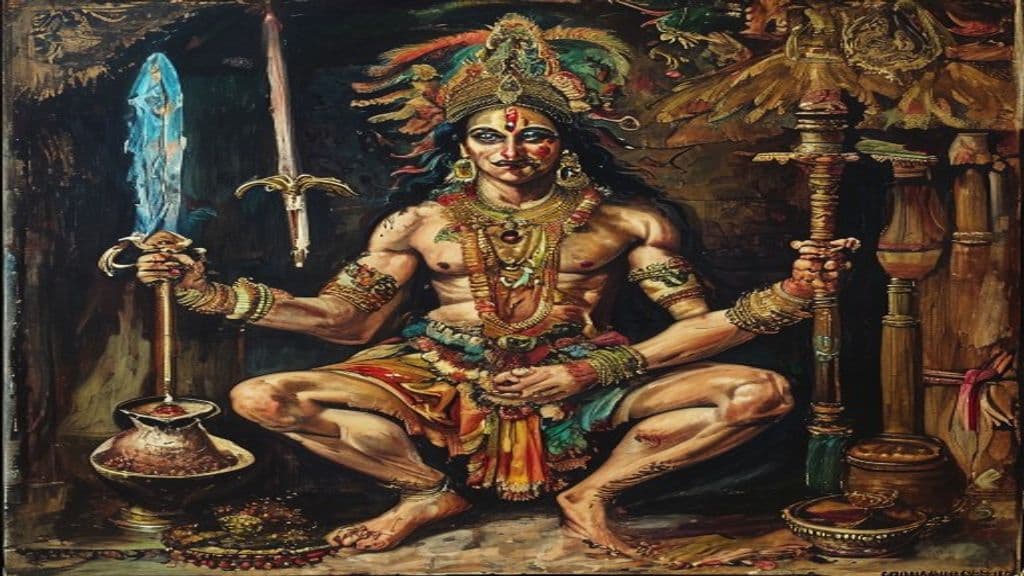
In regional and Puranic-influenced accounts Betal / Vetāla is treated as a Bhairava-form or Śiva-gaṇa figure connected to Śiva and Pārvatī narratives found in Śivapurāṇa and Kālikāpurāṇa traditions; local sources and scholarly summaries identify him as an incarnation/manifestation or attendant of Bhairava within the Śaiva mythic network. (Sources summarize this identification without offering a single definitive liturgical birth narrative.)
Traditional popular images are described as fierce, often portrayed nude and larger-than-life, holding a sword (khadga) and a bowl/patra (described in sources as a skull-bowl in popular accounts). Scholarly sources and ethnographic descriptions note two ritual registers—an 'Ugra Betal' (fierce) and a 'Saumya Betal' (gentle)—but iconography in sources centers on the sword and bowl attributes.
Betal functions primarily as a protective kshetrapāla and grāmadevatā of villages and households, enforcing local order and acting in the ambiguous protective/punishing mode associated with Bhairava and Śiva's attendants. Folk practice treats him as capable of beneficence when propitiated and dangerous if neglected; his comportment is managed through differentiated offerings and assimilation into Śaiva ritual frames.
Weaknesses
- ritualpropitiation by appropriate offerings (Ugra vs. Saumya regimen)
- otherassimilation into Śaiva worship / linga association (ritual containment by incorporation)
Wards
- ritualUgra Betal offerings (liquor and animal offerings)
- ritualSaumya Betal offerings (betel leaves, clothing, sandals)
- ritualregular village shrine maintenance and inclusion in local Śaiva practice
Berthold of Moosburg
Berthold of Moosburg (fl. 1316–1361) was a 14th‑century German Dominican theologian and scholastic commentator best known for his Expositio super Elementationem theologicam Procli, a lengthy commentary that seeks to reconcile Proclean Neoplatonism with Christian theological categories within Dominican scholasticism.
Bertilak (the Green Knight)
A lordly figure in the Matter of Britain who, in Sir Gawain and the Green Knight and related texts, is revealed to be the Green Knight in disguise. He functions as a host and supernatural tester who stages a beheading-game and a day-by-day exchange bargain to examine Sir Gawain's chivalric virtue.
Bes
Bes is an ancient Egyptian household protective deity, commonly kept close to domestic life to guard mothers, children, and childbirth; he also defends households against snakes and malevolent spirits and is associated with music, dance, and sexual vitality.
Beset
Beset is the feminine counterpart or female avatar of the household protector deity Bes in ancient Egyptian religion. Attested as a domestic protective figure, she is associated especially with mothers, children, and childbirth and is understood by sources as part of the Bes–Beset protective function opposing harmful influences.
Bestla
Bestla is a jötunn (giantess) in Old Norse mythic genealogies, attested as the mother of Odin, Vili, and Vé by the giant Borr. She functions primarily as a maternal progenitor in the medieval Icelandic corpus (Poetic Edda, Prose Edda, and skaldic verse), and surviving references to her are sparse and fragmentary.
Beta Ray Bill
Beta Ray Bill is a fictional extraterrestrial warrior and comic-book character created by Walt Simonson for Marvel Comics. Introduced in The Mighty Thor #337 (1983), he is a Korbinite champion revived by a sentient ship who becomes able to wield Thor-like power and is later given his own hammer, Stormbreaker.
Betelgeuse (Beetlejuice)
A fictional character in the 1988 film Beetlejuice who appears in the movie's bureaucratized afterlife. Portrayed by Michael Keaton, he is depicted in-universe as a former caseworker's assistant turned freelance 'bio-exorcist' whom the recently deceased may summon to frighten or remove living occupants.
Bethel (House of El)
Bethel (Hebrew: Bēṯ ʾĒl, "House of El" or "House of God") is primarily a sacred place-name in the Hebrew Bible denoting a sanctuary, an anointed cult-stone (baetyl), and—in some interpretive traditions—a localized manifestation or hypostasis of the divine associated with that site.
Betobeto-san
A Japanese yōkai manifesting as the sound of footsteps that follow lone travelers at night. Traditionally regarded as non‑harmful: walkers are advised to step aside and address it politely to have the footsteps pass.
Betsy Bobbin
Betsy Bobbin is a human child character in L. Frank Baum's Oz books who arrives in Oz (notably by shipwreck with her mule Hank) and becomes a resident guest of Ozma's court, appearing in several canonical Oz volumes and later adaptations.
Betsy Braddock
A fictional comic-book superheroine published by Marvel Comics, introduced in Captain Britain #8 (1976). Portrayed as a human mutant (born with an X-gene) whose principal abilities are telepathy and telekinesis; she has served as a member of the X-Men, Excalibur and, in recent status quo, assumed the mantle of Captain Britain.
Bette Kane
Bette Kane (originally Betty Kane) is a human costumed heroine in DC Comics who began as the pre-Crisis Bat-Girl (Betty Kane) and was reimagined in post-Crisis continuity as Mary Elizabeth "Bette" Kane, taking the Flamebird mantle and operating as a West Coast/team-based adventurer. She is a legacy figure whose history and identity have been reshaped by editorial continuity events.
Community Record
- [1]Betal (Wikipedia). Wikipedia contributors, 'Betal,' Wikipedia, The Free Encyclopedia, https://en.wikipedia.org/wiki/Betal (accessed via provided research notes).wiki