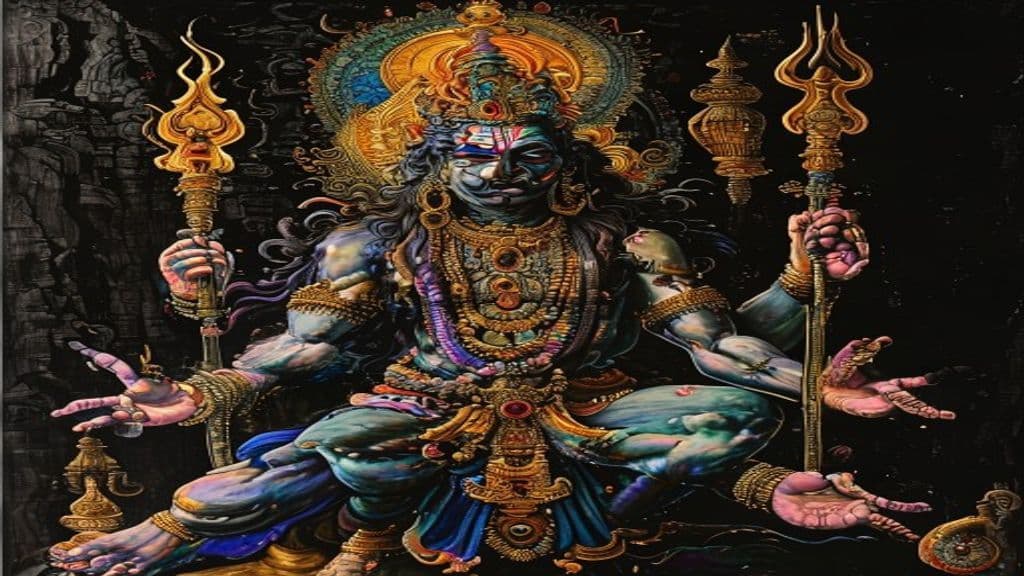
In Hindu Shaivite myth Bhairava is produced by Shiva (accounts state emergence from between Shiva's brows or from a lock of hair) as a fierce manifestation to punish Brahma for arrogance; Bhairava decapitates Brahma's fifth head. Having committed brahmahatyā (the murder of a Brahmin), Bhairava wanders the three worlds pursued by the personification of that sin until, upon reaching Kashi (Varanasi), the sin leaves him and the skull is released—an aetiology linking violent divine action to the need for atonement and sacred geography.
Sources describe Bhairava as fierce and fearsome; epithets record specific attributes: Daṇḍapāni ('he who holds the daṇḍa/rod') indicating a punitive staff, and Śvāśva linking him with a dog as vehicle. Buddhist tantric forms (Vajrabhairava, Heruka, Mahākāla, Yamantaka) are described as wrathful meditational deities used as yidams; such forms in tantric contexts are presented as fierce, often complex iconographically in their traditions.
Bhairava functions mythically as executor of divine punishment (notably decapitating Brahma's head) and as the agent who bears and then is purified of brahmahatyā; cultically he is guardian of Śaiva shrines and Shakta pīthas. In Kashmir Shaivism (Trika) Bhairava is equated with the Absolute (Para Brahman) and is the speaker of tantric soteriological instructions (the Vijñāna Bhairava Tantra presents 112 meditation methods). In Vajrayāna Buddhism Bhairava-forms (e.g., Vajrabhairava, Heruka) serve as fierce emanations of Mañjuśrī, dharmapālas and yidams whose tantric practice aims to transform anger/hatred into insight and protect the doctrine.
Weaknesses
- ritualmythic expiation at Kashi (Varanasi)
Wards
- ritualcultic propitiation (worship at Bhairava shrines; observance of Bhairava Ashtami and monthly Kalashtami)
Brahmā
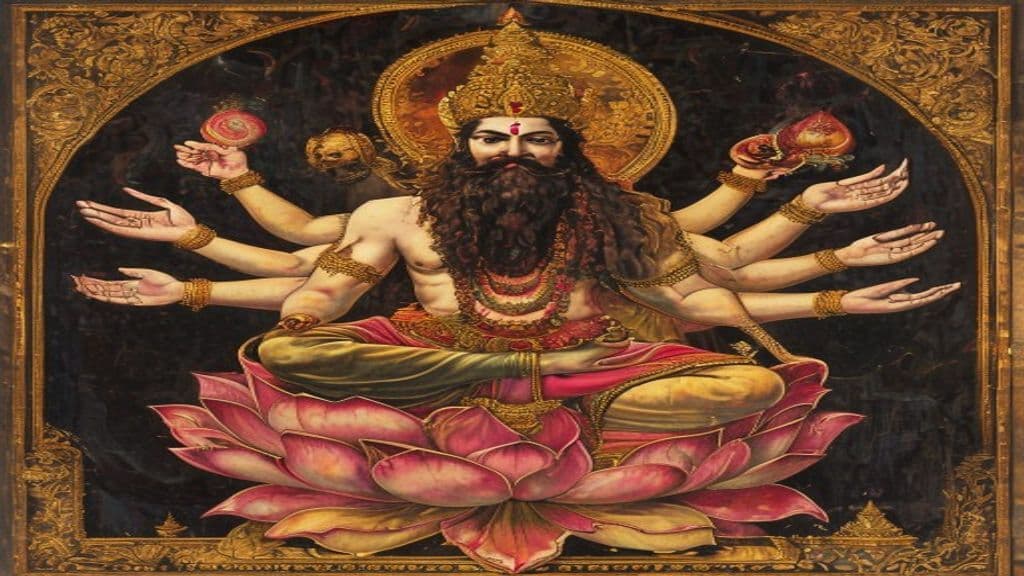
Brahmā is the personified Creator god in Hindu textual tradition, presented as the creative member of the Trimurti (with Viṣṇu and Śiva). In Purānic cosmogonies he is said to emerge as Svayambhu from Hiranyagarbha (the golden egg) and to produce the world and living beings; the term is distinct from the impersonal metaphysical brahman.

Bhairavi
Bhairavi (Sanskrit: भैरवी) is a Mahāvidya — a fierce form of the Great Mother in Hindu tantric and Puranic traditions. She appears both as a deity, consort of Bhairava, and as a title or attainment for a female tantric adept (a realized yogini). Iconography and texts portray her as awe-inspiring and ambivalently maternal: protective to devotees and terrible to the wicked.
Beyonder
The Beyonder is a Marvel Comics fictional extra‑multiversal sentient energy being described as the conscious manifestation of the 'Beyond‑Realm'. Originally presented as a near‑omnipotent entity who abducted Marvel heroes to Battleworld, later continuity retcons identify it with Cosmic Cube energy or as a child unit of a race called the Beyonders.
Beyul Guardian Spirits
Place‑bound guardian spirits associated with beyul (Tibetan sBas yul), the concealed or hidden valleys of the Himalayas and Tibetan plateau. They function as protectors and gatekeepers of these sacred, fortress‑like lands and are integrated into Nyingma treasure (terton) traditions and local Himalayan ritual practice.
Bhadra (भद्र)
Bhadra is a Sanskrit word meaning 'good', 'fortunate', or 'auspicious' that functions in Hindu literature as a personal name and epithet applied to multiple distinct mythic persons and forms (queens, yaksha, goddess-forms, kings, and others) rather than a single unified supernatural being.
Bhadrakali
Bhadrakali is a fierce form of the Hindu supreme goddess Adi Shakti worshipped especially in South India. She functions as a martial and protective divine person who destroys wickedness in mythic narratives, protects women and lineages, and is integrated into Shaiva, Vaishnava, and Shakta registers.
Bhagavatī
Bhagavatī is an honorific Sanskrit epithet applied to revered female divinities in Hinduism and Mahayana Buddhism rather than a single individualized spirit. The title functions as a respectful form of address for goddesses such as Sarasvati, Lakshmi, Parvati and certain Buddhist female deities (e.g., Cundā) and is the feminine counterpart to Bhagavān.
Bhairav (tantrik)
A complex figure in Hindu tradition, associated with Shiva as the destroyer or transformer. He is a powerful tantric disciple of Guru Gorakshanath and appears in various contexts within Hindu mystical traditions. (Note: - Power tier should be adjusted to Greater (powerful regional) as Bhairav's abilities are related to Shiva, but he is not a cosmic being himself. - Appearance: Add that no detailed physical descriptio)
Bhairavi
Bhairavi (Sanskrit: भैरवी) is a Mahāvidya — a fierce form of the Great Mother in Hindu tantric and Puranic traditions. She appears both as a deity, consort of Bhairava, and as a title or attainment for a female tantric adept (a realized yogini). Iconography and texts portray her as awe-inspiring and ambivalently maternal: protective to devotees and terrible to the wicked.
Bhaisajyaguru
Bhaisajyaguru (Bhaiṣajya‑guru; Medicine Buddha) is a Mahāyāna buddha associated with healing, medicine, and a pure land called Vaiḍūryanirbhāsa (Pure Lapis Lazuli). He functions as a therapeutic savior whose remedies operate through the "medicine of his teachings," vows, devotional practice, and radiance associated with lapis‑lazuli light.
Bhaiṣajyarāja (Medicine King Bodhisattva)
Bhaiṣajyarāja (Sanskrit: Bhaiṣajyarāja; Chinese: 藥王 Yào Wáng) is a Mahāyāna bodhisattva associated with healing, medicine, and supreme self‑offering. He appears in the Lotus Sūtra and in visualization/contemplation sutras and is often connected ritually and iconographically with the Medicine Buddha (Bhaiṣajyaguru) and with the paired bodhisattva Bhaiṣajyasamudgata.
Bhaiṣajyasamudgata
A Mahāyāna bodhisattva associated with the therapeutic activity of the Buddha and invoked in visualization (Guan) sūtras. He is named alongside the Medicine King (Bhaiṣajyarāja) and is the co-subject of a dedicated contemplation sūtra used in meditative-healing practice.
Bharadvaja
Bharadvaja is a canonical Vedic maharṣi (sage) and eponymous progenitor of a lineage and multiple textual corpora in ancient Indian tradition. Treated as an authoritative seer, teacher, and recipient/attributor of ritual, technical, and ethical knowledge, his name appears across Vedic, epic, Purāṇic, and Buddhist literature as an individual sage and as a clan/author label.
Bharata (Mahābhārata)
Bharata (Sanskrit: भरत) is a legendary human emperor and ancestral king in the Indic epic tradition. Portrayed as a cakravartin‑type sovereign and progenitor, his deeds, rituals, and lineage provide an eponymous foundation for the name Bhārata and for later dynastic identity.
Community Record
- [1]Bhairava. Wikipedia: Bhairavawiki
- [2]Bhairava (Wikidata). Wikidata Q854730other
- [3]Chapter 17 Solar Chakra V 3 1 (archive reference). Archive.org resource cited in research notesother
- [4]Chapter – 6 Uttarartha - Part 1 of 2 (archive reference). Archive.org resource cited in research notesother