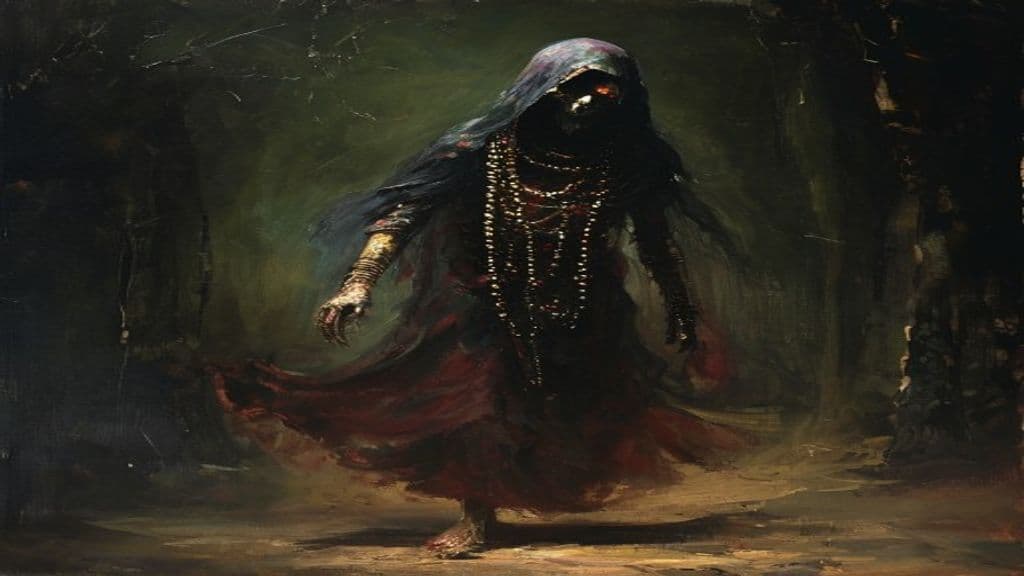
Any death that is unclean — suicide, murder, accident, dying far from home, dying without the last rites — may produce a bhoot. The soul, unable to complete its passage, remains attached to the place or person who caused it unfinished business.
Unlike more classified supernatural beings, bhoot is the generic term — many regional variants (chudail, pret, pishacha, mumiai) are specific bhoots given names, much as ghost is used across traditions in English.
The supplied source does not provide fixed physical descriptions. Across popular and literary usages the term denotes the ghost of a deceased person and therefore may be represented as the departed individual's form or as a non‑corporeal presence; the source emphasizes identity as a human soul rather than describing consistent visual traits. Regional narratives and artistic traditions vary—some contexts portray bhootas as manifesting in recognizably personal ways tied to the deceased, while others treat them as formless or immaterial—though such variants lie beyond the specific details given in the summary source.
The source characterizes bhootas primarily by their unrest: they are perturbed and remain in the realm of the living because of impediments to their onward transition. While the excerpt does not enumerate concrete supernatural powers, it frames typical behaviors associated with such restless spirits (lingering among the living, being bound to matters left unresolved, and potentially affecting those connections). More specific claims about possession, direct harm, or specific miraculous or maleficent capacities are not detailed in the provided material and therefore remain unspecified in this account.
Weaknesses
- conditionproper funerary rites (prevention/remedy)
Wards
- ritualproper funeral rites
Agiya Baital
The fire-form of the Vetala — a cremation ground spirit of UP and Bihar that manifests as a wandering flame rather than a corpse-inhabitor, leading night travellers off roads and into marshland or flames with a dancing fire that seems always just ahead.
Aleya
Ghost lights of the Sundarbans delta — flickering flames over swamp water said to be the souls of dead fishermen, luring the living off safe paths into drowning waters.
Angiras
Angiras (Sanskrit Aṅgiras/Aṅgirāḥ) is primarily a Vedic rishi (sage) and eponymous lineage (Angirasa) associated with authorship of Vedic hymns, priestly/fire functions, and transmission of mantras; later Puranic accounts multiply his identities in genealogies and lists of sages.
Ap (the Waters)
Ap (Vedic áp-, Classical Sanskrit āpas/āpa-) denotes the sacred category of 'the waters' in Vedic/Hindu thought: a physical element (water), an animate cosmic principle addressed in Rigvedic hymns, and an elemental category later counted among the Panchamahabhuta. The term names collective waters invoked in ritual, is linked to deities such as Varuna and the epithet Apām Napāt, and survives in related Indo-Iranian vocabularies (Avestan āpō/Aban, Persian āb).
Apsara
Celestial dancers and water nymphs of Hindu cosmology — beautiful semi-divine beings who dance at the court of Indra and, by his command, descend to earth to distract sages from excessive asceticism.
Ashi-magari
Ashi-magari (足まがり) is a ghostly phenomenon from Kagawa Prefecture, Shikoku, Japan, described as a soft, unseen thing that wraps around a person's legs at night and impedes walking. It is commonly presented in local accounts as a tactile obstruction rather than a visually manifest creature and is often attributed to tanuki trickery.
Bhoma
Primordial earth deity in Balinese mythology associated with fertility and vegetation. (Note: 1. Power tier should be Primordial, which is correct. 2. Appearance description matches source material; no corrections needed. 3. Abilities: Add "liminal space between wilderness and human settlement)
Bhoota (ghost)
A bhoota (Sanskrit: भूत, bhūta) is a class of supernatural beings in South Asian traditions most commonly identified as the restless ghost of a deceased person. Depending on region and context a bhoota may be feared as a harmful, perturbing spirit or worshipped and integrated as a local protective spirit or demigod (notably in Tulu Nadu practices).
Bidadari
Bidadari is a Southeast Asian regional term related to the South Asian apsara: a class of celestial/ethereal female beings originally associated with clouds and water in Hindu and Buddhist cosmology, later represented in regional art and performance as nymph- or fairy-like figures. The term is also widely used in modern Southeast Asian toponymy and popular culture (place names, media, vessel names), distinct from detailed mythic narratives in the provided sources.
Bordoisila
The storm deity of spring in Assamese tradition — Bordoisila is the daughter of Brahma who visits her mother's home at the end of winter, and whose journey back creates the violent pre-monsoon storms of April and May. She is a goddess-spirit propitiated in Assam for thousands of years.
Brahmadaitya
Bengal's most distinctive ghost: the spirit of a Brahmin who died celibate — before marriage, or having taken a vow of celibacy — whose accumulated learning and unfulfilled life persists. Unlike the North Indian Brahmpret, the Brahmadaitya is often passive or even helpful, but its presence makes any household it inhabits spiritually unsettled.
Brahmarakshas
The most learned and terrible of spirits — the ghost of a Brahmin who misused his scriptural knowledge in life and was condemned after death to be both demon and scholar, haunting places of learning.
Community Record
- [1]Bhoota (ghost) — Wikipedia. Wikipedia, 'Bhoota (ghost)'wiki
- [2]Bhoot (film). Wikipedia, 'Bhoot (film)'other
- [3]Bhoot Returns. Wikipedia, 'Bhoot Returns'other
- [4]Bhoot FM — 23 March 2012 (archive). Archive.org, 'Bhoot FM — 23 March 2012'other
- [5]Bhoot FM — 26 August 2011 (archive). Archive.org, 'Bhoot FM — 26 August 2011'other
- [6]Bhoot FM — 09 March 2012 (archive). Archive.org, 'Bhoot FM — 09 March 2012'other
- [7]Bhoot Ghar: Sounds of the Kathmandu Horror House — Aaron Dilloway (LP product page). Soundohm product page for Aaron Dilloway, 'Bhoot Ghar: Sounds of the Kathmandu Horror House'other
- [8]Strange Horizons — 'Bhoot Part One: The Haunted Ship' by Neha Yadav. Strange Horizons, 'Bhoot Part One: The Haunted Ship' by Neha Yadavother
- [9]Gurbani Blog — 'Bhoot Pret' (discussion/critique). Gurbani Blog, 'Bhoot Pret – Ghost…' (critical commentary)folk
- [10]BizHat.com — Bhoot Returns Movie Review. BizHat.com, 'Bhoot Returns Movie Review'other
- [11]Jayesh Bhoot — 'Bhoot' developer site. Jayesh Bhoot, 'Bhoot' websiteother
- [12]The Popular Religion and Folk-Lore of Northern India. Crooke, William. 1896. The Popular Religion and Folk-Lore of Northern India. Archibald Constable.academic
- [13]Death in Banaras. Parry, Jonathan. 1994. Death in Banaras. Cambridge University Press.academic