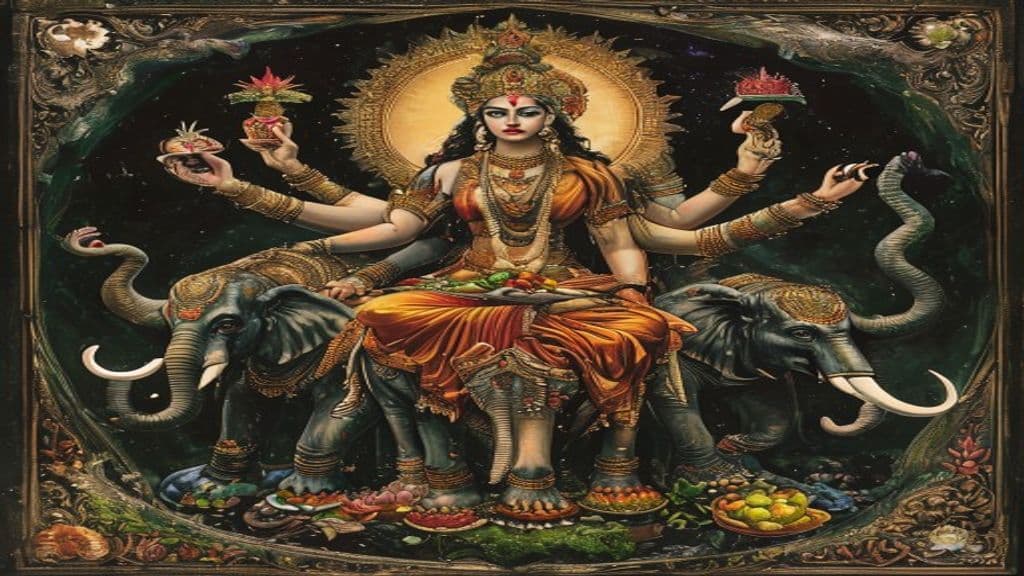
Rooted in the Vedic goddess Prithvī, Bhūmi is the divine personification of the Earth in Purānic and later Hindu narratives. In Purānic chronology her distress or concealment (for example, being hidden in the cosmic waters by the asura Hiranyakṣa) provokes Viṣṇu to take avataric form (Varāha) to rescue her; in other episodes (the Prithu story) she withdraws her bounty until a righteous ruler compels her to yield sustenance. She also functions as a maternal source in origin myths: for example, Sītā is described in Purānic-derived accounts as emerging from the earth and thus as Bhumija. (Sources: Wikipedia: Bhumi (goddess); Kanyakumari Yatra excerpt; Purānic summaries cited in the supplied materials.)
Iconographically Bhūdevī is often shown seated on a platform supported by four elephants (symbolizing the four directions). Some descriptions present her with four arms holding items such as a pomegranate, a water vessel, a bowl of healing herbs, and a bowl of vegetables; other common depictions show two hands (right holding a blue lotus — kumuda/utpala — and left in abhaya-mudrā or a Lolahasta pose). She frequently appears alongside Viṣṇu or his Varāha avatar in Vaishnava imagery. These details are attested in Purānic and later summaries and are reported in the cited overviews, though iconographic variants occur across regional traditions. (Source: Wikipedia: Bhumi (goddess).)
As the divine Earth Bhūmi is the mythic source of vegetation, sustenance, and the material basis for life; Purānic narratives attribute the origin of virtues and nourishment to her in symbolic terms. She can be petitioned or portrayed as oppressed—myths describe her being concealed or abducted by asuras (e.g., Hiranyakṣa) and rescued by Viṣṇu as Varāha, and in the Prithu episode she withdraws her bounty and takes the form of a cow until the ruler pacifies and milks her to restore sustenance. She gives birth to or produces important figures (for instance, Sītā as Bhumija) and may request ritual action (yajña) by other divine agents to generate manifestations that address cosmic problems. Her condition functions as an index of cosmic and moral order rather than as a hostile spirit to be fought. (Sources: Wikipedia: Bhumi (goddess); Purānic episode summaries; Kanyakumari Yatra excerpt.)
Weaknesses
- conditionCan be oppressed/hidden by asura action or by wrongful rule (narrative vulnerability exemplified by Hiranyakṣa's abduction and the Prithu narrative of withdrawn bounty)
Wards
- ritualYajña (sacrificial rite) — invocation to produce or manifest a goddess
Community Record
- [1]Bhumi (goddess) — Wikipedia. Wikipedia, 'Bhumi (goddess)'wiki
- [2]Kanyakumari Yatra (Archive excerpt). Kanyakumari Yatra excerpt (archive.org)other
- [3]Purānic summaries (Varāha rescue, Prithu episode, Sītā birth) — cited in supplied materials. Summaries of Purānic episodes referenced in the provided research notes (Varāha rescue of the Earth; Prithu milking episode; Sītā as Bhumija).literary