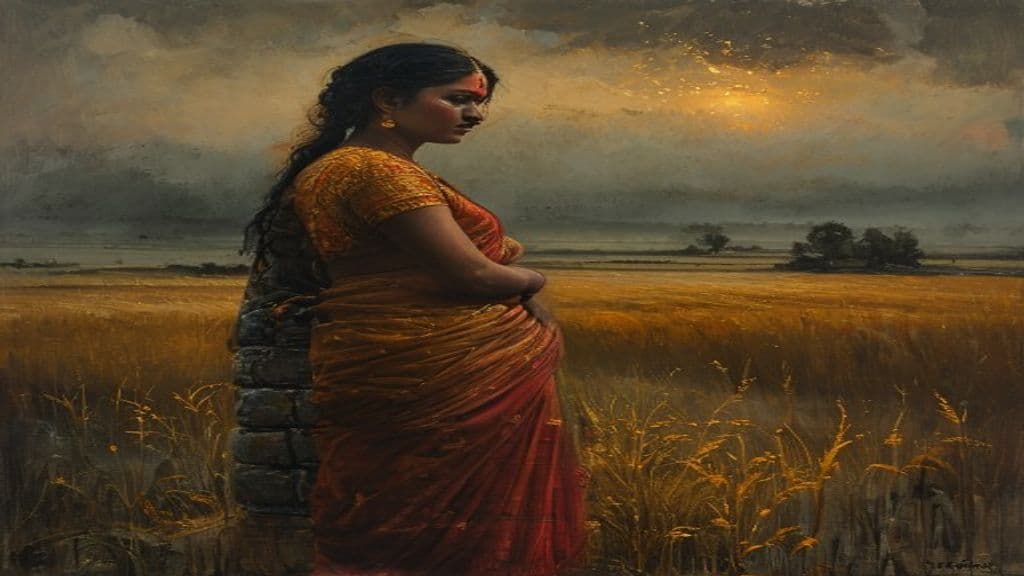
In Bihar's agricultural communities, the Bhunni is the feminine spirit energy of a specific plot of land — not a universal deity but an entity tied to a particular field, sometimes across generations. She is believed to be the spirit of the first woman to have worked a piece of land, or in some accounts, the spirit of a woman who was buried in the field during an older time when the land was first cleared.
Before the first ploughing of each season, farmers in some Bihar districts still perform the Bhunni-puja: a small offering of turmeric, sindoor, and cooked rice placed at the field's boundary stone, accompanied by a spoken request for permission to begin work.
The Bhunni is described as a woman of indeterminate age in a red or ochre sari, seen at the field's edge at dawn or dusk. She is rarely frightening in appearance; farmers who describe her use words like 'serious' or 'watchful' rather than threatening.
When she is angry, the manifestation shifts: the same figure is seen standing in the middle of the field at night, not at the edge, and her sari colour appears darker. Standing in the middle is the signal that something has been done wrong.
A pleased Bhunni makes the soil yield exceptionally well. Her punitive repertoire includes: causing the plough to break repeatedly, making workers fall ill with fever specifically when in the field (but nowhere else), and causing the harvest to rot in the storage room after it has been successfully brought in.
She does not harm people outside her field. Her authority is entirely territorial.
Weaknesses
- ritualBhunni-puja before first ploughing
Wards
- symbolRed thread tied to the boundary stone before ploughing
Community Record
- [1]Village India: Studies in the Little Community. Marriott, M. (Ed.). (1955). Village India: Studies in the Little Community. University of Chicago Press.academic
- [2]Agricultural ritual and land spirits in Bihar. Briggs, G.W. (1920). The Chamars. The Milaras Mission Press, Lucknow.academic