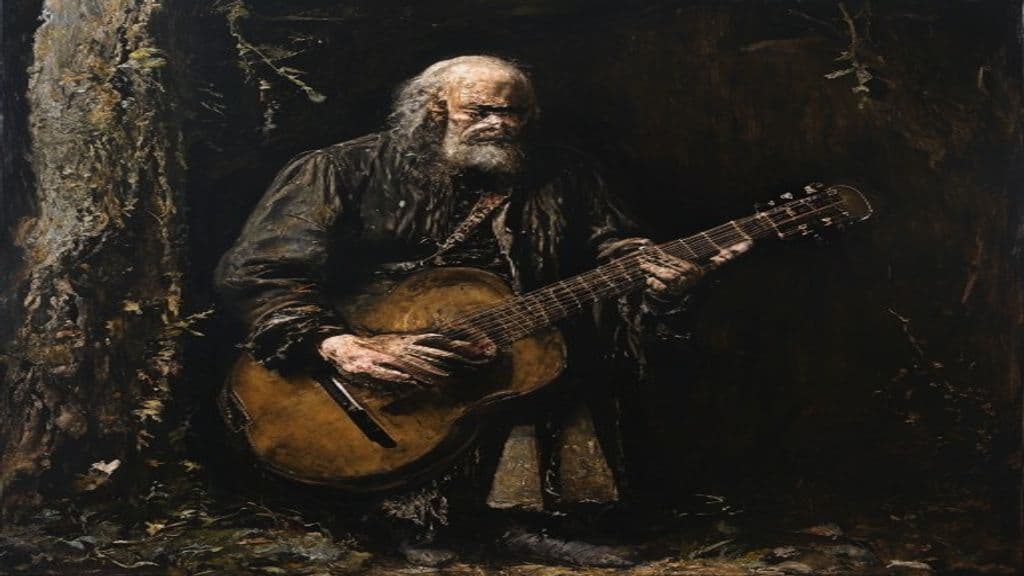
Attestations for Billy Blind come from narrative ballads (the Child Ballads) rather than prose origin myths; the provided sources do not record an independent cosmogonic origin story. Secondary commentary included in the source material offers speculation that the character may be a folk-memory or vestigial echo of older Germanic deity imagery (for example, a playful aspect of Woden/Odin) or that he may relate to Scottish figures such as 'Blind Harie.' Those suggestions are explicitly presented as scholarly or speculative hypotheses in the secondary source material and are not established within the ballads themselves.
The supplied materials do not provide a detailed or consistent physical description of Billy Blind in the ballads. The primary characterization in the sources is functional—he is a household spirit 'much like a brownie' who appears within ballad narratives to give advice—rather than a described visual type. Modern fictional adaptations (not primary traditional sources) sometimes portray him visually, but no traditional-size, clothing, or facial-feature descriptions are provided in the cited summaries.
In the documented ballad examples Billy Blind's abilities are advising, revealing hidden facts, and directing or prescribing stratagemic or ritualized actions that neutralize hostile magic or resolve social crises. Specific examples in the source summaries: in 'Gil Brenton' (Child no. 5c) he advises that the bride beside the hero is not the true bride and reveals the true situation; in 'Willie's Lady' (Child no. 6) he prescribes making a wax baby and staging a christening to force the witch-mother to reveal and thereby undo her enchantments; in 'Young Bekie' (Child no. 53C) he advises Burd Isobel and aids a magical journey to reach the bridegroom; in 'The Knight and the Shepherd's Daughter' (Child no. 110) he appears in variants to reveal hidden facts about births. The sources present these functions within narrative contexts; they do not ascribe cosmic, elemental, or broadly destructive powers to him.
Weaknesses
- otherNo traditional weaknesses recorded in provided sources
- otherIf any limitations are inferred from brownie-like category, such inferences are speculative and not documented in the cited materials
Wards
- otherNo traditional wards or protective measures against Billy Blind are recorded in the provided sources
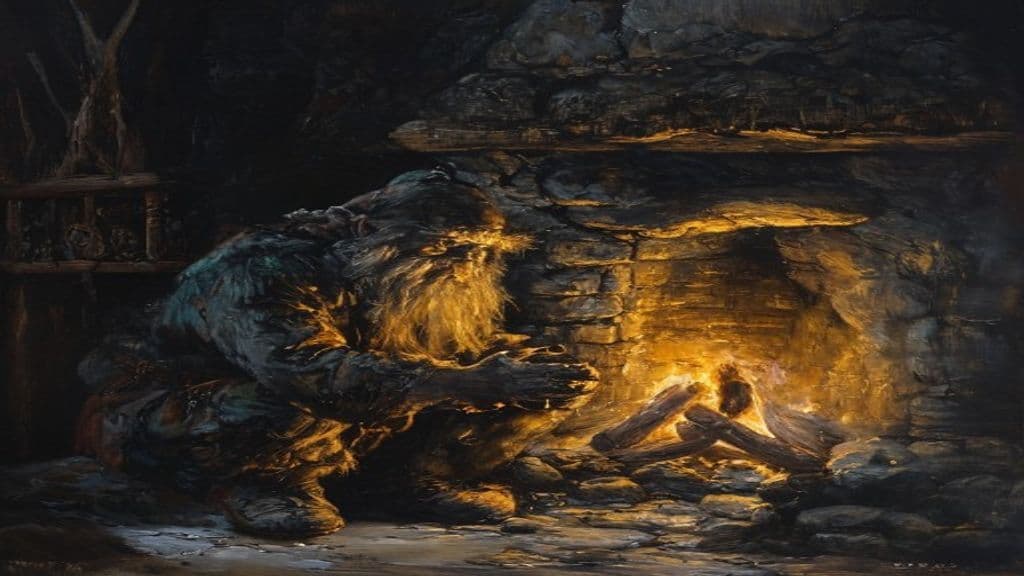
Domovoi
The house spirit of Slavic tradition — a small, invisible guardian of the home bound to a specific dwelling and its family. Protective when respected; dangerous when insulted or forgotten.
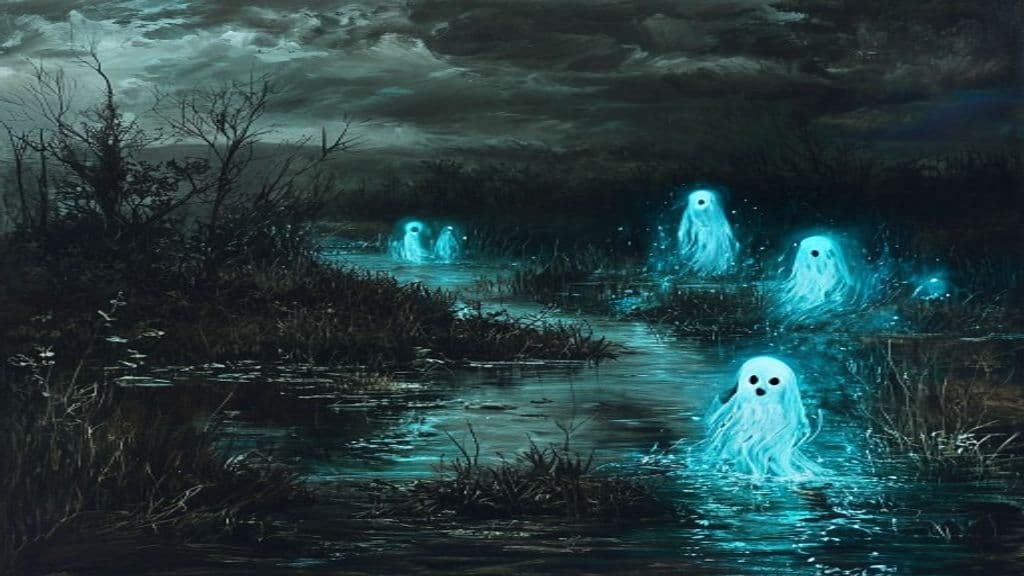
Will-o'-the-Wisp
A wandering light seen over marshy ground at night, leading travellers astray into bogs and fens. Possibly a spirit, possibly the soul of the unbaptised dead, possibly the devil himself.
Black Dog (folklore)
A class of supernatural canine apparition in British vernacular folklore, often associated with liminal places and regarded as an omen-bearing or guardian hound. Local named forms (Black Shuck, Barghest, Gurt Dog, Gallytrot) show a range from malign, death-portending hellhounds to benevolent guide-figures.
Blunderbore
Blunderbore is a stock giant of English and Cornish folklore, appearing as a corporeal monstrous antagonist in tales such as Jack the Giant Killer and regional variants like Tom the Tinkeard. He is depicted through his actions—kidnapping, highway obstruction, and violent strength—and is typically overcome by a human folk-hero who frees captives and reasserts social order.
Brown Man of the Muirs
A moorland guardian figure from Anglo-Scottish Border folklore. In a field account he appears as a solitary dwarf who reproves hunters and claims custodianship of upland animals; in later fairy-tale literature he appears as (or is related to) a tribe—the Brown Men of the Moors and Mountains—associated with stronger, more violent motifs and a compulsion-incantation.
Bugbear
A folkloric scare-figure historically invoked to frighten disobedient children, classed among boogeyman-type beings. Medieval descriptions in English sources portray it as a creepy, bear-like lurker in woods; modern popular culture and gaming have reimagined it as a large goblinoid monster.
Cap-o'-Rushes
Cap-o'-Rushes is the title and heroine of an English folktale collected by Joseph Jacobs. The story is classed among international folktale types (principally ATU 510B) and opens with the 'Love Like Salt' motif; it tells of a daughter who disguises herself in a garment of rushes, works as a kitchen maid, attends secret balls, causes recognition by hiding a ring in a dish, and engineers reconciliation by ordering a saltless wedding feast so her father remembers his earlier words.
Church Grim
A site-bound guardian spirit in English, Scottish and Nordic/Scandinavian folklore that watches over an individual Christian church and its churchyard, defending the consecrated ground from profanation and hostile spirits. Forms and origin accounts vary by region, including a large black dog in English tradition, the bound spirit of an animal (often a lamb) in Scandinavian accounts, and in some Scottish strands the spirit of the most recently buried person acting as a temporary watcher.
Dando's Dogs
Dando's Dogs are an English folkloric pack of spectral hounds tied to the tale of a sinful huntsman named Dando. They are classed among English 'black dog' apparitions and described as taking part in the Wild Hunt; tradition reports their sounds on early Sunday mornings as they pursue game or search for their master after his abduction.
Firedrake
A term in English tradition for dragon-shaped manifestations of fire observed in the sky; used both as an Old English poetic word for dragon (fyrdraca) and, from the Renaissance onward, to describe luminous aerial phenomena such as meteors or ignis fatuus. Sources treat firedrakes variously as mythic dragons, atmospheric luminous vapors, or morally charged apparitions (e.g., the Devil in dragon form).
Freybug
The Freybug (also Fray‑bug) is a named monstrous Black Dog from English folklore, recorded in association with Norfolk. Cited in early modern letters and later antiquarian commentary, it is described chiefly as a large black canine apparition that wanders country roads and terrifies travellers.
Goblin
A class of small, often grotesque humanoid beings in European folk belief that range from household helpers to tricksters and violent figures. Goblins occupy liminal spaces—hearths, cellars, ruins and wild places—and their behavior toward humans depends on region, story, and reciprocal treatment.
Herne the Hunter
Herne the Hunter is a place-bound ghost of English folklore associated with Windsor Forest and the Great Park in Berkshire, tied to a specific oak known as Herne's Oak. Sources describe him as a horned, mounted spectral figure who rattles chains, torments cattle, and blasts or withers trees; many later details derive from 19th–20th century literary elaboration.
Jenny Greenteeth
A figure of northern‑English folklore personifying dangerous still and slow freshwater. Presented as a green‑skinned river‑hag who lures or seizes children and the elderly into ponds, rivers, and lakes; stories function primarily as cautionary warnings about aquatic hazards.
Community Record
- [1]Billy Blind — Wikipedia. Wikipedia, 'Billy Blind' entry — summary of attestations in Child Ballads and secondary commentarywiki
- [2]Wikidata: Billy Blind (Q4912222). Wikidata item classifying Billy Blind as a household sprite in British folkloreother
- [3]Archive references (modern adaptations and mentions). Archive.org item listed among source materials provided; mentioned in the research notes as part of compiled materials (not a primary ballad text)other
- [4]Archive references (modern adaptations and mentions). Archive.org item listed among source materials provided; mentioned in the research notes as part of compiled materials (not a primary ballad text)other
- [5]Archive references (modern adaptations and mentions). Archive.org item listed among source materials provided; mentioned in the research notes as part of compiled materials (not a primary ballad text)other