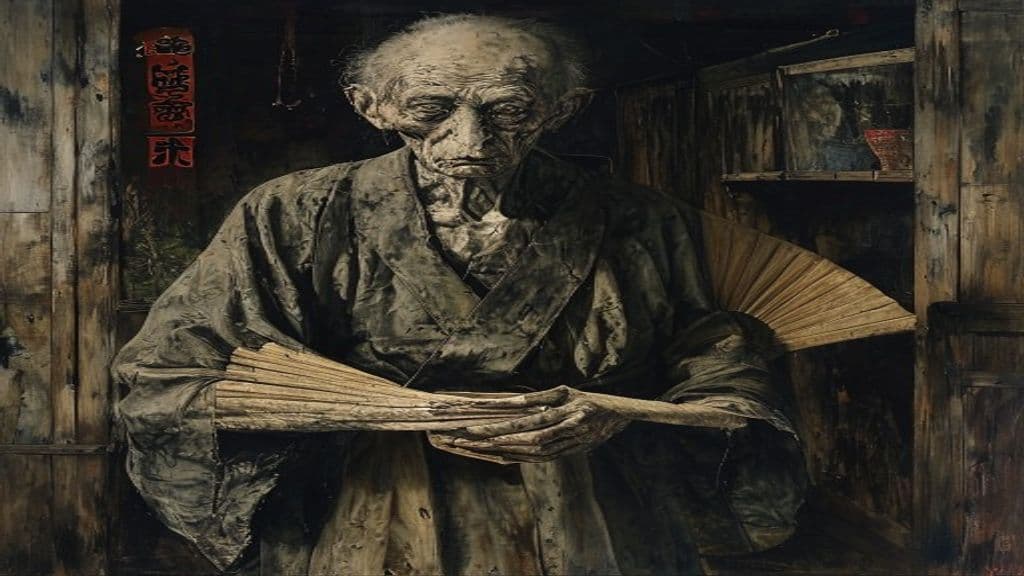
Binbōgami appears in medieval and early-modern Japanese narratives and popular belief as a poverty-associated kami. A 13th-century tale in the Shasekishū names a Lord Poverty (Hinkyū-den) who is expelled by monks, and later medieval and Edo-period collections and local customs preserve stories in which a household's long misfortune is explicitly attributed to a binbōgami. Urban rumors from the Muromachi period (e.g., a 1481 Kyoto rumor) also frame the being within civic hopes and rivalries between places and their fortunes.
Accounts commonly describe binbōgami as a skinny, dirty old man with a pale complexion, often carrying a paper fan (shibu-uchiwa) and wearing a sad expression; some Edo-period and popular summaries add minor variant details such as a broken geta or fondness for particular domestic foods. When said to inhabit dwellings, it is reported to prefer confined spaces such as closets. Visual details vary across texts and later media adaptations, but the recurring iconography in ethnographic summaries emphasizes an emaciated, shabby male figure associated with domestic interiors.
In tales and customs binbōgami is responsible for bringing poverty, continual misfortune, and sometimes sickness to a person or household. It may inhabit a person or a residence and is described as attachable to objects or drawn by certain household signs in narrative accounts. Sources record that it can be negotiated with: it can be lured out and discarded, expelled by ritual specialists, temporarily enshrined and then sent away, or transformed into a fukugami (god of good fortune) by acts of hospitality. Because it is framed as a kami in many sources, stories emphasize that it cannot be killed but only driven off or severed from a household.
Weaknesses
- ritualLured disposal by baked miso/oshiki into running water
- symbolPeach branches struck with chant (monastic expulsion)
- conditionHousehold hearth heat on Ōmisoka (drives it away in Niigata custom)
Wards
- ritualLighting and tending the irori on Ōmisoka
- ritualTemporary enshrinement and sending-off after a period (Ōta Shrine / Nippon Eidaigura practice)
- ritualMonastic expulsion using peach branches and incantation (Shasekishū account)
Billingr
Billingr is a named paternal figure in Old Norse sources, best attested as the father of a maiden whose household prevents Odin from consummating a nocturnal rendezvous (Hávamál stanzas 96–102). Manuscript and kenning evidence leave his taxonomic identity (dwarf or jötunn) ambiguous.
Billy Blind
Billy Blind is a named household spirit from English and Lowland Scottish ballad tradition who appears as an advising helper in Child ballads, providing information, revelation, and stratagems that enable protagonists to resolve enchantment, identity, and childbirth crises. Attestations are narrative (ballads) and later literary/television adaptations draw on his advising role.
Bilulu
Bilulu is a Mesopotamian divine personification linked to rain clouds and aspects of water; in the Sumerian myth Inanna and Bilulu she raids Dumuzi, is punished by Inanna, and is transformed and reassigned a liminal tutelary role connected to the desert and to reporting libations to the deceased Dumuzi. Theonymic relations to Ninbilulu and Enbilulu are discussed in scholarship but remain uncertain.
Bilwis
A Germanic field- and corn-spirit (one of the Feldgeister/Korndämonen) associated with grain, harvest and weather; portrayed variously in sources as a mischievous household sprite, a healer if propitiated, or a crop‑stealing bogeyman.
Binabinaaine
Binabinaaine (also spelled pinapinaaine) is a culturally specific third-gender role from the Gilbert Islands (now Kiribati) that has been loaned into Tuvaluan usage; it denotes people assigned male at birth who adopt feminine gender expressions, social responsibilities, and roles and are regarded locally as neither men nor women but a distinct social category.
Binah (בינה)
Binah (Hebrew: בִּינָה Bīnā, "understanding") is the third sephirah on the Kabbalistic Tree of Life, a non-personal divine attribute that receives, contains and structures the undifferentiated creative impulse (Chokmah). It functions as an intellectual/metaphysical principle in Kabbalistic cosmology and psychology rather than as an independent, anthropomorphic spirit.
Bindus
Bindus is an Illyrian theonym attested in Roman-period votive inscriptions from the Iapodes/Dardanian area (1st–3rd centuries CE). Epigraphic and iconographic evidence associates Bindus with springs, streams and maritime motifs and links the deity to the Roman Neptune in local syncretic cult practice.
Binette
Binette is documented in the provided sources as a family name appearing in contemporary Francophone/Canadian contexts (film credits, television broadcast, bibliographic records). The available materials do not treat Binette as a supernatural being or provide folkloric, mythological, or etymological information about the name.
Binot
Binot is attested in the provided sources as a French personal and family name, notably borne by the early 16th-century navigator Binot Paulmier, sieur de Gonneville. The documentation consists of archival, bibliographic, and encyclopedic references; no source in the packet presents Binot as a supernatural or folkloric entity.
Birds of Prey (team)
A fictional ensemble of costumed crimefighters originating in American comic books and adapted into television and film; the team name designates a cooperative superhero/vigilante franchise within the DC Comics media universe rather than a supernatural being.
Birongo
Birongo (also bilongo) is an Afro‑Venezuelan magico‑religious tradition and folk‑healing repertoire derived from Kongo‑area concepts and syncretized with Catholic saint veneration and local Venezuelan ritual forms. It functions as a lived system of diagnosis, healing, mediumship, and communal ritual practice rather than as an individual supernatural being.
Biróg
Biróg (also Biroge, Birog of the Mountain) is a female supernatural helper in Irish narrative tradition who aids Mac Cinnfhaelaidh/Cian in gaining access to the imprisoned Ethniu and rescues the surviving infant of that union; later retellings variably portray her as a leanan sídhe (female familiar spirit), a filidh (poet/seer), or a druidess.
Community Record
- [1]Binbōgami - Wikipedia. Wikipedia: Binbōgamiwiki
- [2]Wikidata entry: Binbōgami. Wikidata: Q4189408wiki
- [3]Heian Period Japan: Binbogami Poverty Legends (blog summary). HeianPeriodJapan blog: Binbogami Poverty Legendsother
- [4]Japan - Shrines and Temples: Fuku no Kami legends (blog). Japan Shrines & Temples blog: Fuku no Kami legends (context on fukugami contrast)other
- [5]Daruma Museum gallery: God of Poverty (blog gallery). Daruma Museum Gallery: God of Povertyother
- [6]Archive references (Senba/Tankai ritual mentions and media notes). Archive: iStalk - 1145 (media/archive referencing binbōgami motifs)other
- [7]Archive: The Otaku Rebirth Podcast - Episode 8 (media discussion). Archive: Otaku Rebirth Podcast Ep.8 (media reference)other
- [8]Archive: YouTube excerpt referencing binbōgami motifs. Archive: YouTube clip (referenced in research notes)other
- [9]Good Luck Girl (Binbogami Ga!) DVD review (modern adaptation note). ReviewGraveyard: Good Luck Girl DVD review (popular culture adaptation)other
- [10]RangerWiki / Power Rangers entry: Binbogami (adaptation). PowerRangers Fandom: Binbogami (media adaptation entry)other