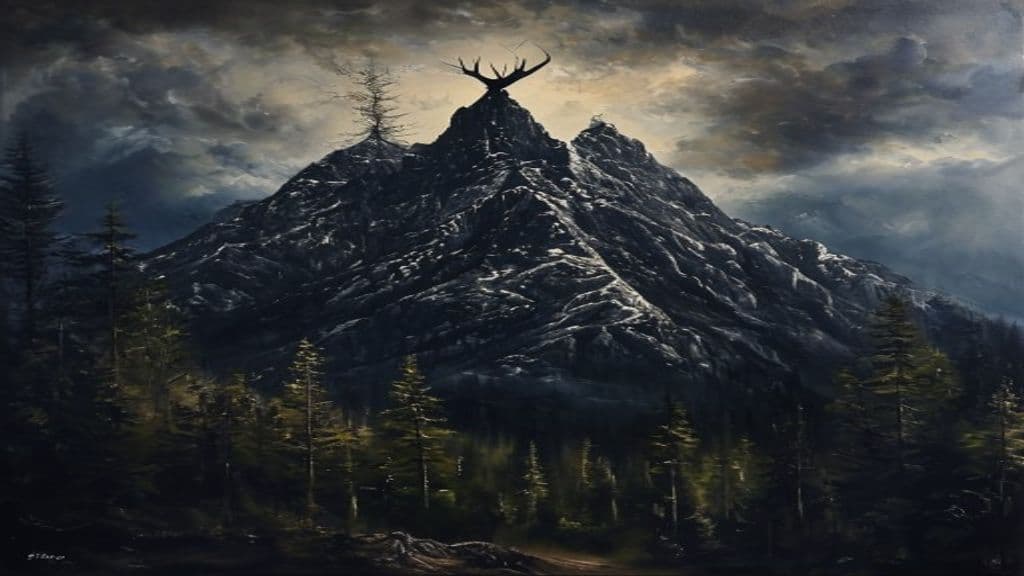
According to the Lakota tradition, the Black Hills were formed through the upwarping of ancient rock and subsequent erosion. This process has imbued the land with significant spiritual meaning for the Lakota people.
The physical description of Pahá Sápa is that of an isolated mountain range with its highest summit, Black Elk Peak, rising to 7,242 feet (2,207 m).
Anog Ite
In Lakota mythology, Anog Ite is a complex entity associated with emotional pain and chaos. She is punished for attempting to disrupt balance. (Note: 1. Power tier should be revised based on the entity's abilities described in the source material (Primordial=cosmic, Ancient=deity-level, Greater=powerful regional, Lesser=local spirit, Minor Spirit=w)
Sun Dance (Lakota tradition)
A spiritual practice and ritual ceremony practiced by certain Native American and Indigenous communities in North America, emphasizing personal and community sacrifice to reaffirm beliefs about the world and the supernatural. (Note: 1. Remove "certain" from the summary as it's not specified which communities participate. 2. Power tier should be Primordial as the Sun Dance has a more cosmic significance and isn't necessarily tied )
Untunktahe (Lakota Water Spirit)
In Lakota mythology, Untunktahe is a water spirit associated with bodies of water. (Note: 1. Power tier: Greater seems inconsistent with "associated with bodies of water", which could imply Lesser or Primordial. 2. Abilities: Not enough information to determine abilities; should be marked )
Škaŋ (Lakota Superior Spirit)
One of the four Superior Spirits created by Wakáŋ Tȟáŋka to comprise the universe, representing 'Motion' or 'Sky'. (Note: 1. Power tier: Primordial (as it is one of the four fundamental elements created by Wakáŋ Tȟáŋka) 2. Origin story: Corrected wording for Wakáŋ Tȟáŋka, referring to "The Great Spirit" in both cases 3. )
Padma (Vishnu)
One of the four attributes of the Hindu deity Vishnu, representing creation and birth. (Note: * Power tier should be Ancient, as it represents a deity-level aspect of Vishnu. * Abilities: Padma doesn't have distinct abilities itself; the description should be revised to reflect its association)
Padmaprabha
Padmaprabha is the sixth tirthankara (ford-maker) of the current Jain cosmic age (avasarpini). A perfected arihant who attained omniscience (Kevala Jnana) and later moksha, he is venerated in Jain devotion and iconography, especially by his red lotus emblem and meditative depiction.
Padmāvatī
Padmāvatī is a polyvalent South Asian female name and identity applied across Hindu, Jain, and literary-legendary contexts — used for a Vaishnava consort (Alamelu Manga), a Jain yakṣiṇī (attendant goddess), and multiple legendary or historical queens and heroines (notably the Rani Padmini/Padmāvati of the Padmavat tradition). The figure functions variously as a devotional goddess, attendant protective figure in Jainism, and as a narrative heroine across classical and modern media.
Paeon (son of Endymion)
The supplied sources do not document Paeon (son of Endymion) as an attested mythological or supernatural figure. The materials instead show uses of the strings 'paean'/'paeon' and 'Paeonia' in lexical, musical, botanical, and archival contexts, but provide no narrative, genealogy, iconography, or ritual information that would support treating Paeon son of Endymion as a described entity in the provided corpus.
Paikea
An important ancestor in Māori tradition, associated with a whale and significant to tribes such as Ngāti Porou and Ngāi Tahu. (Note: 1. Power tier: Reduce to Greater (powerful regional) as there's no indication of cosmic or deity-level powers. 2. Appearance: Add description from source material, e.g., "No specific appearance descri)
Paimon
Paimon is a high-ranking spirit from early-modern and medieval European grimoire traditions (notably the Ars Goetia and related compilations). He is depicted as a king who rules other spirits, teaches sciences and secret knowledge, and can be summoned and compelled by ceremonial operators within the ritual corpus.
Palaechthon
In classical Greek literary context Palaechthon (Παλαίχθονος) is an earth-linked eponymous ancestor invoked to mark indigenous origin; attested only in Aeschylus' The Suppliants and discussed by later commentators and modern reference works. The name combines elements meaning 'old/long' (palai-) and 'earth' (chthon-) and functions as an aetiological device legitimizing Pelasgian claims to the land.
Palaemon
Palaemon (Παλαίμων), in the best-attested Greek tradition, is the deified form of the youth Melicertes who becomes a youthful sea-protector associated with sailors and fishermen; he is commonly depicted as a boy riding a dolphin and received local cultic honours in some places (notably linked in some traditions to the Isthmian games).
Community Record
- [1]