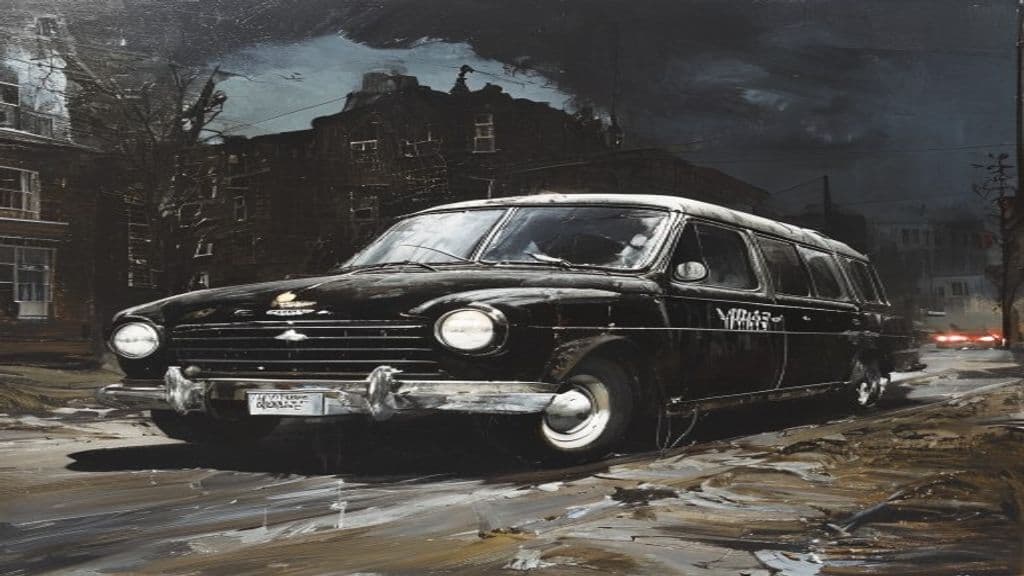
The Black Volga arises as an urban-legendal motif in mid‑to‑late 20th century Europe and neighboring regions and circulated widely in the 1960s and 1970s. Folk explanations link the image of a black official car (the Volga make produced by GAZ) with anxieties about state security organs, criminal groups, and occult conspiracies; commentators note that the visible use of state automobiles in earlier repressive periods was folded into the tale and helped create the car's ominous image. The motif spread across multiple national contexts and adapted to local car models and concerns (for example, a black ambulance variant in Czechoslovakia and Dacia/ambulance substitutions in Romanian variants).
Standard descriptions present a black GAZ vehicle (commonly GAZ-21 or GAZ-24) with distinctive white elements such as white wheel rims, white curtains or white interior trim; variants include horns in place of wing mirrors, license plates marked "666", and white windows/curtains. In later retellings Western makes (BMW, Mercedes) sometimes replace the Volga; in some countries the motif is recast as a black ambulance or local automobile models (e.g., Dacia in Romania).
Across tellings the car abducts people (with children emphasized in some summaries and 'people' more generally in others) and in many variants abductees are murdered for bodily substances—reports include claims that victims' blood was used as a cure for wealthy foreigners or that organs were taken, sometimes linked to older kidney‑theft rumors about security services. Explanatory agents vary by version and include communist secret police, Russian mafia, Satanists or Satan himself. Supernatural features appear in some accounts (the driver may be the devil; the driver can make the car vanish), and a prophetic formula appears in some variants (the driver telling a victim "Tomorrow you will die at this hour" with the death occurring as foretold in the tale).
Weaknesses
- mantra"It is God's time" (reported verbal response)
Wards
- mantra"It is God's time" — reported in some versions to make the car vanish
Black Shuck
A spectral black dog of East Anglian legend, with glowing red or green eyes. Its appearance is an omen of death. Its howl has been heard on clifftops during storms for centuries.
Black Spectre
Black Spectre is a fictional villain identity used by multiple human antagonists in Marvel Comics, primarily as an adversarial persona opposing the vigilante Moon Knight. The mantle has been adopted by different individuals (not a supernatural being) to carry out criminal, political, and terroristic schemes within contemporary urban narratives.
Black Spider
Black Spider is a name applied to distinct cultural entities: (A) a costumed human vigilante/assassin (Eric Needham) in DC Comics continuity, and (B) a supernatural figure around which Jeremias Gotthelf's nineteenth‑century Swiss novella The Black Spider is framed. The usages are separate: one is a modern fictional vigilante within superhero narratives, the other a literary supernatural motif tied to plague and a Faustian pact in a rural Swiss setting.
Black Terror
A Golden Age American comic-book costumed hero identity originating in 1941 as pharmacist Bob Benton who gained powers from a chemical called "formic ethers." Across decades and publishers the identity has been reinterpreted as a powered crimefighter, a vengeful vigilante, an impersonated costume used by agents, and a consciousness housed in a computer program called Terror 2000.
Black Tom Cassidy
Black Tom Cassidy (Thomas Samuel Eamon Cassidy) is a fictional mutant supervillain from Marvel Comics who first appeared in Uncanny X-Men #99 (1976). He is an Irish-born criminal boss and recurring X-Men adversary whose powers center on projection of force through wooden media and, after a medical graft, become plantlike in nature; in later stories he forms a physiological union with the mutant island Krakoa and serves in a security role.
Black Turtle‑Snake (Xuánwǔ / Genbu)
A composite cosmological guardian from East Asian tradition (Chinese: 玄武, Xuánwǔ; Japanese: Genbu) that functions as the northern member of the Four Symbols. Represented iconographically as a tortoise intertwined with a snake, it orders sky and landscape (north, winter, seven lunar mansions) and is venerated in temples, palace gates, and funerary contexts as a protective presence.
Black Vulcan
Black Vulcan is a fictional African-American superhero created by Hanna-Barbera for the Super Friends animated series (debuting 1977). Presented as an electricity-manipulating costumed hero in the show and later reinterpreted satirically in Harvey Birdman, Attorney at Law, he was created as a replacement for DC's Black Lightning due to rights disputes.
Black Widow (Natasha Romanova / Natasha Romanoff)
A modern popular-culture fictional character originating in Marvel Comics (1964) and later adapted into the Marvel Cinematic Universe; a highly trained human spy and operative whose codename 'Black Widow' denotes a role in espionage and covert operations rather than a supernatural being.
Black Zero
A name used within DC Comics for multiple distinct fictional constructs: a 1968 space‑saboteur antagonist, a Kryptonian terrorist/clone‑liberation movement that detonated a device in Krypton's core, an intelligent computer virus dormant in Kryptonian technology, an alternate Superboy who assumes the mantle Black Zero, and the name of a Kryptonian prison frigate in film adaptations.
Black cat
A domestic cat with black fur that functions both as an ordinary companion animal and as a versatile folkloric symbol. In many traditions it is an omen of good or bad fortune, is associated with witches and seafaring luck, and has been repurposed in modern political and cultural symbolism.
Black horse
A black horse is an equine whose hair coat is wholly black; in the provided sources this is a biological coat-color phenotype described in terms of genetics, breed occurrence, and identification rather than a supernatural being.
Black wolf
A melanistic colour variant of the gray wolf (Canis lupus) documented in zoological and regional observational sources. The term is used both for living black-coated wolves—whose coloration is now known to trace to a dog-origin mutation in some populations—and as a modern cultural label (titles, team names, etc.). The provided sources do not document a discrete supernatural being called “Black Wolf.”
Community Record
- [1]Black Volga — Wikipedia. Wikipedia, 'Black Volga' article (overview of variants, appearance, abilities, geographic spread, and reported protective formula).wiki
- [2]Black Volga — Wikidata. Wikidata item summary for 'Black Volga' (brief statement referencing Polish urban legend about a black Volga car that would abduct children).wiki