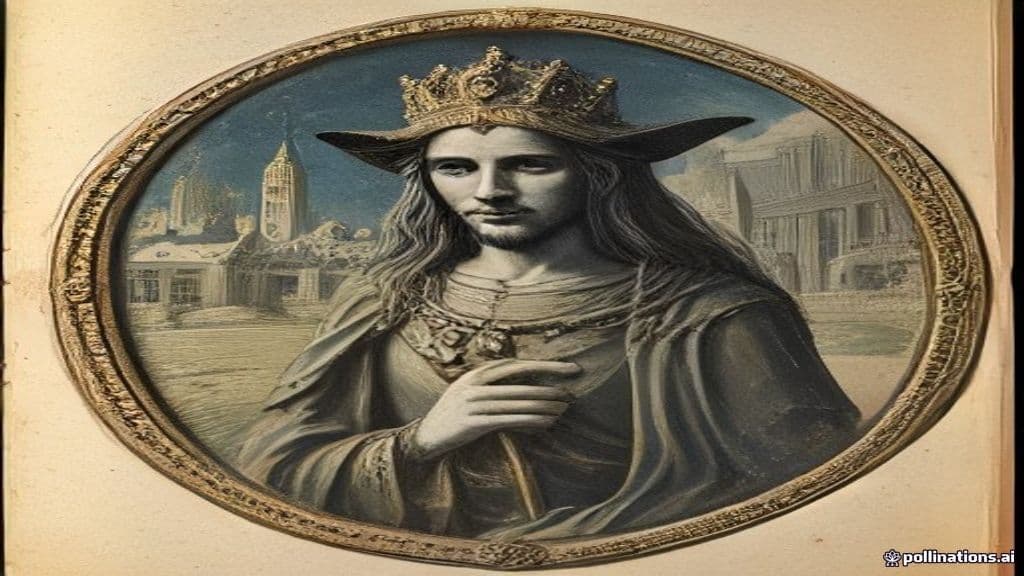
In the Geoffrey of Monmouth tradition and subsequent retellings Bladud is a prince who contracts leprosy and is exiled from court. While working as a swineherd at Swainswick he noticed pigs wallowing in warm black mud and that those pigs did not suffer from skin disease. After trying the mud-bath himself he was cured and was later restored to authority; he is credited with founding the city of Bath so others might benefit from the springs. Variants add that he was educated in Athens and brought philosophers with him, and some later accounts claim he founded a university at Stamford which was suppressed by Augustine of Canterbury for perceived heresies. The figure is presented as legendary; modern summaries note there is no historical evidence for his existence.
Primary medieval and early-modern sources provide little sustained physical description of Bladud as an individual beyond his social roles (prince, swineherd, king). Visual references are largely later civic representations: Bath features a statue associated with Bladud overlooking the King's Bath assembled from parts of older statuary, an eighteenth‑century reuse whose weathered appearance contributed to the local association of the figure with disease and cure. Nineteenth‑century and later literary retellings recycle the figure in narrative contexts but do not establish a consistent historical portrait.
Sources attribute to Bladud an etiological miracle of healing—his discovery and promotion of warm black mud and hot springs as a cure for skin disease—and the role of founder and patron of communal bathing at Bath. Some traditions present him as an introducer of learning (education in Athens; bringing philosophers; founding a university at Stamford in certain versions). Later embellishments credit him with practices of necromancy or divination through the dead and with constructing wings to attempt flight; these accounts end with his death by falling, striking a wall, or breaking his neck. These claims are folkloric and literary attributions rather than attestations of systematic supernatural powers.
Weaknesses
- conditionHubris leading to fatal flight (death by fall or collision)
- conditionEcclesiastical suppression of associated teachings (narrative motif: Augustine suppresses Stamford university)
Wards
None recorded.
Community Record
- [1]Bladud. Wikipedia, 'Bladud' article (summary of Geoffrey of Monmouth and later traditions)wiki
- [2]The Mystery of Bladud. BuildingHistory.org, 'The Mystery of Bladud' (discussion of the Bath legend and Swainswick motif)other
- [3]The pioneers of flight : a documentary history. The Pioneers of Flight (collection referencing later retellings that compare Bladud's winged flight to classical motifs)other
- [4]Swainswick. Wikipedia, 'Swainswick' (local association with Bladud's swineherd episode)wiki
- [5]The Pickwick Papers — 'The True Legend of Prince Bladud' (retelling). Charles Dickens, Pickwick Papers, Chapter 36 (19th‑century literary retelling of the legend)literary