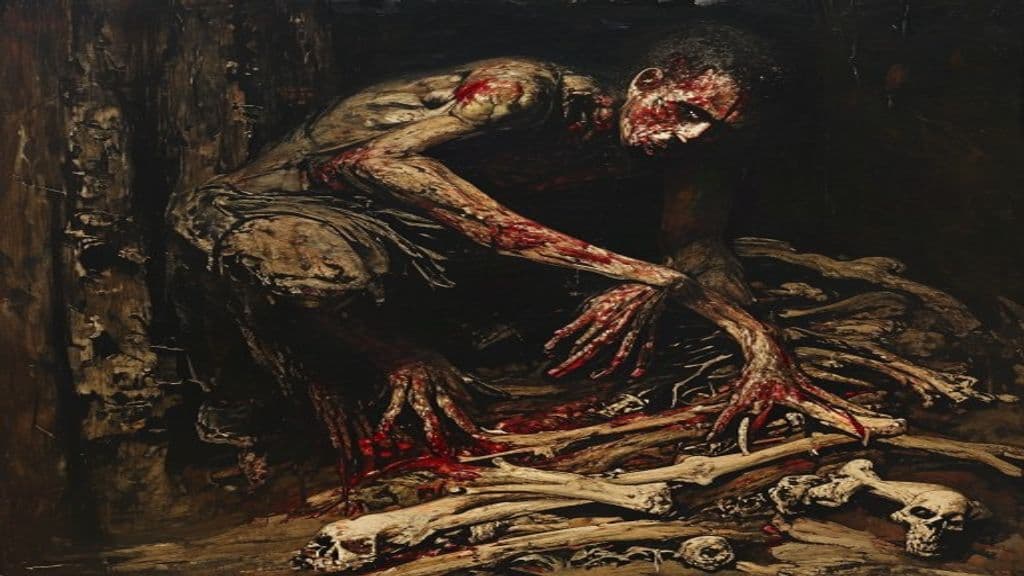
Bloody Bones appears in English vernacular tradition and early modern references as a name used to frighten children (cited in writings from the 17th–18th centuries). John Locke recorded the use of 'Raw-Head and Bloody-Bones, and such other Names' to awe children and keep them in subjection; Samuel Johnson defined 'Rawhead' as 'the name of a spectre, mentioned to fright children.' Folklorists collecting regional accounts (e.g., Ruth Tongue for Somerset; F. W. Jones for Cornwall) record it as a localised cautionary monster rather than a theologically systematised deity. The figure migrated with British speakers into North American regional traditions where it appears in variant forms (notably Southern U.S. accounts that separate Rawhead and Bloody Bones into paired figures).
Descriptions vary by region and collector. In Ruth Tongue's Somerset account the creature is a crouching, dreadful figure with blood running down his face seated on a pile of raw bones taken from children who lied or spoke badly. Some Southern U.S. variants distinguish Rawhead as a skull stripped of skin that bites victims and Bloody Bones as a dancing headless skeleton. A Cornish account ('Old Bloody Bones' at Knockers Hole) ties the name to a local site and to bloodshed in the past, suggesting ghostly or vengeful aspects in that variant. Accounts emphasize variability rather than a single uniform form.
Across the collected narratives Bloody Bones functions as a punitive, predatory presence used to discipline children: motifs include dragging children into deep ponds or marl pits, biting (in skinned‑skull depictions), and graphic punishment for gossiping or lying (one tale motif records a gossip losing his head). The creature is said to occupy or lurk in dark domestic recesses (cupboards, under stairs) or specific hazardous landscape features; its main 'power' in tradition is as an enforced threat in cautionary storytelling and as a localized danger‑bringer rather than a cosmically potent being.
Weaknesses
- conditionavoidance and correct behaviour
- conditionstaying away from hazardous places (marl‑pits, deep ponds, dark cupboards)
Wards
- conditionverbal warning and parental instruction to keep children away from named hazards
- conditionsocial enforcement of proper speech and behaviour (not lying, not using bad words)
Blenda
Blenda is the eponymous heroine of a Småland legend (Blendasägnen) who, according to local tradition, rallied the rural women of Värend to defeat a pillaging Danish force; the tale functions as an aetiological foundation for certain local social rights and ritual markers rather than describing a supernatural being.
Bleoberis
Bleoberis is a legendary Arthurian knight appearing across medieval romance cycles as a recurring Round Table member, kinsman of Lancelot, and participant in major campaigns, funerary duties, and penitential pilgrimage narratives. He functions as a noble companion and political-military actor rather than a supernatural being.
Blind Al
Blind Al (Althea Winifred Sanderson) is a fictional, non-supernatural supporting character in Marvel Comics who serves as a long-term companion, housemate, and verbal foil to Wade Wilson (Deadpool). Presented as an elderly, blind woman with a sharp tongue and complex interpersonal authority, she appears across Deadpool comics and film adaptations.
Blodeuwedd
In the Fourth Branch of the Mabinogi, Blodeuwedd is a woman fashioned by the magicians Math and Gwydion from flowers to be the wife of Lleu Llaw Gyffes; she later betrays him, is transformed into an owl as punishment, and functions etiologically to explain owl nocturnality and enmity with other birds.
Blonde Phantom
A Golden Age American costumed crime-fighter published by Timely Comics (later Marvel Comics). The Blonde Phantom is the masked vigilante identity of secretary Louise Grant (later Louise Mason), a glamorous alter ego who aids detective Mark Mason and starred in her own comics in the late 1940s and was revived in Modern Age stories beginning in 1989.
Bloodwynd
Bloodwynd is a legacy superhero identity in DC Comics tied to a mystical 'blood gem' created by an ancient ritual. The gem houses the spirit Rott (the incarnate spirit of Jacob Whitney in the gem's microscopic world) and bestows necromantic and psychic powers on its bearers while exacting moral and metaphysical costs.
Bloody Mary
A mirror-associated apparition invoked by chanting a female name in dim or candlelit conditions. Originating in catoptromantic divination practices, the figure functions in modern youth-lore and urban legend as an ambiguous ghost/witch who may reveal future information or enact violent harm on participants.
Blud
Blud is a Slavic concept that functions both as a supernatural agent said to cause physical disorientation—leading people to wander "aimlessly around and round"—and as a lexical term in church discourse denoting illicit sexual desire or moral deviation, which clerics attributed to the Devil.
Blue Beetle
Blue Beetle is a recurring American comic-book superhero identity first appearing in 1939. The mantle has been borne by multiple human individuals over decades and has been explained variously by technology, a mystical scarab artifact, or legacy succession depending on publisher continuity.
Blue Beetle (Jaime Reyes) — tradition
Blue Beetle is a published fictional superhero identity in American comic-book tradition that has been held by multiple human protagonists. The Jaime Reyes incarnation is the modern, scarab-bonded teenager whose scarab morphs into an armored battle suit; the mantle as a whole illustrates editorial legacy, shifting origins (chemical, mystical, technological), and reinvention across publishers (Fox, Charlton, DC).
Blue Ben (of Kilve)
A local Somerset dragon-legend tied to the coastal landscape of Kilve. The tale explains coastal features and a fossil ichthyosaur skull by attributing them to the life and death of a fire-breathing dragon sometimes said to have been ridden by the Devil.
Blue Lantern Corps
A fictional interstellar organization in DC Comics that channels the blue light of the emotional spectrum—hope—through power rings and constructs. Founded by former Guardians Ganthet and Sayd on the planet Odym, the Corps acts as a structured order whose abilities often function cooperatively with other Lantern Corps, especially the Green Lantern Corps (willpower).
Community Record
- [1]Bloody Bones. Wikipedia: Bloody Bones (entry summarising regional folklore, citing Ruth Tongue, F. W. Jones, John Locke, Samuel Johnson)wiki
- [2]Bloody Bones (Wikidata entry). Wikidata item for Bloody Bonesother
- [3]Old Cornwall (reference to 'Old Bloody Bones' at Knockers Hole). F. W. Jones, Old Cornwall (cited in summaries of the Bloody Bones tradition concerning a Cornwall place‑variant)folk
- [4]Somerset folklore collected by Ruth Tongue (Rawhead/Bloody Bones cupboard account). Ruth Tongue, Somerset folklore (quoted in secondary summaries: description of cupboard dwelling, blood on face, pile of raw bones)folk