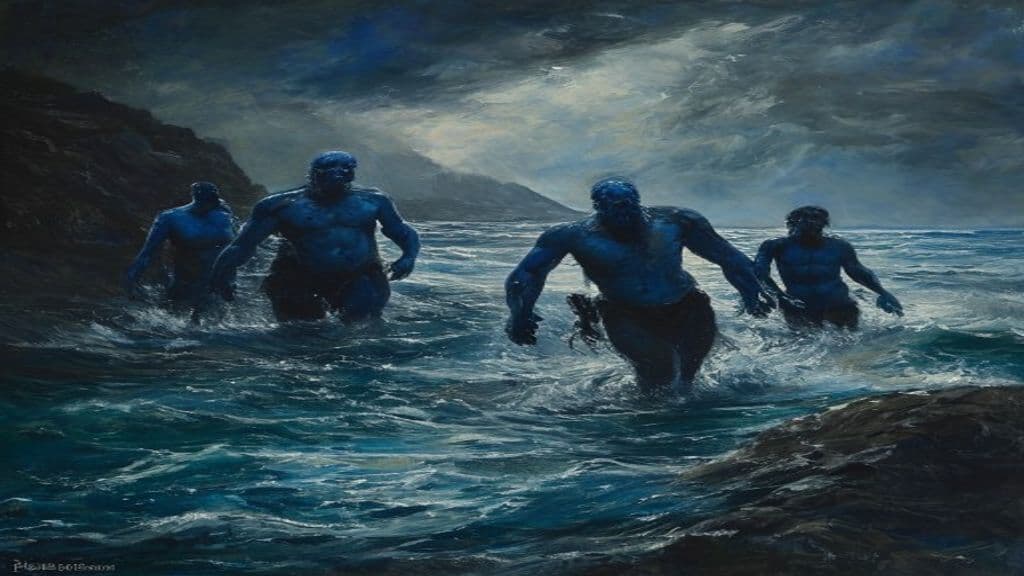
Traditional sources present the blue men as a local people of the sea rather than as a single monster; some folklorists reconstruct them as the sea‑portion of a larger mythic division (one reconstruction by Mackenzie frames a tribe of 'fallen angels' split into land fairies, the sea blue men, and auroral 'Merry Dancers'), while other commentators have speculated (as modern hypotheses) about historical echoes — painted Picts or sightings of darker‑skinned men encountered by seafarers. These origin theories are scholarly interpretations and not fixed elements of the tales, which chiefly treat the blue men as an indigenous, localized class of water‑spirits inhabiting the Minch.
Accounts consistently describe them as humanoid and about human size and as blue in colour (Gaelic na fir ghorma, 'the blue men'). Traditional descriptions emphasize torsos rising from the water — they are often seen swimming with the body raised from the waist upward, twisting and diving like porpoises, or floating at the surface when the sea is calm. Variant tellings report long arms, grey or long‑shaped faces in some descriptions, occasional detail of blue headgear in particular accounts, and rare isolated accounts (e.g., an old bearded form in a Shetland notice); such features are presented in the sources as variants rather than universal traits.
Folktales attribute to the blue men the power to create severe storms and dangerous seas capable of swamping or capsizing ships, and they are said to board vessels to demand tribute or to attempt seizure when provoked. They speak and converse with sailors; a recurrent motif is a ritualized poetic challenge in which the group's chief shouts two lines of verse to a ship's master and demands a correct completion — success in completing the stanza is reported in tales as causing the blue men to desist and return to their caves. In fair weather they are said to float near the surface and to play (nighttime play such as shinty is recorded in some tellings). Stories also preserve episodes of capture — sailors discovering a sleeping blue man and binding him — though such captures end with escape when companions call his name.
Weaknesses
- conditionverbal challenge answered correctly
- conditionpayment of demanded tribute
Wards
- ritualpoetic completion (challenge/response)
- othercompliance by paying tribute
Blud
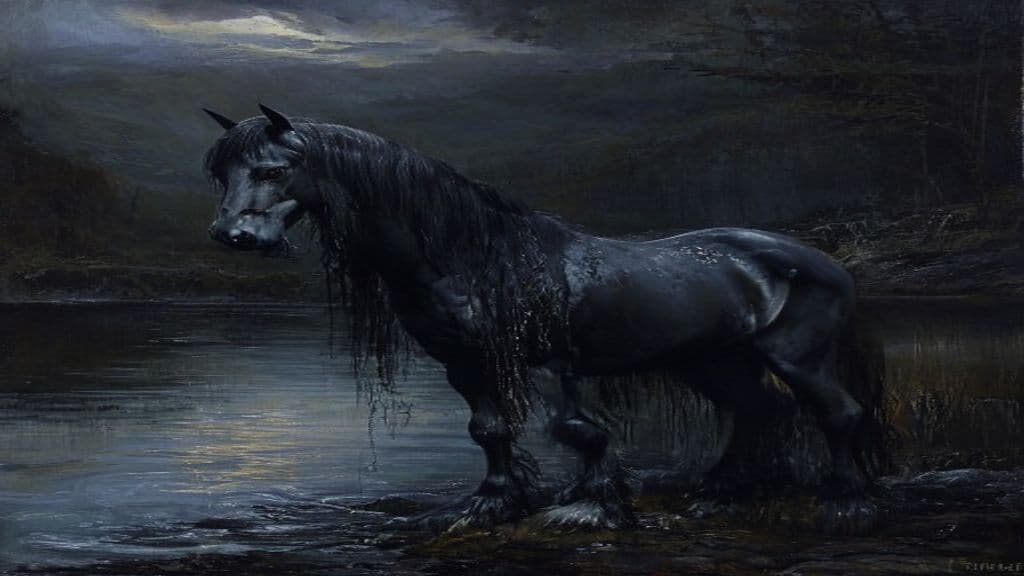
Blud is a Slavic concept that functions both as a supernatural agent said to cause physical disorientation—leading people to wander "aimlessly around and round"—and as a lexical term in church discourse denoting illicit sexual desire or moral deviation, which clerics attributed to the Devil.
Blue Beetle
Blue Beetle is a recurring American comic-book superhero identity first appearing in 1939. The mantle has been borne by multiple human individuals over decades and has been explained variously by technology, a mystical scarab artifact, or legacy succession depending on publisher continuity.
Blue Beetle (Jaime Reyes) — tradition
Blue Beetle is a published fictional superhero identity in American comic-book tradition that has been held by multiple human protagonists. The Jaime Reyes incarnation is the modern, scarab-bonded teenager whose scarab morphs into an armored battle suit; the mantle as a whole illustrates editorial legacy, shifting origins (chemical, mystical, technological), and reinvention across publishers (Fox, Charlton, DC).
Blue Ben (of Kilve)
A local Somerset dragon-legend tied to the coastal landscape of Kilve. The tale explains coastal features and a fossil ichthyosaur skull by attributing them to the life and death of a fire-breathing dragon sometimes said to have been ridden by the Devil.
Blue Lantern Corps
A fictional interstellar organization in DC Comics that channels the blue light of the emotional spectrum—hope—through power rings and constructs. Founded by former Guardians Ganthet and Sayd on the planet Odym, the Corps acts as a structured order whose abilities often function cooperatively with other Lantern Corps, especially the Green Lantern Corps (willpower).
Blue Marvel
Blue Marvel (Adam Bernard Brashear) is a fictional, human-origin superpowered scientist and former Marine in the Marvel Comics universe. He gained vast antimatter-derived powers in an accident involving a Negative Zone reactor, operating as a high-powered hero from the 1960s onward while also serving as a long-lived academic and team member of groups like the Mighty Avengers and the Ultimates.
Blue Nile patas monkey
The Blue Nile patas monkey (Erythrocebus poliophaeus), also called Heuglin's patas monkey, is an Old World monkey species native to the Blue Nile river valley of Ethiopia and Sudan and possibly South Sudan. Described in 1862, it was long treated as conspecific with other patas monkeys until re-elevation to species status in 2017; its distribution, ecology, and population status remain poorly known.
Blue Snowman
The Blue Snowman is a fictional comic-book supervillain in the DC Comics universe who acts as a recurring adversary of Wonder Woman. Portrayed as Byrna Brilyant, the character employs genius-level inventiveness and specialized cold/cryogenic technology—most notably devices that generate "blue snow"—while wearing a distinctive snowman-themed blue costume or exo-suit. The Blue Snowman has no innate supernatural powers; threats are technological and resolved by heroic intervention.
Blue Stone (Russia)
A type of sacred stone in Slavic tradition, held significant spiritual significance and venerated through simple rituals. (Note: - Power tier should be Lesser (since they don't have major hallows and are venerated in a simpler way). - Abilities: "Venerated through simple rituals" is vague; clarify that these rituals include pou)
Blue Trinity
Blue Trinity (Russian: Голубая Троица, Golubaya Troitsa) is a fictional team of three Soviet-engineered superhuman operatives in DC Comics, created by Soviet scientists as state-controlled assets in a Cold War narrative; they are described in sources as abnormally strong, emotionally unstable, and raised for loyalty to the Soviet Union.
Bluebeard
Bluebeard (French: Barbe bleue) is a literary folktale character best known from Charles Perrault's 1697 version: a wealthy, powerful nobleman who marries repeatedly and secretly murders his wives, hiding their bodies in a locked chamber. He functions as a cultural archetype and cautionary exemplar about secrecy, patriarchal power, and the dangers facing women in marriage rather than as a supernatural being.
Bluecap
A small blue flame-like mining spirit from Anglo-Scottish border and North East England folk belief that inhabits coal mines and pits. Appearing as a flickering blue flame, Bluecaps guide miners to rich seams, warn of cave-ins, and expect payment in the form of a working man’s wages left in a secluded corner of the mine.
Community Record
- [1]Blue men of the Minch — Wikipedia. Wikipedia contributors, 'Blue men of the Minch', Wikipedia, The Free Encyclopediawiki
- [2]Wikidata: Blue men of the Minch. Wikidata entry Q17152117other
- [3]25 Creatures in Scottish Folklore and Myth (archive). Archive: popular summary listing mentioning Blue Men of the Minch among Scottish folkloric creaturesfolk