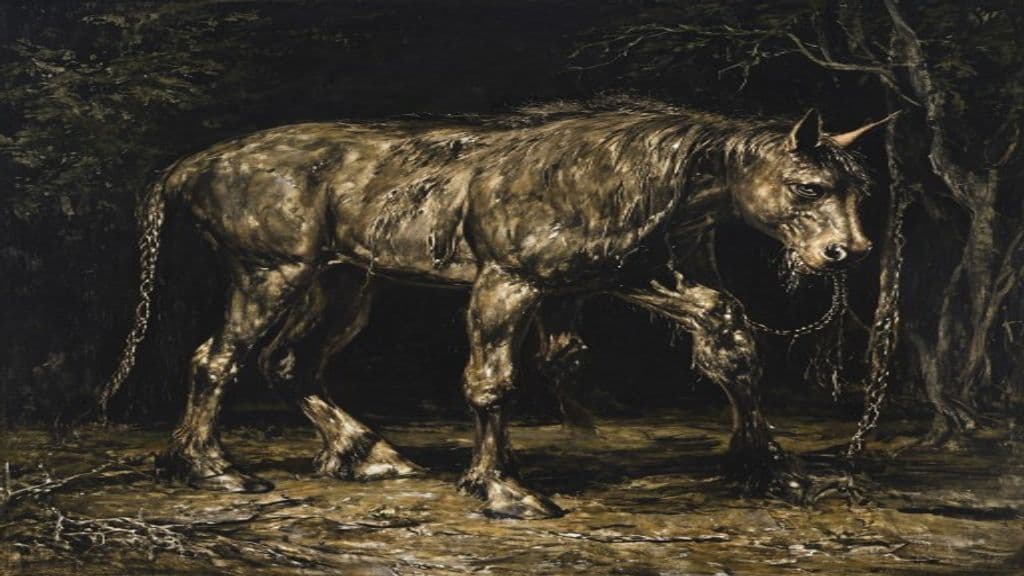
The term and concept derive from Middle English bugge (a spirit or monster) with later dialectal formations like boggart used across north‑west English traditions; sources treat the boggart as a local class of spirit (household or place‑bound) rather than offering a single pan‑regional origin myth. Individual named or localized instances are recorded in collected tales and local lore (for example the Grizlehurst account, the Boggart of Longar Hede, the Hackensall Hall boggart and the named Nut‑Nan), but these are discrete folkloric instances rather than a unified origin narrative.
Descriptions are highly variable by locality and tale. Attested forms include relatively human‑like but uncouth and often bestial figures; a 'squat hairy man' with long arms; a calf‑sized shaggy beast with saucer eyes and a trailing chain (Longar Hede); the appearance of a huge horse (Hackensall Hall); and leader‑figures described in Lancashire lore with satyr/devil attributes (Owd Hob: horns, cloven hooves, tail). At least one named local apparition, 'Nut‑Nan,' is recorded as appearing among hazel bushes. Sources stress variability and locality rather than a stable universal form.
Boggarts are reported causing household mischief and nocturnal harassment—crawling into beds, placing a clammy hand on sleepers' faces, stripping bedclothes, causing doors to bang, emitting shrieks or laughter and producing mysterious blue lights; they can overturn carts, unhorse animals and frighten livestock (people say animals 'took boggarts'). In landscape contexts they may be tied to specific features (caves, lanes, bends) and leave physical traces such as cloven hoofprints or noisy chains. Tale motifs also depict bargaining or claims on crops (see 'The Farmer and the Boggart') and local accounts sometimes place boggarts in a populated unseen landscape with possible leader figures.
Weaknesses
- ritualavoid naming (taboo)
- conditionavoid digging near reputed burial/haunt
Wards
- ritualnever name it
- ritualburial with staked cockerel under an ash tree
- conditionavoid disturbing reputed haunt
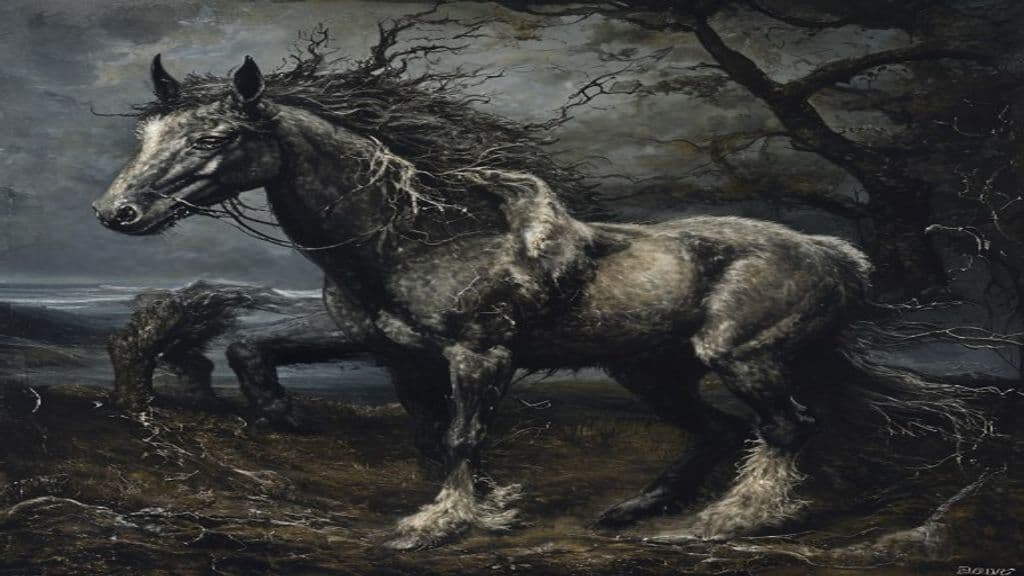
Púca (Pooka / Puca)
A long-standing folkloric spirit from Irish and related Celtic traditions, the púca is a shape‑shifting, ambivalent supernatural being commonly associated with rural and maritime communities and said to bring both good and ill fortune.

Bogeyman
A folkloric, non‑canonical monster figure invoked across cultures as a disciplinary device to frighten children into compliant behaviour; presented in sources as a flexible category rather than a single, systematized being and often used figuratively as a personification of terror.
Black Annis
Black Annis is a Leicestershire bogeywoman in English folklore: a blue-faced, clawed hag said to haunt Dane Hills and a cave called Black Anny's Bower Close. Traditionally portrayed as a nocturnal predator of children and lambs who tans victims' skins to wear, she inspired local customs including an Easter Monday drag-hunt.
Seventh son of a seventh son
A folkloric birth-status applied to a male who is the seventh consecutive male child in an unbroken male line whose father was also a seventh son; across several European-derived and Latin American traditions this status is associated variously with exceptional healing or with dangerous supernatural transformations. The figure functions as a social/biological category that explains extraordinary capacities or misfortunes rather than a single mythic individual or species.
Body of Light
A layered-humanity concept from classical Neoplatonism through Renaissance and later esoteric traditions: a quasi-material luminous vehicle (also called the astral or subtle body) that mediates between the physical body and the divine, enabling ascent through planetary/heavenly spheres and serving as the carrier of certain mental faculties.
Boeotus (son of Poseidon)
Boeotus is a mythic eponymous ancestor in Greek tradition credited with giving his name to the region and people of Boeotia. He appears in genealogical accounts as a son of Poseidon (often with Arne) or in variant traditions as son of Itonus and the nymph Melanippe, functioning chiefly as a founding ancestor rather than an active cultic or supernatural agent.
Boethoos
Boethoos (also Boethous/Boethos) is a minor named figure in Greek mythological genealogy, attested as a Lacedaemonian son of Argeios (son of Pelops) and Hegesandra (daughter of King Amyclas of Sparta). He appears only as a genealogical descendant within Peloponnesian heroic lineages in the supplied sources.
Bogatyr
A bogatyr is the stock heroic figure of East Slavic (primarily Russian and Ukrainian) epic-poetic tradition (bylinas): an elite, exceptional warrior associated with the princely court (notably the Kievan court of Vladimir in many tales) who defends the land and people. Bogatyrs are literary/folk-epic archetypes rather than a class of supernatural beings, though some individual figures are mythic or giant-like.
Bogeyman
A folkloric, non‑canonical monster figure invoked across cultures as a disciplinary device to frighten children into compliant behaviour; presented in sources as a flexible category rather than a single, systematized being and often used figuratively as a personification of terror.
Boginka
A Slavic/Polish female nature-spirit category: personifications of wild natural forces (forests, fields, mountains, fresh and sea waters) that appear in folklore as ambivalent beings—often hostile toward humans, especially pregnant women and infants, but also recalled in some sources with neutral or protective aspects.
Boginki (boginka)
Boginki (singular boginka) are female personifications of wild natural forces in Polish/Slavic popular belief, described in sources as minor goddesses or female spirits/demons associated with forests, fields, mountains, and waters (both inland and sea). They are ambivalent in disposition, sometimes neutral or beneficent and sometimes hostile to humans, and figure among other Slavic female nature-spirits such as rusalki and vily.
Bogle
A Northumbrian, Cumbrian and Scots folkloric being reputed to perplex and frighten humans. Bogles are a polyvalent category in northern-British tradition, applied to scarecrows, household troublemakers and other uncanny creatures whose chief orientation is mischief rather than systematic harm.
Boitatá
Boitatá is a supernatural guardian creature from Brazilian folklore, originating in Tupi–Guarani tradition and preserved in wider Brazilian popular tradition. Commonly rendered as a fiery serpent that protects forests and fields by punishing people who burn, cut, or otherwise destroy nature, the legend also appears in brief variants that liken it to a will-o'-the-wisp or (less commonly) a bull-like creature.
Bolas
Bolas are a physical throwing weapon consisting of weights connected by cords, used historically and traditionally to entangle the legs of animals (and occasionally humans) at a distance. They appear in multiple regional traditions—notably in southern South America among Tehuelche and gauchos, in Mapuche and Inca military contexts, and in Inuit bird-hunting practice—under a variety of local names and constructions.
Community Record
- [1]Boggart — Wikipedia. Wikipedia contributors, 'Boggart', Wikipedia, The Free Encyclopediawiki
- [2]The Magic Lands: Folk Tales of Britain and Ireland (collection referencing boggart tales). Crossley-Holland (ed.), The Magic Lands: Folk Tales of Britain and Ireland, archive collection referencing regional talesfolk
- [3]Archive material including 'A+B (110961)' (collected folktale items). Archive.org collection (folktale items) cited in research notesfolk
- [4]Myth and Magic - Fantasy Writers Kitbag (archive collection). Archive.org collection containing references to related folklore summariesother