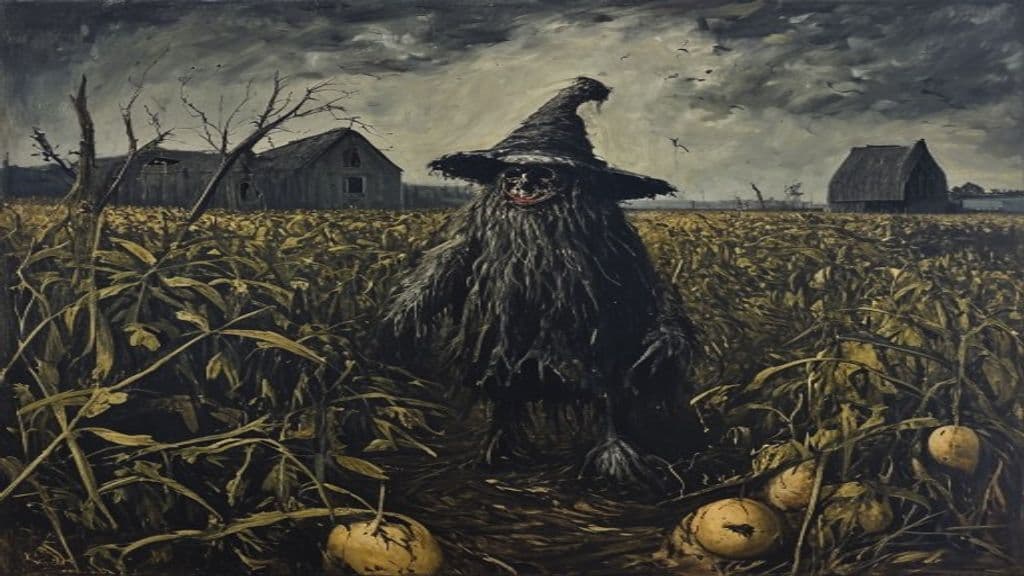
The sources do not record a single mythic origin story for bogles. The available folkloric summary treats 'bogle' as a traditional regional term (derived from Middle English Bugge) applied across a range of uncanny beings in northern Britain. Rather than having a creation myth, bogles are presented as a category of local supernatural troublemakers and uncanny presences embedded in agricultural, domestic and landscape lore.
No canonical physical description is fixed across sources; appearance varies by local usage. One well-attested form, the Tattie-Bogle, is depicted as a scarecrow hiding in potato fields. In mid-20th-century lowland Scottish usage 'bogle' also functions as a general word for ghost or bogeyman, and literary references (e.g. W. D. Cocker’s poem 'The Bogle by the Boor Tree') associate bogles with wind and trees, emphasizing an atmospheric or uncanny presence rather than a single body form. The broader category is linked in source material to other regional beings (Shellycoats, Barghests, Brags, Hedley Kow, certain giants), implying that local stories may imagine bogles as anything from animated objects to trickster humanoids, depending on context.
Sources characterize bogles primarily as mischief-makers whose purpose is to perplex mankind rather than to render sustained service or to wreak wholesale destruction. Reported behaviours include hiding in potato fields (the Tattie-Bogle), causing blight in crop patches, startling or (in some accounts) attacking unwary people in fields, and in at least one 1866 newspaper account being credited with poltergeist-like activity (missiles thrown through windows and roofs). The emphasis in the sources is on puzzling, frightening or annoying human beings rather than exhibiting consistent, catalogue-able supernatural powers.
Weaknesses
- otherNo specific weaknesses recorded in sources
- conditionUse of a scarecrow (Tattie-Bogle) as a pragmatic deterrent in fields
Wards
- ritualTattie-Bogle (scarecrow)
- otherRespect/avoidance of materials linked to 'little people'
Boethoos
Boethoos (also Boethous/Boethos) is a minor named figure in Greek mythological genealogy, attested as a Lacedaemonian son of Argeios (son of Pelops) and Hegesandra (daughter of King Amyclas of Sparta). He appears only as a genealogical descendant within Peloponnesian heroic lineages in the supplied sources.
Bogatyr
A bogatyr is the stock heroic figure of East Slavic (primarily Russian and Ukrainian) epic-poetic tradition (bylinas): an elite, exceptional warrior associated with the princely court (notably the Kievan court of Vladimir in many tales) who defends the land and people. Bogatyrs are literary/folk-epic archetypes rather than a class of supernatural beings, though some individual figures are mythic or giant-like.
Bogeyman
A folkloric, non‑canonical monster figure invoked across cultures as a disciplinary device to frighten children into compliant behaviour; presented in sources as a flexible category rather than a single, systematized being and often used figuratively as a personification of terror.
Boggart
A polyvalent supernatural being in north‑west English and adjacent dialect traditions, the boggart can be a household spirit attached to a family or dwelling or a localized landscape spirit tied to a particular place. Accounts vary widely by locality, recording mischievous, malicious, and sometimes frightening behaviours rather than a single fixed form.
Boginka
A Slavic/Polish female nature-spirit category: personifications of wild natural forces (forests, fields, mountains, fresh and sea waters) that appear in folklore as ambivalent beings—often hostile toward humans, especially pregnant women and infants, but also recalled in some sources with neutral or protective aspects.
Boginki (boginka)
Boginki (singular boginka) are female personifications of wild natural forces in Polish/Slavic popular belief, described in sources as minor goddesses or female spirits/demons associated with forests, fields, mountains, and waters (both inland and sea). They are ambivalent in disposition, sometimes neutral or beneficent and sometimes hostile to humans, and figure among other Slavic female nature-spirits such as rusalki and vily.
Boitatá
Boitatá is a supernatural guardian creature from Brazilian folklore, originating in Tupi–Guarani tradition and preserved in wider Brazilian popular tradition. Commonly rendered as a fiery serpent that protects forests and fields by punishing people who burn, cut, or otherwise destroy nature, the legend also appears in brief variants that liken it to a will-o'-the-wisp or (less commonly) a bull-like creature.
Bolas
Bolas are a physical throwing weapon consisting of weights connected by cords, used historically and traditionally to entangle the legs of animals (and occasionally humans) at a distance. They appear in multiple regional traditions—notably in southern South America among Tehuelche and gauchos, in Mapuche and Inca military contexts, and in Inuit bird-hunting practice—under a variety of local names and constructions.
Bolbe
In Ancient Greek mythology Bolbe (Βόλβη) is a localized lake goddess or nymph identified with the Macedonian lake of the same name (modern Lake Volvi). She is described as beautiful and is attested as mother of freshwater nymphs (Limnades) and, in one source, as mother of Olynthus by Heracles.
Bolg
The supplied sources do not document Bolg as a traditional supernatural being. Available references identify 'Bolg' primarily as a proper name in modern popular culture (a Middle-earth character in J. R. R. Tolkien's fiction) and as an ordinary lexical item in other contexts (e.g., Irish 'bolg' meaning 'belly'). No ethnographic or folkloric description of a supernatural entity named Bolg is present in the provided materials.
Bolivar Trask
Bolivar Trask is a fictional human character from Marvel Comics and adaptations. A scientist, anthropologist, and industrialist, he initiates large-scale technological programs (most famously the Sentinels) intended to detect and control mutants; his projects and decisions catalyze major human–mutant conflicts across multiple continuities.
Bolotnik
A Slavic place‑spirit of swamps and bogs, regarded in popular tradition as the proprietor or guardian of marshy places who lures people and animals into the depths. Descriptions and names vary regionally; in Christianized accounts bolotniks are sometimes classed with fallen angels or demonic beings.
Community Record
- [1]Bogle (Wikipedia). Wikipedia contributors, 'Bogle,' Wikipedia, The Free Encyclopedia, https://en.wikipedia.org/wiki/Bogle (accessed via provided research notes).wiki
- [2]Larne Weekly Reporter, 31 March 1866 — 'Bogles in Ballygowan' (as cited in Wikipedia article). Larne Weekly Reporter, 31 March 1866, front-page article 'Bogles in Ballygowan' (reported in summary on Wikipedia).folk