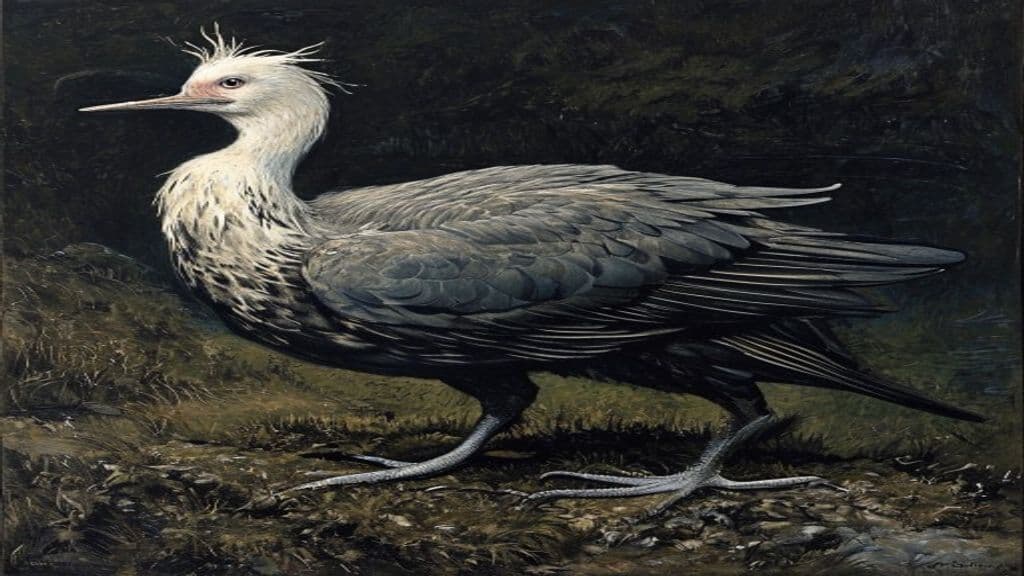
Folkloric material reproduced by collectors (notably Campbell of Islay as printed by Henderson) represents the boobrie as the 'abode of a spirit' capable of assuming multiple forms. The name appears in many Gaelic orthographic variants recorded by lexicographers (Dwelly and others), and etymological suggestions link boibhre to elements meaning 'cow giver' or to tarbh (Gaelic 'bull'), signalling a lexical association of bovine imagery with transformational power. The primary narrative corpus is oral and locally variable; no single canonical cosmogonic origin tale is provided in the cited sources.
Sources (chiefly Campbell of Islay as reproduced by Henderson and summarized in popular references) describe the bird form as a gigantic water‑bird resembling a cormorant or great northern diver with white markings: folkloric measurements claim a beak roughly 11 inches wide and 17 inches long, a neck almost 3 feet long and just under 2 feet in girth, short powerful black legs, webbed feet with gigantic claws and wings better adapted for swimming than flight. In bull form it appears as a colossal black tarbh (water‑bull); in horse form it resembles a water‑horse able to run across the loch surface; in summer it is infrequently described as a 'big striped brown gobhlachan or ear‑wig' with many tentacles or feelers that sucks horses' blood. These physical details are presented as elements of the folkloric descriptions rather than zoological measurements.
Core folkloric powers are shapeshifting between bird, bull, horse and insect forms; predation on livestock (particularly calves, also lambs and sheep), attacking animals carried on ships and carrying prey into deep water; fondness for and heavy consumption of otters; and locomotion specialized to water—wings adapted for swimming, the capacity to gallop across a loch's surface in horse form, and to transport humans rapidly in bull form. The bird's call is reported as a loud bellow more like a bull than a bird. Folklorists have sometimes speculated that some descriptive elements echo misidentified real animals or sounds (e.g. great auk, bittern), but the tradition treats the boobrie as a real, dangerous supernatural presence.
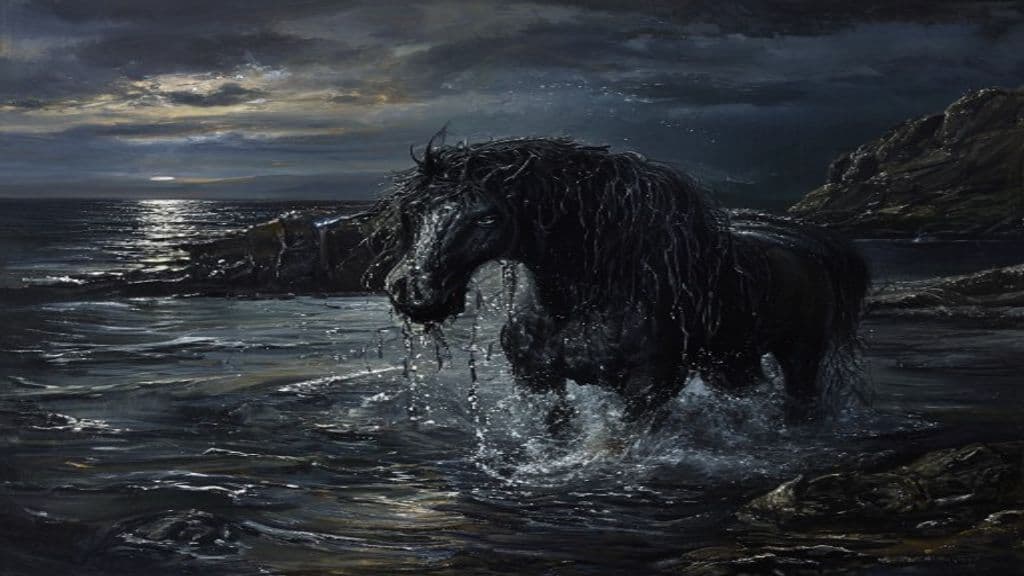
Bonadona i Altemir
Bonadona i Altemir are a pair of processional giants (gegants) associated with the town of Premià de Dalt in Catalonia. They function as civic effigies carried in public processions and local festivals, part of the municipality's intangible cultural traditions.
Bonaventure
Bonaventure (Giovanni di Fidanza, 1221–1274) is a historical 13th‑century Italian Franciscan theologian, Minister General of the Order of Friars Minor, cardinal, canonized saint (1482) and Doctor of the Church. Sources treat him as a major medieval ecclesiastical and intellectual figure rather than a folkloric supernatural being; later uses of the name appear as toponyms and institutional names.
Bonbibi
Bonbibi is the Lady of the Forest venerated across Hindu and Muslim communities of the Sundarbans as a local guardian figure for people who work the mangrove (honey-collectors, woodcutters). Her cult functions pragmatically to regulate forest conduct, mediate encounters with tiger-associated spirits, and provide communal protection and meaning during crises.
Bonconte da Montefeltro
Bonconte da Montefeltro (d. 1289) was a late‑13th century Italian nobleman and condottiero associated with the Montefeltro family and the Ghibelline forces at the Battle of Campaldino. In Dante Alighieri's Divine Comedy (Purgatorio, Canto 5) he appears as a speaking soul who recounts the circumstances of his death and reports that he died invoking Mary.
Bonga/Bong
Mythological figure from Bengali mythology considered the progenitor of the Bengalis, with conflicting accounts in Hindu and Muslim literature. (Note: 1. Power tier: Primordial is likely an overestimation given the conflicting descriptions and lack of clear abilities. 2. Appearance: Should be stated as "No physical description provided" instead of ")
Bonus Eventus
Bonus Eventus is the Roman divine personification of a 'Good Outcome', originally attested within agricultural ritual contexts and later represented more broadly in public religion, imperial imagery, and private amulets as an embodied principle invoked for success and favorable results.
Boodikka
Boodikka is a Bellatrix-born Green Lantern Corps member: a centuries-old warrior, former Bellatrix Bombers mercenary, ring-bearer, trainer/recruiter, and later an Alpha Lantern enhanced with Manhunter technology.
Book of Caverns (Egyptian tradition)
The Book of Caverns is an ancient Egyptian text that describes Ra's journey through the underworld, Duat. It does not describe a specific supernatural entity but mentions interactions between Ra and the residents of the underworld. (Note: 1. Power tier should be Ancient (deity-level) since it describes a journey of the sun god Ra and interactions between him and other deities. 2. Origin story needs clarification that the Book of Cavern)
Book of Thoth
A collection of ancient Egyptian texts attributed to and believed to be created by the god Thoth, holding significant knowledge and magical power. (Note: 1. Power tier: Primordial (given its association with a deity-level entity like Thoth) 2. Appearance: While some illustrations depict it as an ornate book, the source does not explicitly describe appe)
Book of the Dead
A collection of magical spells and texts that assist a deceased person's journey through the Duat (underworld) into the afterlife. (Note: 1. Power tier: Reduce to Ancient (deity-level), as it's a collection of spells and texts that aid in the deceased person's journey, but not a cosmic entity itself. 2. Appearance: Remove or rephrase, a)
Book of the Earth
Ancient Egyptian funerary text associated with Aker, a deity possibly connected to time, the sun, and creation. (Note: 1. Power tier should be Ancient (deity-level) instead of Primordial (cosmic). 2. Abilities section is missing; source material does not mention any powers or behaviors. 3. No sensory cues, wards, or w)
Booster Gold
Booster Gold (Michael Jon "Booster" Carter) is a fictional superhero from DC Comics: a 25th-century human who travels to the 20th/21st century using future technology to operate as a publicity-minded hero in Metropolis and later matures into a more responsible protector involved in time-travel storylines and Justice League membership.
Community Record
- [1]Boobrie — Wikipedia. Wikipedia contributors, 'Boobrie', Wikipedia, The Free Encyclopediawiki
- [2]Wikidata: Boobrie. Wikidata entry Q2748219other
- [3]Campbell of Islay materials reproduced in Henderson (as summarized). Henderson reproducing Campbell of Islay (summarized in secondary sources, cited on Wikipedia); primary tale 'boobrie as tarbh uisge' referenced in Hendersonfolk
- [4]Edward Dwelly — Gaelic lexicographical notes (as cited). Edward Dwelly (as cited in secondary summaries): lexical variants and definitions for boibhre, tarbh-boidhre, tarbhfolk
- [5]Let sleeping sea‑monsters lie and other cautionary tales (index/reference). Collected references and popular retellings (archive listing)other
- [6]Myths, gods & fantasy (reference index). Reference compilation listing the boobrie entry (archive listing)other