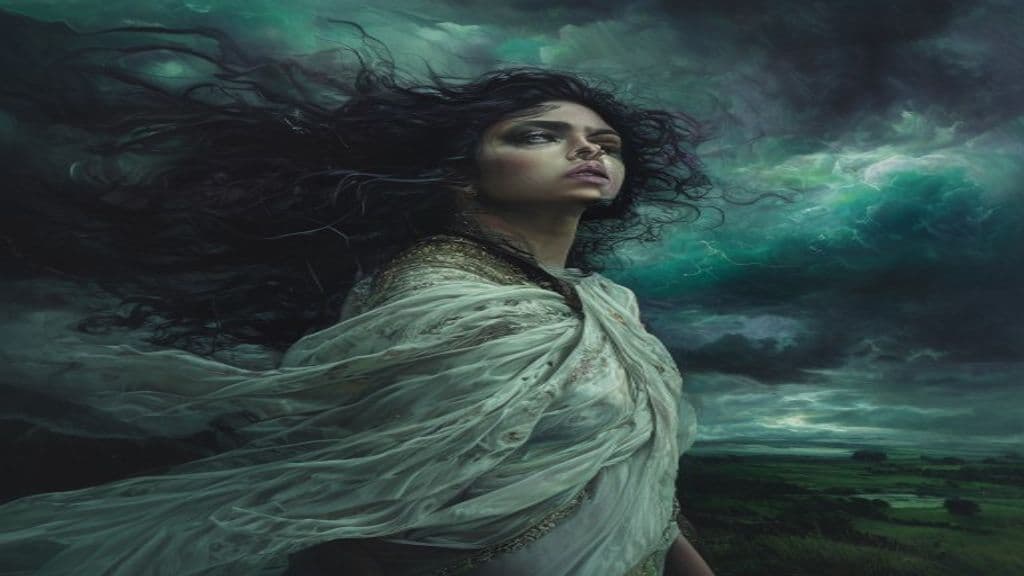
Bordoisila is the personification of the violent pre-monsoon storms that strike Assam in April and May — in Assamese called 'bordoisila' storms, named for her. The mythological framing is domestic and deeply human: she is the daughter of Brahma, married and living in her husband's home, who is allowed to visit her maternal home once a year at the end of winter.
The storms are her journey: the violent winds as she sets out from her husband's home to visit, and the even more violent return storms as she travels back. The tradition treats storms not as dangers to be avoided but as the passage of a beloved guest — noisy, disruptive, but ultimately a sign of relationship being maintained.
Bordoisila does not have a fixed iconographic form. She is experienced as weather: the southwest wind that arrives in April, the clouds that build over the Brahmaputra valley in late afternoon, the violent thunderstorm that breaks in early evening. She is the storm, not a figure within it.
In folk art she is sometimes depicted as a young woman in white with wind-swept hair, travelling very fast — a figure implied by the movement of the storm rather than present within it.
Bordoisila commands the pre-monsoon storm: lightning, hail, strong winds, and torrential brief rain. She can destroy crops, uproot trees, and damage structures. She also blesses: the moisture she brings ends the dry winter and prepares the soil for the rice season.
Those who observe the propitiation tradition — small offerings made when the first bordoisila storm approaches — are said to receive protection of their property during her passage.
Weaknesses
- conditionShe is a goddess, not an adversary — she is propitiated, not weakened
Wards
- ritualSmall offering at the doorstep when the first bordoisila wind arrives
Community Record
- [1]Folklore of Assam. Goswami, P.D. (1960). Folklore of Assam. National Book Trust, New Delhi.academic
- [2]Early History of Kamrupa. Barua, K.L. (1966). Early History of Kamrupa. Gauhati: Lawyers Book Stall.academic