
No cosmogonic or theogonic origin is recorded in the provided source. The brag is treated in local tradition and the summarized record as a localized animate presence rather than a deity, ancestor spirit, or member of a formal supernatural hierarchy.
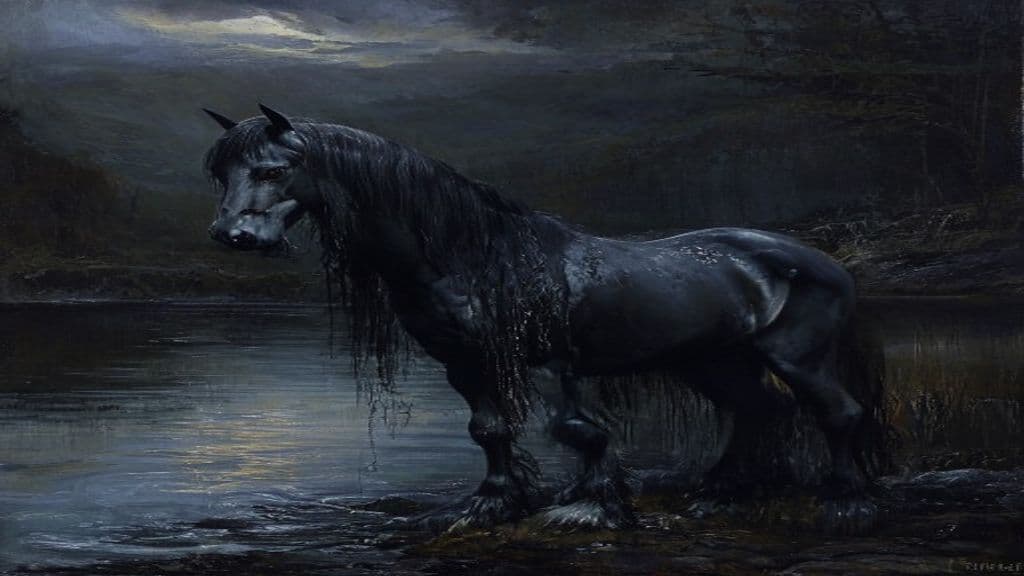
The brag is a shapeshifter whose visible appearances vary by account. Source material records it most often taking the form of a horse or donkey (the guise used to offer rides). The Picktree Brag is reported to take additional forms — a calf with a white handkerchief around its neck, a naked headless man, and even four men holding a white sheet. At Humbleknowe a brag was never seen but was reported to make hideous noises in the night, indicating that auditory-only manifestations are part of its repertoire.
According to the recorded account, the brag habitually shapeshifts (frequently into equine or domestic-animal forms and occasionally into grotesque human figures) and uses deception to entice humans to ride it; it then bucks riders off into ponds or bushes and runs away laughing. The provided source attributes these shapeshifting, auditory-manifestation, and ride-and-buck prank behaviors to the brag; no wider powers are recorded there.
Bound monster (motif)
A mythic motif in Norse mythology describing powerful hostile beings who are physically or cosmologically restrained in the present but are prophesied to break free during Ragnarök to wreak destruction. The label is a modern scholarly summary applied to several canonical figures (Loki, Fenrir, Jörmungandr, Hel) rather than an Old Norse technical name.
Bounos (Bunus)
Bounos (Ancient Greek: Βοῦνος) is a legendary early king of Ephyra (an early name for Corinth), described in surviving mythographical summaries as a son of Hermes and the mortal Alcidamea/Alcidamia. He is credited with receiving the throne from Aeëtes when the latter sailed to Colchis and with founding a sanctuary to Hera Bunaea on the road to Acrocorinthus; after his death the kingdom passed into the hands of Epopeus of Sicyon.
Bozorgmehr
Bozorgmehr (Middle Persian Wuzurgmihr ī Bōkhtagān) is attested in Middle Persian, Persian epic, and Arabic/Persian historiography as a Sasanian-era sage, minister (wuzurg framadār), and military commander associated with the House of Karen during the late 5th–6th centuries CE. He is remembered as an exemplary court counselor, author of treatises, and a theme figure in literary traditions rather than a supernatural being.
Božalość
Božalość is a Wendish (Lusatian Sorb) omen-figure described in ethnographic sources as a messenger or harbinger whose audible lamentation announces imminent death or other calamity for particular people, households, or communities. The name is commonly rendered in German sources as "Gottesklage" ("God's Lament").
Božić (Slavic mythology)
A symbolic figure associated with the themes of New Year, spring, and youth in Slavic paganism. (Note: 1. Power tier: Incorrectly classified as Lesser Spirit; based on its association with renewal and spring, it should be at least Ancient. 2. Origin story: The source material does not mention an origin)
Br'er Rabbit
Br'er Rabbit is an African-American folktale trickster — an anthropomorphic rabbit/hare who survives and triumphs by cunning rather than strength. Originating in oral traditions of enslaved Africans in the American South and related Caribbean communities, the character features in story cycles that teach, entertain, and comment on social relations.
Bragi
Bragi is a figure in Old Norse mytho-poetic tradition associated with skilled eloquence and poetry among the Æsir; Snorri presents him as a god of poetry and husband of Iðunn, while modern scholarship often treats the divine Bragi as a mythologized reflection of the historical 9th-century skald Bragi Boddason.
Brahmadaitya
Bengal's most distinctive ghost: the spirit of a Brahmin who died celibate — before marriage, or having taken a vow of celibacy — whose accumulated learning and unfulfilled life persists. Unlike the North Indian Brahmpret, the Brahmadaitya is often passive or even helpful, but its presence makes any household it inhabits spiritually unsettled.
Brahmahatya (Hindu tradition)
A grave sin and entity in Hindu tradition, representing the act of killing a Brahmin. (Note: 1. Power tier should be Primordial (cosmic) instead of Ancient (deity-level), as Brahmahatya represents a grave sin and not a deity. 2. The article lacks an appearance description, which needs to be a)
Brahman
Brahman is the ultimate, all-encompassing metaphysical principle in Vedic, Upanishadic and later Vedantic literature: the ground, origin, support and goal of all that exists. It is described variously as an attributeless, ineffable absolute (nirguṇa) and, in devotional contexts, as manifest with qualities (saguṇa) without becoming a conventional cult-deity.
Brahmani (Matrika)
Brahmani (Sanskrit: ब्रह्माणी, IAST: Brahmāṇī; also ब्राह्मी, Brāhmī) is one of the Sapta Matrikas, the seven mother-goddesses in Hindu tradition. She is regarded as the Shakti (feminine power) of the creator god Brahma and is often identified with or described as a form of Saraswati.
Brahmaputra Bhoot
No substantive evidence for a distinct folkloric entity called the 'Brahmaputra Bhoot' appears in the supplied sources. Mentions of the string 'Bhoot' in the materials refer to a chili pepper (Bhoot/Bhut Jalokia) or unrelated lexical contexts, not to a river-associated ghost entity.
Community Record
- [1]Brag (folklore) — Wikipedia. "A brag is a mischievous shapeshifting goblin in the folklore of Northumbria (Northumberland and Durham) and often takes the form of a horse or donkey." — Wikipedia: Brag (folklore)wiki