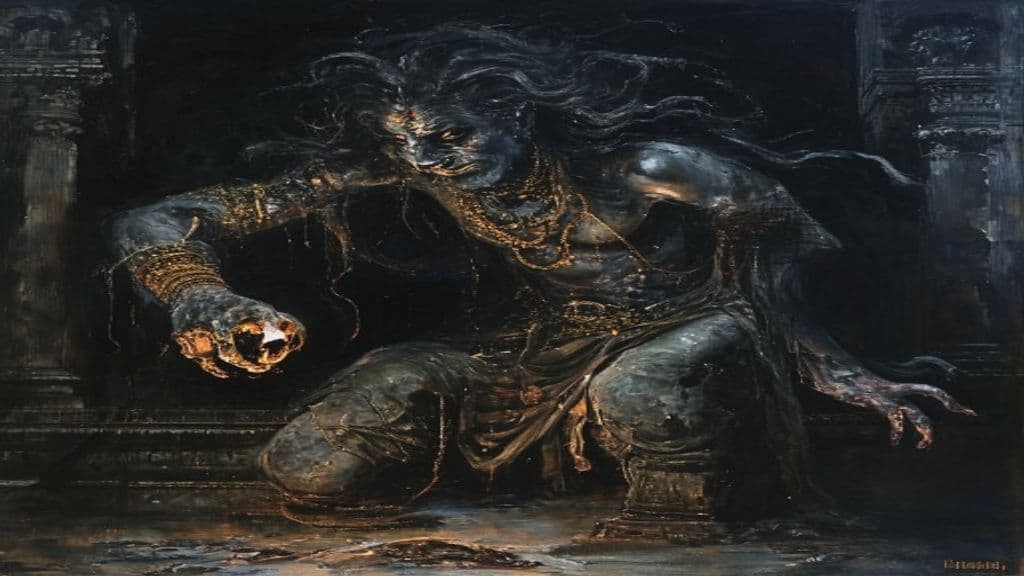
The Brahmarakshasa appears in the Ramayana (the sage Vishvamitra warns Rama about Brahmarakshasas inhabiting the Dandaka forest), the Mahabharata, and the Manu Smriti, which specifies the precise acts that transform a dead Brahmin's spirit into this demon-class. It is distinguished from an ordinary Rakshasa by its origin: it was once a Brahmin — a person who possessed all the tools of spiritual liberation — who chose instead to use sacred knowledge for harm.
The Garuda Purana states that a Brahmarakshasa endures its condition for many thousands of lifetimes before the accumulation of consequence is exhausted. The Manu Smriti lists specific transgressions: accepting forbidden gifts, teaching the Veda for money, performing rites for the unworthy, stealing sacred property. Each makes the postmortem state worse.
Classical texts describe the Brahmarakshasa as enormous, dark as charcoal, matted with filth, carrying a skull as both weapon and drinking vessel. It is sometimes depicted as semi-transparent — a quality that distinguishes it from fully embodied Rakshasas. The sacred thread is still visible in its degraded form, marking its Brahmin origin.
In folk encounter accounts it is associated with ancient ruined temples abandoned following a transgression, and old pipal or banyan trees near such ruins. It is rarely seen moving — it is heard first: the sound of Sanskrit being recited wrongly, deliberately inverted, the syllables deformed into their cursing aspect.
The Brahmarakshasa combines the physical power of a Rakshasa with the ritual knowledge of a priest. It can recite curses in Sanskrit that take effect immediately, disrupt all religious ceremonies within its territory, cause specific targeted harm to those who enter its domain, and cannot be banished by ordinary exorcism.
The same classical texts that describe exorcism of common ghosts specifically note that the Brahmarakshasa requires a specialist — a learned Brahmin capable of reciting the Brahmarakshasa-specific verses of the Atharva Veda and performing the prayaschitta (expiation ritual) for the specific sin that created the entity. Without addressing the originating sin, no removal is permanent.
Weaknesses
- ritualPrayaschitta (expiation) for the specific originating sin
- mantraBrahmarakshasa-nivaran verses from the Atharva Veda
Wards
- substancePancha-gavya (five cow products) sprinkled at the threshold
- mantraVishnu Sahasranama recited in the entity's presence — Vishnu being its specific counter-force
Agastya
Agastya (also Agathiyar/Agasti) is a revered Vedic and later-period Indian rishi (sage) figure credited in textual traditions as an inspired seer, ascetic, teacher, culture-founder, and attributed author of Vedic, Puranic and Tamil works; in South Indian tradition he is associated with origins of Tamil grammar and Siddha medicine and is identified astronomically with the star Canopus.
Agiya Baital
The fire-form of the Vetala — a cremation ground spirit of UP and Bihar that manifests as a wandering flame rather than a corpse-inhabitor, leading night travellers off roads and into marshland or flames with a dancing fire that seems always just ahead.
Aleya
Ghost lights of the Sundarbans delta — flickering flames over swamp water said to be the souls of dead fishermen, luring the living off safe paths into drowning waters.
Angiras
Angiras (Sanskrit Aṅgiras/Aṅgirāḥ) is primarily a Vedic rishi (sage) and eponymous lineage (Angirasa) associated with authorship of Vedic hymns, priestly/fire functions, and transmission of mantras; later Puranic accounts multiply his identities in genealogies and lists of sages.
Ap (the Waters)
Ap (Vedic áp-, Classical Sanskrit āpas/āpa-) denotes the sacred category of 'the waters' in Vedic/Hindu thought: a physical element (water), an animate cosmic principle addressed in Rigvedic hymns, and an elemental category later counted among the Panchamahabhuta. The term names collective waters invoked in ritual, is linked to deities such as Varuna and the epithet Apām Napāt, and survives in related Indo-Iranian vocabularies (Avestan āpō/Aban, Persian āb).
Apsara
Celestial dancers and water nymphs of Hindu cosmology — beautiful semi-divine beings who dance at the court of Indra and, by his command, descend to earth to distract sages from excessive asceticism.
Bhadrakali
Bhadrakali is a fierce form of the Hindu supreme goddess Adi Shakti worshipped especially in South India. She functions as a martial and protective divine person who destroys wickedness in mythic narratives, protects women and lineages, and is integrated into Shaiva, Vaishnava, and Shakta registers.
Bhoma
Primordial earth deity in Balinese mythology associated with fertility and vegetation. (Note: 1. Power tier should be Primordial, which is correct. 2. Appearance description matches source material; no corrections needed. 3. Abilities: Add "liminal space between wilderness and human settlement)
Bhoot (bhoota)
A bhoot (also bhoota, bhoot, bhut) is the culturally specific term across parts of the Indian subcontinent for a perturbed, restless spirit generally understood to be the ghost of a deceased person. Sources describe bhoots as arising when a person's death or post-death circumstances prevent them from moving on — for example violent death, unresolved affairs, or failures in funerary rites — and the term appears frequently in modern South Asian media and discussions.
Bidadari
Bidadari is a Southeast Asian regional term related to the South Asian apsara: a class of celestial/ethereal female beings originally associated with clouds and water in Hindu and Buddhist cosmology, later represented in regional art and performance as nymph- or fairy-like figures. The term is also widely used in modern Southeast Asian toponymy and popular culture (place names, media, vessel names), distinct from detailed mythic narratives in the provided sources.
Bordoisila
The storm deity of spring in Assamese tradition — Bordoisila is the daughter of Brahma who visits her mother's home at the end of winter, and whose journey back creates the violent pre-monsoon storms of April and May. She is a goddess-spirit propitiated in Assam for thousands of years.
Brahmadaitya
Bengal's most distinctive ghost: the spirit of a Brahmin who died celibate — before marriage, or having taken a vow of celibacy — whose accumulated learning and unfulfilled life persists. Unlike the North Indian Brahmpret, the Brahmadaitya is often passive or even helpful, but its presence makes any household it inhabits spiritually unsettled.
Brahmadaitya is the ghost of a Brahmin who died without completing last rites, sometimes benevolent. Brahmarakshasa is a demon born of a Brahmin's willful evil — it cannot be appeased, only repelled.
Brahmpret is a ghost that can be liberated through shraddha and proper rites. Brahmarakshasa is a category of demon — its evil is intrinsic, not a result of circumstance, and rites do not free it.
Community Record
- [1]Ramayana — Brahmarakshasa in Dandaka forest. Valmiki. Ramayana, Aranya Kanda. (Griffith, R.T.H., trans., 1870–1874). E.J. Lazarus, Benares.academic
- [2]Manu Smriti — on Brahmin transgressions and postmortem fate. Bühler, G. (trans.). (1886). The Laws of Manu. Sacred Books of the East, Vol. 25. Clarendon Press, Oxford.academic
- [3]Brahmarakshasa — Wikipedia. Wikipedia contributors. Brahmarakshasa. Wikipedia, 2024.wiki