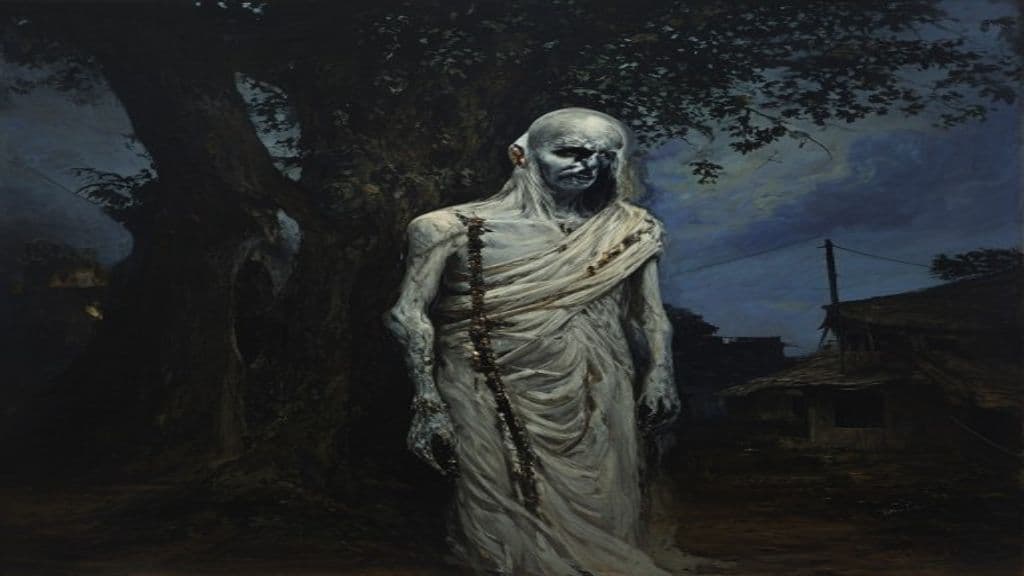
In Hindu cosmology, a preta is the spirit of a person who has not received the shraddha rites — the ancestral offerings that allow the dead to complete the crossing from the living world to pitru loka (the realm of ancestors). Without these rites, the preta remains trapped in a liminal hunger.
The Brahmpret is the most feared category of preta because the Brahmin in life possessed ritual authority. His blessings had power, and so do his curses. A Brahmin who died in unpaid debt, was murdered, was denied proper cremation, or whose descendants failed to perform the annual Pitru Paksha shraddha, becomes a Brahmpret of enormous potency. The Garuda Purana — which details the fate of the dead in Hindu cosmology — gives particular attention to Brahmin souls as especially consequential in their ghostly state, capable of causing harm far beyond the range of an ordinary unquiet spirit.
The Brahmpret is described as unnaturally tall — accounts consistently report figures of seven or eight feet — gaunt, with ash-white or grey skin. The sacred thread (janeu) is still visible across the shoulder, marking its Brahmin origin in death as in life. The eyes are large, hollow, and luminous.
Some accounts have the Brahmpret in the white dhoti of funeral dress; others describe it naked and ash-smeared, resembling an ascetic. In both cases it is recognisable as a Brahmin by the thread and often by the manner of its speech — it addresses those it haunts in archaic Sanskrit or formal Brajbhasha.
The Brahmpret can recite Sanskrit curses that take immediate effect: illness in children, failure of crops, destruction of household prosperity. Unlike random hauntings, its attacks are targeted — it remembers who wronged it in life and pursues specific grievances across generations if necessary.
It is also capable of full possession, speaking through the afflicted person in Sanskrit or archaic Hindi, citing the specific injustice that created it. An exorcist who does not address the underlying grievance — the debt, the incomplete ceremony, the abandonment — achieves only temporary relief. The Brahmpret returns.
Weaknesses
- ritualAddressing the specific grievance
- mantraGayatri Mantra recited 108 times in the entity's presence
Wards
- substanceTil (sesame) and water offered at a crossroads on Amavasya
- ritualAnnual shraddha performed without fail during Pitru Paksha
Agiya Baital
The fire-form of the Vetala — a cremation ground spirit of UP and Bihar that manifests as a wandering flame rather than a corpse-inhabitor, leading night travellers off roads and into marshland or flames with a dancing fire that seems always just ahead.
Aleya
Ghost lights of the Sundarbans delta — flickering flames over swamp water said to be the souls of dead fishermen, luring the living off safe paths into drowning waters.
Angiras
Angiras (Sanskrit Aṅgiras/Aṅgirāḥ) is primarily a Vedic rishi (sage) and eponymous lineage (Angirasa) associated with authorship of Vedic hymns, priestly/fire functions, and transmission of mantras; later Puranic accounts multiply his identities in genealogies and lists of sages.
Ap (the Waters)
Ap (Vedic áp-, Classical Sanskrit āpas/āpa-) denotes the sacred category of 'the waters' in Vedic/Hindu thought: a physical element (water), an animate cosmic principle addressed in Rigvedic hymns, and an elemental category later counted among the Panchamahabhuta. The term names collective waters invoked in ritual, is linked to deities such as Varuna and the epithet Apām Napāt, and survives in related Indo-Iranian vocabularies (Avestan āpō/Aban, Persian āb).
Apsara
Celestial dancers and water nymphs of Hindu cosmology — beautiful semi-divine beings who dance at the court of Indra and, by his command, descend to earth to distract sages from excessive asceticism.
Bhoma
Primordial earth deity in Balinese mythology associated with fertility and vegetation. (Note: 1. Power tier should be Primordial, which is correct. 2. Appearance description matches source material; no corrections needed. 3. Abilities: Add "liminal space between wilderness and human settlement)
Bhoot (bhoota)
A bhoot (also bhoota, bhoot, bhut) is the culturally specific term across parts of the Indian subcontinent for a perturbed, restless spirit generally understood to be the ghost of a deceased person. Sources describe bhoots as arising when a person's death or post-death circumstances prevent them from moving on — for example violent death, unresolved affairs, or failures in funerary rites — and the term appears frequently in modern South Asian media and discussions.
Bhunni
The female guardian-spirit of agricultural fields in Bihar and eastern UP — her presence ensures fertile soil and good harvest, but she is territorial and punishes those who plough without permission, steal crops, or use chemical methods that poison the soil she inhabits.
Bidadari
Bidadari is a Southeast Asian regional term related to the South Asian apsara: a class of celestial/ethereal female beings originally associated with clouds and water in Hindu and Buddhist cosmology, later represented in regional art and performance as nymph- or fairy-like figures. The term is also widely used in modern Southeast Asian toponymy and popular culture (place names, media, vessel names), distinct from detailed mythic narratives in the provided sources.
Bordoisila
The storm deity of spring in Assamese tradition — Bordoisila is the daughter of Brahma who visits her mother's home at the end of winter, and whose journey back creates the violent pre-monsoon storms of April and May. She is a goddess-spirit propitiated in Assam for thousands of years.
Brahmadaitya
Bengal's most distinctive ghost: the spirit of a Brahmin who died celibate — before marriage, or having taken a vow of celibacy — whose accumulated learning and unfulfilled life persists. Unlike the North Indian Brahmpret, the Brahmadaitya is often passive or even helpful, but its presence makes any household it inhabits spiritually unsettled.
Brahmarakshas
The most learned and terrible of spirits — the ghost of a Brahmin who misused his scriptural knowledge in life and was condemned after death to be both demon and scholar, haunting places of learning.
Brahmadaitya is a Brahmin ghost that attained near-divine protective status; Brahmpret is the wandering spirit of a Brahmin whose last rites were incomplete or whose desires were unfulfilled — malevolent, not protective.
Brahmarakshasa is an unredeemable demon class; Brahmpret is a tormented ghost that can be released through proper rituals and offerings.
Community Record
- [1]Garuda Purana — fate of the dead and preta cosmology. Wood, E. & Subrahmanyam, S.V. (trans.). (1911). Garuda Purana. Panini Office, Allahabad.academic
- [2]Preta and ancestor spirits in North Indian folk tradition. Freed, R.S. & Freed, S.A. (1993). Ghosts: Life and Death in North India. Anthropological Papers of the American Museum of Natural History, 72.academic