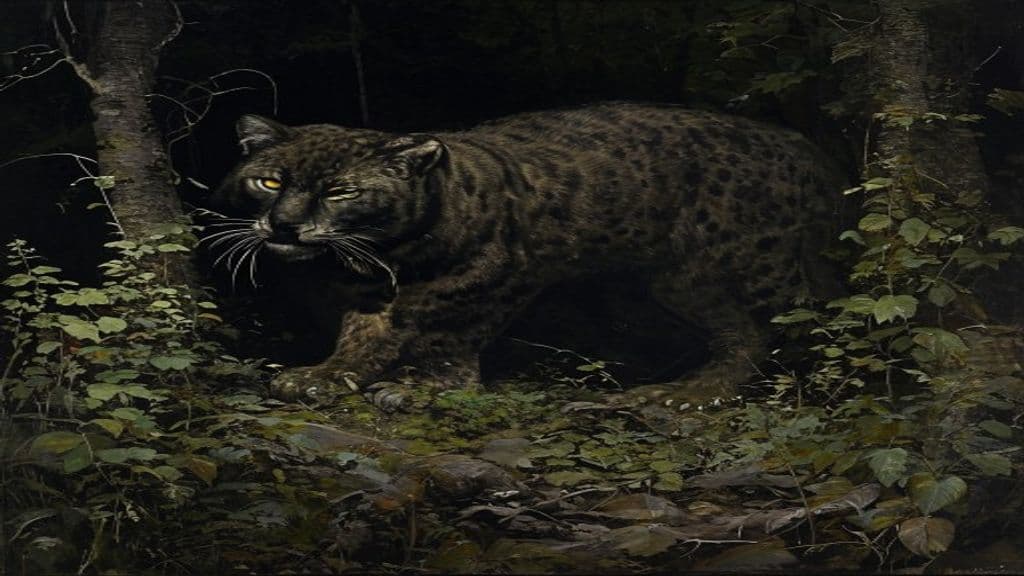
The phenomenon is not a single mythic origin story but a cluster of explanations found in modern sources: many reports are attributed to escaped or released exotic pets (possibly released after they became difficult to manage or after regulation such as the Dangerous Wild Animals Act 1976), while folklorists and commentators also emphasise the role of British media practices in amplifying and sustaining rumours. The motif also connects to older narrative examples of monstrous cats in medieval tradition (e.g., Cath Palug) and local folktales (e.g., Stratford Lyon), indicating continuity between historic large‑cat motifs and contemporary sightings.
Modern eyewitness descriptions vary: animals are variously reported as 'panthers', 'pumas' or large 'black cats', with size estimates ranging from medium‑sized (compared in one historical anecdote to a spaniel) to large predatory felids. Documentary and historical records include authenticated medium‑sized felids (Eurasian and Canadian lynx) and individual exotic cats; medieval and local legendary items related to the motif (Cath Palug, Stratford Lyon) are older narrative figures—Cath Palug is a monstrous 'clawing cat' from medieval Welsh poetry, while the Stratford Lyon is recorded in local lore as a giant red, antlered lion and should be treated as a distinct folkloric item rather than part of modern cryptozoological claims.
Reported behaviours attributed to British big cats in modern accounts include livestock killings (notably the Beast of Exmoor stories where farmers reported repeated sheep losses with violent injuries) and occasional alleged attacks on humans in isolated contemporary claims. Sources emphasise that such attacks and killings remain unproven as the actions of non‑domestic big cats and that experts and government bodies reject the existence of a breeding wild population in Britain due to lack of convincing evidence. Documented recovered animals sometimes indicate captive origin or human handling: for example, a puma captured in Inverness‑shire in 1980 was described as tamed and responsive to tickling, supporting the explanation that some reports reflect escaped or released captive animals rather than feral wild populations.
Weaknesses
- conditionlack of evidence for sustaining a wild breeding population (scholarly assessment)
Wards
None recorded.

Brighella
Brighella is a masked comic stock character of the Italian commedia dell'arte tradition, originating as a Zanni (servant) type associated with Bergamo. He is a scheming, adaptable servant or tavern-owner figure known for cunning, cruelty to social inferiors, improvisatory skill, and characteristic costume and walk.
Brigid
Brigid (Brigit, Bríg, Bríd) is an Irish divine figure of the Tuatha Dé Danann associated with poetry/prophecy, healing, smithcraft and protection of livestock and households; medieval Christian tradition and later scholarship record significant syncretism between this goddess and Saint Brigid of Kildare.
Brigit (Brigid / Brigantia)
Brigit (Brigid, Bríg; Latin Brigantia) is a prominent Irish figure whose identity spans pre‑Christian myth as a member of the Tuatha Dé Danann and early medieval Christian hagiography as St. Brigit of Kildare. Sources show continuity of name, cultic markers (notably a sacred flame), and overlapping attributes across pagan and Christian contexts.
Brimir
In Old Norse mythic tradition the name Brimir appears in two closely related roles: as a name applied to a primordial jötunn (often equated with Ymir/Aurgelmir) whose body supplies the material of the world, and as the name of a beer‑hall or hall of plenty that Snorri interprets as an afterlife dwelling for virtuous survivors after Ragnarök.
Briseis
Briseis is a mortal woman in the Homeric epic tradition, captured at Lyrnessus and attached to Achilles as a war prize; her transfer between leaders (Achilles and Agamemnon) functions as a key social and moral symbol in the Iliad and later literary traditions.
Briseus
Briseus (Ancient Greek: Βρισεύς or Βρίσης) is a mortal figure in the Trojan War tradition, known primarily as the father of Briseis, a woman taken captive by the Greeks. He appears in Homeric tradition and later commentators, who variably place him in Pedasus or identify him as a priest of Lyrnessus; a later pseudo-historical source (Dictys Cretensis) reports that he hanged himself after losing his daughter.
Britomartis
Britomartis is a female divine figure associated in the supplied material with the island of Crete, functioning as a mountain and hunting deity with linked associations to nets and fishermen. She is variously described as a goddess or nymph and was later conflated in Greek tradition with deities such as Artemis, Athena, and Aphaea.
Brittia
In Germanic tradition, Brittia is a mythological concept and physical location associated with the afterlife, where souls of the dead are transported. It exists as both an island and an Isle of the Blessed. (Note: 1. Power tier should be Primordial since Brittia is associated with the afterlife and its description implies a cosmic or transcendent level. 2. Add sensory cues: Brittia's association with death and )
Brizo
Brizo (Greek: Βριζώ) is a minor, local goddess venerated on the island of Delos who functioned as a protector of mariners, sailors, and fishermen and as an oracular deity specialized in oneiromancy (dream-oracle). Her cult was chiefly associated with women of Delos who offered food in small boats and sought prophetic dreams concerning sea-voyages and the fates of seafarers.
Broichan
A 6th century Celtic wizard documented by Adomnán of Iona, with magical abilities and connections to spiritual or supernatural forces. (Note: 1. Power tier should be Ancient, as a wizard serving a king and having connections to a saint is more deity-level than primordial. 2. Add sensory cues based on the fact that Adomnán wrote about Broich)
Brokkr
Brokkr is a dwarf and master smith's assistant in Norse mythic tradition, famed for operating the bellows while his brother (Eitri/Sindri) performed magical forging in the contest that produced Mjölnir, Draupnir, and Gullinbursti. He is best known from the Skáldskaparmál episode in which Loki, as a gadfly, tries to disrupt his bellows work and Brokkr later sews Loki's lips shut when Loki evades a wager.
Bromius
Bromius (Ancient Greek: Βρόμιος) is an epithet and identity-state of the god Dionysus/Bacchus in ancient Greek religion, signifying 'noisy', 'roaring', or 'boisterous'. In some modern readings of fragmentary Orphic material (notably summaries of the Derveni papyrus), Bromius is discussed by scholarship as a name applied to a divine figure placed early in an alternative cosmogony.
Community Record
- [1]British big cats. Wikipedia contributors. "British big cats." Wikipedia, The Free Encyclopedia. https://en.wikipedia.org/wiki/British_big_catswiki
- [2]Wikidata entry Q843824. Wikidata. "Q843824: British big cats." http://www.wikidata.org/entity/Q843824other
- [3]Crap From The Past - 2006 (archive). Archive.org. "Crap From The Past - 2006." https://archive.org/details/cftp-2006other
- [4]Connections: 2 -- Death in The Morning (archive reel). Archive.org. "Connections: 2 -- Death in The Morning." https://archive.org/details/connections2deathinthemorningreel2other