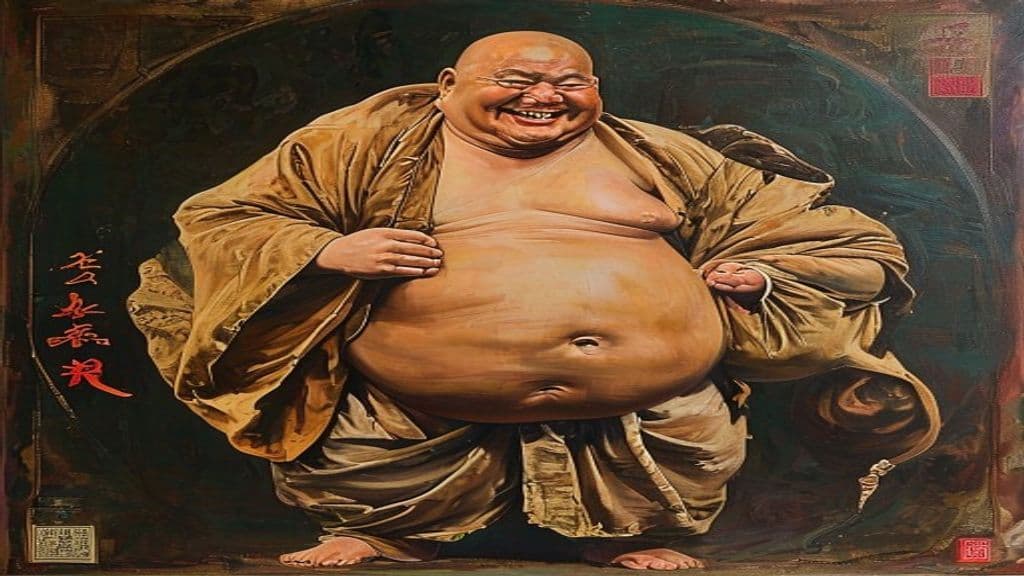
Historically attested as the monk Qieci (契此), Budai was a wandering, sack-carrying mendicant active by the Later Liang period. Late tradition and some Chan sources identify him with Maitreya (a dated note claims an incarnation identification on 28 March 917). Over time Chan masters and artists incorporated his life and image into Chan pedagogical practice and popular veneration, reinterpreting his eccentric, thaumaturgic anecdotes as emblematic and didactic rather than primarily occult.
Depicted as a fat, bald monk wearing a simple robe, almost always shown smiling or laughing and carrying a large cloth sack (the name 'Budai' literally means 'cloth sack'). Common iconography emphasizes a large exposed stomach (read as a symbol of abundance or forgiveness), often includes children or jovial public contexts, and varies regionally and historically (earlier Chinese ink treatments differ from later colorful Japanese sculptural works; some Japanese variants show localized motifs such as occasional tobacco-pipe imagery in specific depictions).
Traditional stories credit Budai with folkloric abilities such as predicting people's fortunes and even weather patterns; he is portrayed as able to ward off cold in anecdotes and as possessing a knack for bringing food, laughter, and good fortune to those he met. Scholarly interpretation of Chan reception emphasizes that such occult attributions were often 'domesticated'—Chan leaders played down miraculous aspects and highlighted Budai's this-worldly, trickster-like charisma as a pedagogical tool to attract broad audiences rather than endorsing systematic thaumaturgy.

Maitreya
Maitreya (Pali: Metteyya) is the bodhisattva prophesied in Buddhist traditions to be the next fully awakened Buddha who currently resides in Tushita heaven and will be reborn on earth to re-establish the Dharma. In modern esoteric/Theosophical literature he is also depicted as an advanced spiritual teacher in a hidden hierarchy, a distinct framing from the classical Buddhist accounts.

Apsara
Celestial dancers and water nymphs of Hindu cosmology — beautiful semi-divine beings who dance at the court of Indra and, by his command, descend to earth to distract sages from excessive asceticism.
Yama (King of the Dead)
Yama (Sanskrit: Yamarāja; Chinese: 閻魔/閻王/閻羅王, Yánmó/Yánwáng/Yánluó Wáng) is a death‑king and judicial official in Buddhist cosmologies who presides over Naraka and the adjudication of post‑mortem karmic retribution. In East Asian Buddhist popular religion he is incorporated into a Ten Kings/purgatorial itinerary central to funerary and ancestral rites.
Bubota
Bubota is attested in a small, heterogeneous set of Catalan-language and English-language sources as a feminine ghost or spectral figure invoked in contemporary artistic works and occasional popular references. Available materials classify it as a female-associated spirit and use the term both as a folkloric label and as a cultural/metaphorical signifier; however, primary folkloric narratives, standardized iconography, and ritual practice are not documented in the provided sources.
Bucca
A class of place‑bound supernatural beings attested in Cornish folklore, associated in surviving sources with coastal and mining landscapes and with local occupational culture; the surviving packet of sources is fragmentary and primarily cites an anthology excerpt (Mabel Quiller Couch).
Buchis
The deification of the kꜣ (ka) of the war god Montu, incarnated as a sacred bull in Egyptian mythology. (Note: - Remove "Greater" power tier; no information in source material supports this level of power. - Add sensory cues (e.g., distinctive markings, specific sounds) related to sacred bulls' selection and w)
Buckriders
A South-Eastern Dutch and North-Eastern Belgian tradition describing groups—treated variously as alleged witches and criminal bands—said to have entered pacts with an infernal master and to have 'ridden' bucks/goats by night to commit raids. The motif appears in 18th-century trials and in local folklore linking goat-riding and diabolic Sabbath imagery.
Bucky Barnes
James Buchanan "Bucky" Barnes is a fictional human character created for American comic books published by Marvel Comics (originally Timely Comics). Introduced in 1941 as the youthful sidekick of Captain America, he was later retconned and reinvented in modern comics as the brainwashed cyborg assassin the Winter Soldier before regaining memories and seeking redemption.
Buda
In Ethiopian and Eritrean popular religion, buda (Ge'ez: ቡዳ) is a socially-located hostile power associated with the evil eye and the ability of its bearer to change into a hyena. It is attributed to particular social groups (for example Beta Israel and metalworking castes) and is countered by amulets, debtera-made protections, and Christian exorcism.
Buddha (Siddhartha Gautama)
Siddhartha Gautama, most commonly called the Buddha, is presented in the provided sources as a historical wandering ascetic and religious teacher of the 6th–5th century BCE who attained nirvana, taught Dharma, and founded the monastic community (sangha) that became Buddhism.
Buddhas of the Ten Directions (Shífāng Fó)
A doctrinal and devotional designation for the manifold buddhas present throughout the Buddhist cosmological field (the 'ten directions'), invoked as fully awakened presences and used as objects of contemplation and repentance in devotional practice.
Budeia
Budeia is a lexical/onomastic term attested in two distinct registers: (1) an ancient Greek mytho-genealogical figure and an epithet of Athena meaning 'oxen-yoker', and (2) a modern Norwegian occupational noun (budeia) denoting the woman who tends the summer farm dairy. The term consistently occupies an agricultural/labor semantic field in both traditions rather than functioning as a singular supernatural entity.
Budha
Budha (Sanskrit: बुध) is the personification of the planet Mercury in Indian astronomical and astrological tradition. He functions both as the observed planetary body whose motions are recorded in classical Sanskrit astronomical texts and as a navagraha deity associated with intelligence, memory, and the weekday Budhavara (Wednesday).
Budini
The Budini (Ancient Greek Βουδῖνοι) are recorded in Graeco-Roman ethnographic sources as a human tribal people of the forest‑steppe north of the Black Sea, associated with the Vorskla river valley and the multiethnic city of Gelonus in the first millennium BC. Classical accounts portray them as a hunting-dependent, linguistically distinct group noted for red hair and blue eyes; some archaeological interpretations tentatively link them to anomalous mortuary deposits.
Community Record
- [1]Budai - Wikipedia. Wikipedia contributors. 'Budai.' Wikipedia, The Free Encyclopedia.wiki
- [2]Budai - Wikidata entry Q37452447. Wikidata: Q37452447 (Budai/Qieci)wiki